If you are an Eritrean living abroad dreaming of a family home in Asmara, or a local family saving for years to build in Keren, Massawa or Mendefera, the first question is always the same: how much is this going to cost? The honest answer is “it depends”, but that does not help you plan a budget.
Eritrea is not a country with a transparent, well-documented property market. Housing finance researchers note that housing projects there are rarely documented, which makes knowledge of the sector patchy. That means every figure below is an estimate, and we flag clearly where each number comes from.
Cost per square metre in Eritrea
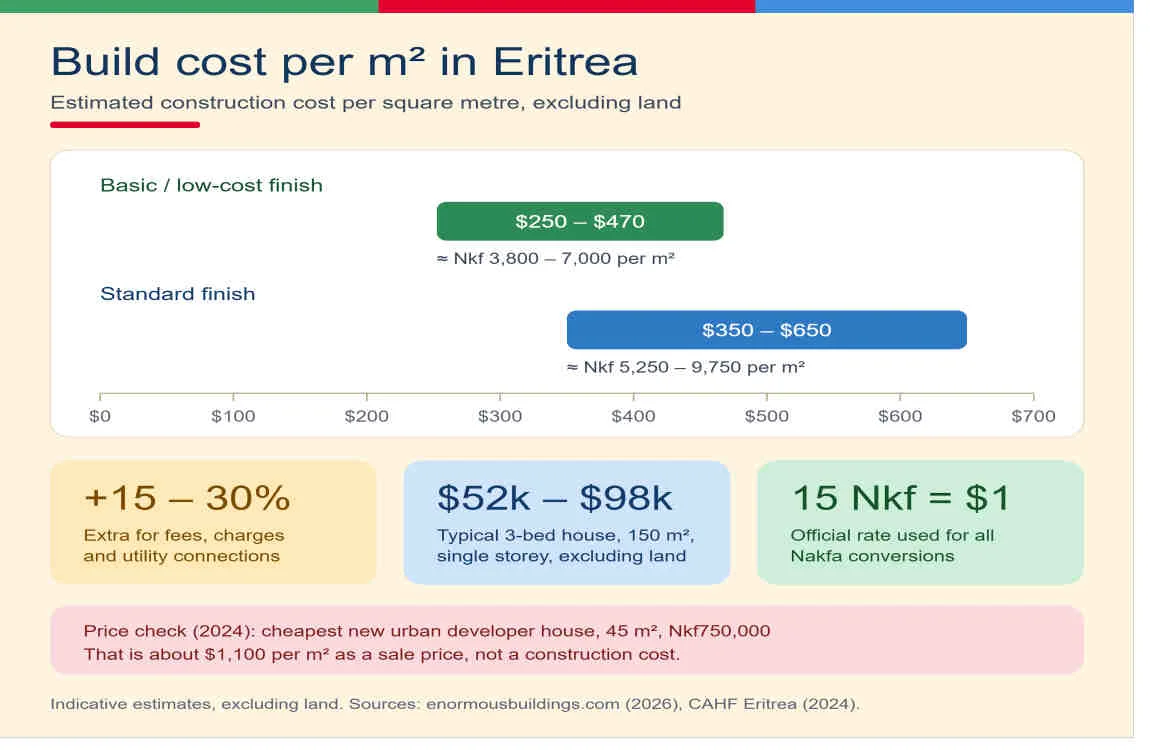
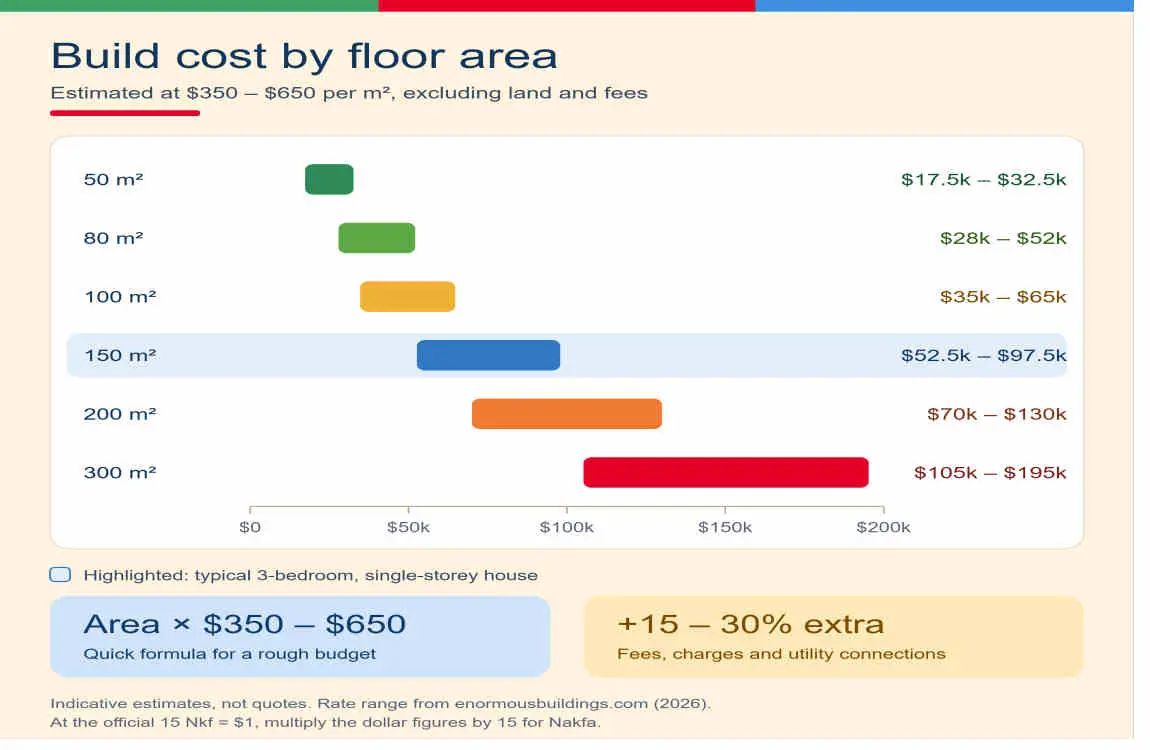
A 2026 construction cost model puts a standard three-bedroom house in Eritrea at about $350 to $650 per square metre ($33 to $60 per square foot). Simple single-storey plans sit at the lower end. Rates climb with extra storeys, because you need a stronger frame and more structural work, and they climb again when you upgrade finishes.
In local currency, the official peg is 15 nakfa to the US dollar, so $350 to $650 per square metre works out to about Nkf 5,250 to Nkf 9,750 at the official rate. One caution: the same data source notes that the unofficial rate differs massively from the official one. If you are sending money from abroad, how you convert it can change your real budget by a wide margin, so ask local contacts what rate actually applies to your transfer.
Total cost by house size
Multiplying the per-square-metre range by common floor areas gives you a rough planning table. These are our own calculations from the source rate, so treat them as a starting point, not a quote.
How finish level changes the price
Two houses with the same floor plan can differ by tens of thousands of dollars purely because of finishes. For the same 150 m² three-bedroom building, the model above shows a basic specification at roughly $37,800 to $70,200, and a premium specification at about $76,125 to $141,375.
Where does the difference come from? Flooring (cement screed versus imported tile or stone), kitchen and bathroom fittings, window quality, roofing materials, and whether you add things like a boundary wall, solar or a water tank. In practice the structure is the part you should never skimp on. Finishes can be upgraded later, but a weak foundation or poor concrete cannot.
Land: the part nobody can price for you
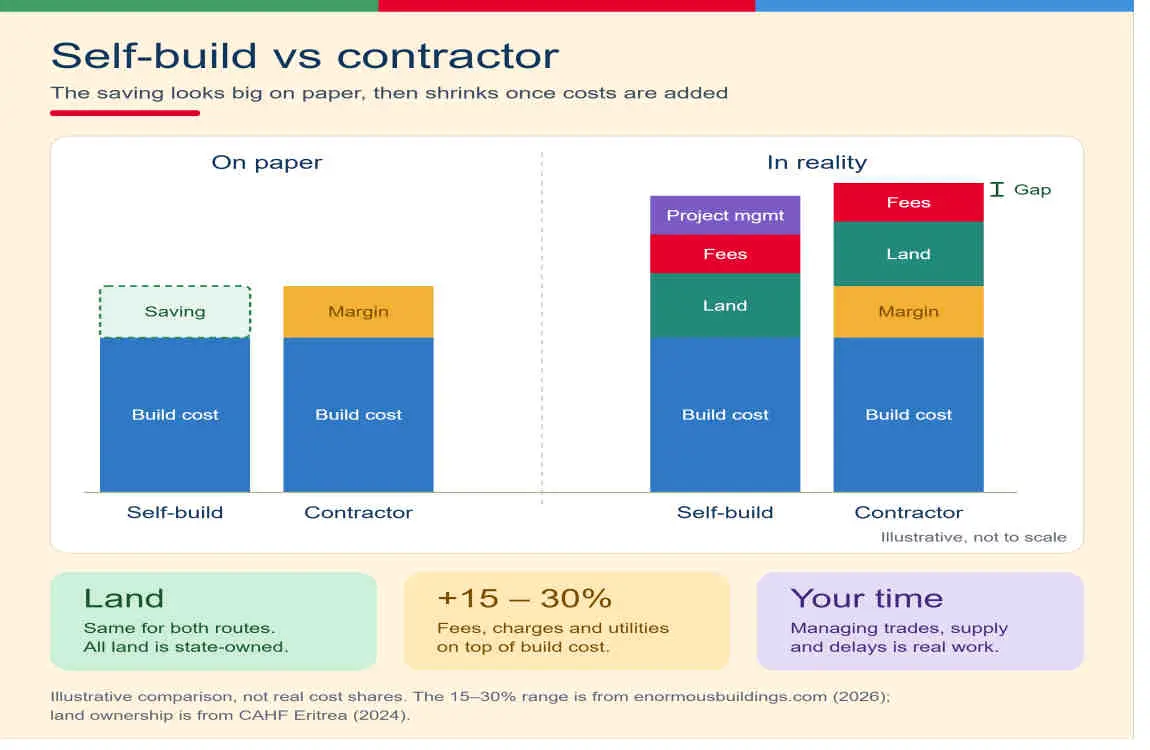
Most budgeting guides for other countries start with the price of a plot. In Eritrea that logic does not work. Under Land Proclamation No. 58 of 1994, land is owned by the State, and citizens hold usufruct rights rather than freehold title. The proclamation also provides for the allocation of “tiesa” land for housing, and for the distribution of urban land. Housing finance researchers add that, because all land is state-owned, it is difficult to estimate what buying land in Eritrea costs.
What this means for your budget: you should not assume you can simply buy a plot on the open market. Land access runs through government allocation, so the timeline and the cost depend on your status, your location and the local administration. Anyone who offers you a plot at a fixed “market price” deserves close scrutiny. Get written confirmation from the relevant Eritrean authority before you pay anyone, and consider speaking with a local lawyer.
Building vs buying in Asmara
Asmara’s centre is a UNESCO World Heritage house property, inscribed in 2017 for its modernist urban plan and architecture, which tends to constrain what can be built and altered in the historic core. Most new housing is therefore going up on the edges of the city.
A bank price list for new developments around Sembel, Halibet and Space 2001 shows what developers were asking. It is dated (around 2013) and was reproduced on a public forum, so use it only as a rough benchmark:
| Home type | Size | Listed price | Per m² (our calc.) |
|---|---|---|---|
| Apartment | 70 m² | about $56,300 | about $804 |
| Apartment | 120 m² | about $87,960 | about $733 |
| Villa | 175 m² | about $131,900 | about $754 |
| Villa | 200 m² | about $150,180 | about $751 |
Those prices work out to roughly $730 to $800 per square metre, noticeably above the $350 to $650 build-cost range. The same source says these homes were largely aimed at the diaspora, with prices in the $150,000 to $200,000 range for houses, and a later notice required buyers to put down a 25% deposit. Crowd-sourced data on Numbeo shows similar numbers, with apartments in the city centre averaging about $1,267 per square metre, though that site relies on user submissions, so treat it with caution.
Costs people forget
The $350–$650 range is a construction figure. It leaves out several things that routinely surprise first-time builders:
- Professional fees. Architect or engineer drawings, structural calculations and site supervision. The cost model we used explicitly excludes these.
- Permits and statutory charges. Also excluded from the model figure. Ask your local municipality what applies to your plot.
- Utilities connection. Water, electricity and drainage hook-ups, plus a water tank or backup power if supply is irregular.
- Boundary wall, gate and landscaping. Easy to forget, and often 5–10% of a project in practice (our rule of thumb, not a sourced figure).
- Currency and transfer costs. Exchange-rate gaps and transfer fees can quietly eat a large share of money sent from abroad.
- A contingency. Plan for 10–15% extra for price changes and delays. This is standard construction practice rather than an Eritrea-specific statistic.
Step-by-step: how a build actually unfolds
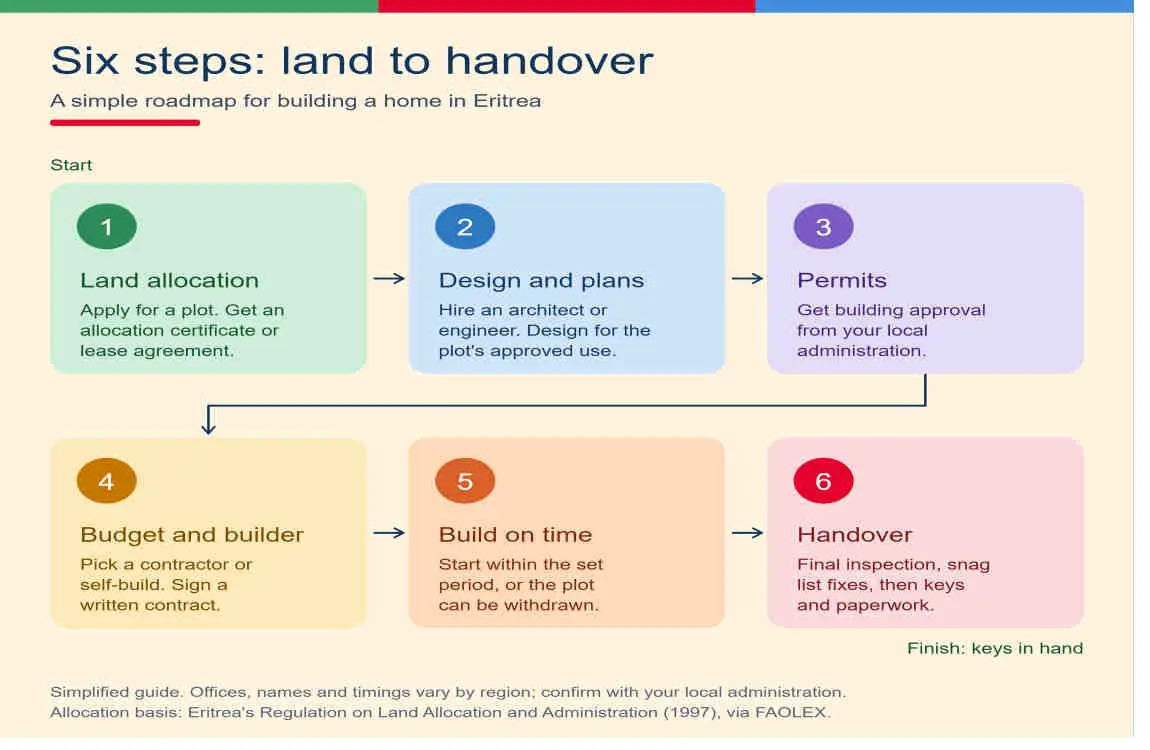
The sequence below is a practical roadmap based on how residential projects generally run. The exact order of approvals will depend on your local administration.
- Secure the land. Confirm your right to a plot in writing through the proper authority.
- Design and permits. Hire a local architect or engineer. If your design is in the historic part of Asmara, check heritage rules first.
- Site works and foundation. Clearing, setting out, excavation and footings. This is where most structural mistakes begin, so supervise it closely.
- Structure and roof. Columns, slabs, walls and roofing. Get materials ordered early, because lead times and availability can slow the schedule.
- Finishes and services. Plastering, plumbing, electrics, doors, windows, tiling and painting.
- Handover and snagging. Walk the house with your builder, list defects, and hold back final payment until they are fixed.
How to keep the budget under control
- Start simple. A rectangular, single-storey plan is the cheapest shape to build.
- Build in phases. Many families finish the shell and core rooms first, then add extra bedrooms and finishes as money allows.
- Get three written quotes from local contractors and compare line by line, not just the total.
- Pay against progress, not promises. Tie each instalment to a finished stage.
- Have someone you trust on site. This matters most if you live abroad. A relative or an independent engineer who can send photos and report weekly will save you far more than they house cost.
Frequently asked questions
How much does it cost to build a house in Eritrea?
About $350 to $650 per square metre for a standard finish, so roughly $52,500 to $97,500 for a 150 m² three-bedroom home, excluding land, fees and permits.
Can I buy land in Eritrea?
Not in the usual sense. Land is owned by the State and citizens hold usufruct rights. Always verify your eligibility and the allocation process with the relevant authority before paying anyone.
Is it cheaper to build or buy?
Based on build-cost estimates versus a bank price list for new Asmara homes, building yourself is usually cheaper per square metre, as long as you can manage the project and obtain land.
What currency should I budget in?
The nakfa is pegged officially at 15 per US dollar, but the unofficial rate differs massively, so confirm how your funds will actually be converted.
Final thoughts
Building in Eritrea is very doable, but it rewards patience and homework. Use $350 to $650 per square metre as your starting point, add professional fees, utilities and a contingency, and settle the land question before you spend a single dollar on materials. Treat every number in this article as a planning estimate. Before you commit, get local quotes and written confirmation from the authorities involved.