


What does a plumber do when installing a kitchen sink?
Plumbers install and repair piping, fixtures and systems, and the U.S. Bureau of Labor Statistics notes that they read blueprints and follow state and local building codes as part of the job (BLS Occupational Outlook Handbook). A kitchen sink fits squarely inside that description. Here is what a typical visit looks like:
- Shut off the water at the under-sink valves, or at the main if those valves are worn out.
- Disconnect the old sink: supply lines, drain, trap, and any disposal or dishwasher connections.
- Free the old sink from the countertop by loosening clips and cutting through the sealant.
- Pre-assemble the new sink with its faucet and strainer while it is still easy to reach.
- Set and seal the sink in the countertop opening.
- Connect supply and drain lines, including the P-trap, then run water to test every joint.
That order is no accident. This Old House’s plumbing guidance points out that it is easier to attach the faucet before the sink goes into place, and that carefully scoring around the old sink’s edge protects the countertop (This Old House: How to Replace a Sink).

How much does it cost to have a plumber install a kitchen sink?
There is no single price, because the sink type and the plumbing behind it drive the bill. Published cost guides give these reference points:
- Undermount sink installation: about $250 to $1,500, since the sink is mounted under the countertop and sealed with caulk or epoxy (HomeAdvisor).
- New pipes tied into existing lines: about $450 to $1,000 per fixture (Thumbtack).
- Removing the old sink: about $20 to $70, plus roughly $25 to $35 to haul it away (Thumbtack).
What pushes the price up?
- Sink style. Farmhouse and flush-mount sinks are trickier and can need both a plumber and a cabinet installer (HomeAdvisor).
- Worn plumbing. Old or corroded pipes under the sink may need replacing, which adds to the budget (HomeServe).
- Garbage disposal or dishwasher hookups. More connections mean more labor.
- Moving the sink. Relocating drains and vents is the single biggest cost jump.
Plumber, handyman or DIY: who should install your sink?
If the new sink goes where the old one was, and the faucet holes and sink size match, the job is manageable for a capable DIYer. This Old House says doing it yourself saves labor costs and scheduling hassle, but it also warns that inexperienced installers face real risks (This Old House: How to Install a Kitchen Sink). Thumbtack’s advice for hiring is to choose a licensed local plumber rather than a handyman for sink work (Thumbtack).
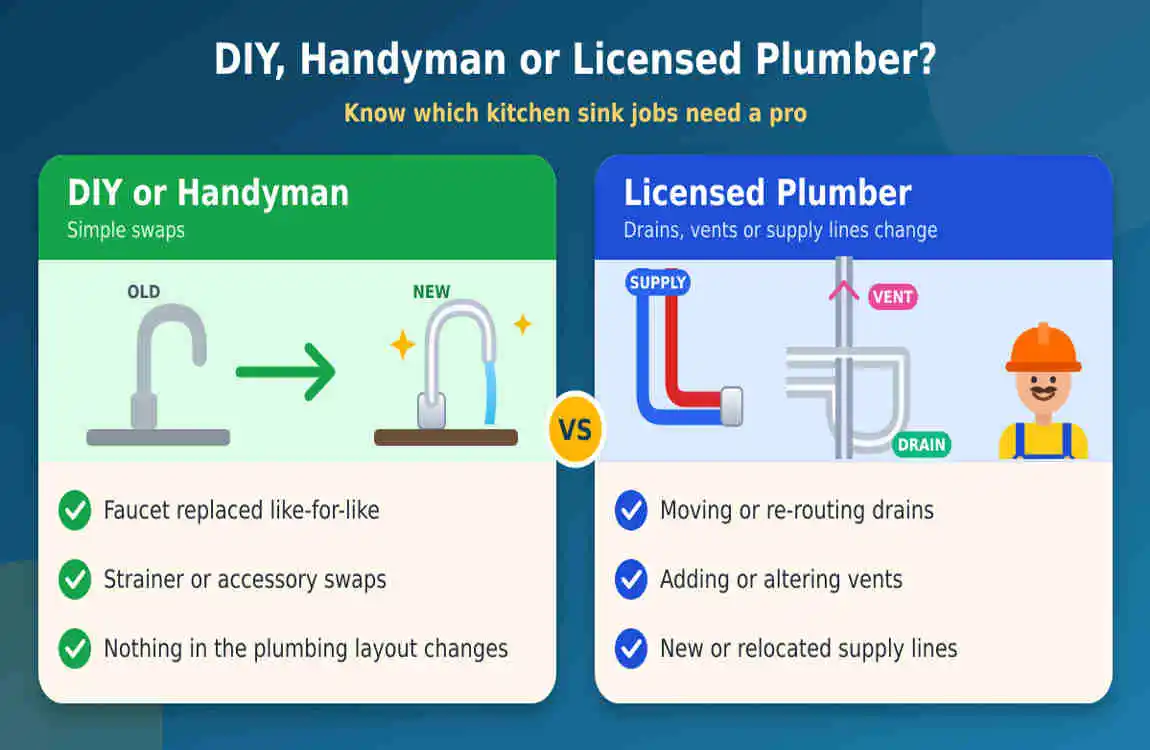
| Situation | Best choice |
|---|---|
| Replacing a sink in the same spot, same size | DIY or handyman, or a plumber for peace of mind |
| Adding a new sink or moving it | Licensed plumber |
| Island sink | Licensed plumber with island-venting experience |
| Undermount, farmhouse or stone countertop | Plumber plus countertop or cabinet installer |
| Old, corroded or leaking pipes | Licensed plumber |
Do you need a permit or code approval?
For a plain replacement, often not, but local rules decide. Moving or adding drains and vents usually triggers a permit and inspection. The reason is safety: both the International Plumbing Code and the Uniform Plumbing Code require each fixture’s P-trap to be vented, so the water seal that blocks sewer gas is not pulled out as water drains (Hunker). The International Code Council publishes the venting methods in Chapter 9 of the IPC (International Code Council).
One practical code detail: the drain parts under the sink, including the P-trap, must be at least 1½ inches in diameter, while the pipe after the trap is 1½ inches under the IRC and 2 inches under the UPC (Hunker: Building Code Requirements for Kitchens).
Check locally. Code editions differ by city and state. Your local building department, or a licensed plumber, can tell you which rules apply and whether your job needs a permit. Most states and some localities also require plumbers to be licensed (BLS).
What about island and farmhouse sinks?
These are the cases where hiring a plumber matters most.
Island sinks have no wall behind them, so the trap cannot be vented the usual way. Under the 2024 IRC, an island sink without any vent is a common inspection failure, because without a vent the trap can siphon dry and let sewer gas into the kitchen. The usual fixes are a loop vent or, where local code allows, an air admittance valve (Jaspector: IRC 2024 Island Fixture Venting).

Farmhouse (apron-front) sinks sit in custom base cabinets and are often installed by a plumber working alongside a carpenter or cabinet installer (HomeAdvisor, HomeServe). Garbage disposals add a trap requirement and an electrical need. Inspectors check that the drain stub-out is sized for a disposal and that power is available in the cabinet (Jaspector: IRC 2024 Garbage Disposal). Dishwashers need a high loop in the drain hose, a point This Old House’s Richard Trethewey stresses (This Old House: Plumbing a Kitchen Sink).
How do you hire the right plumber for a kitchen sink?
- Verify the license and insurance. Most states and some localities require plumbers to be licensed (BLS).
- Buy the sink and faucet first, or ask the plumber to supply them, so the job is measured correctly. Keep the sink the same size or larger than the old cutout; a smaller sink may need a new countertop.
- Get a written estimate that lists removal, hauling, new shutoff valves, disposal or dishwasher hookups and permit fees.
- Ask who handles the countertop. If you are going undermount or changing sink size, you may need a separate countertop fabricator.
- Ask about a leak test and a warranty on labor before work starts.
Frequently asked questions
Will a plumber install a kitchen sink?
Yes. It is routine work. A plumber sets the sink, connects the faucet, supply lines, drain and trap, and tests for leaks. Countertop cutting is usually done by a countertop or cabinet installer.
How long does the job take?
A like-for-like replacement commonly takes a few hours. Undermount, farmhouse or island sinks, and any job that changes plumbing, can take most of a day or longer.
Can a plumber install my sink if I bought it online?
Generally yes. Confirm the faucet-hole count and cutout size match your countertop before the visit, and keep the manufacturer’s installation sheet handy.
Does a plumber also install the faucet and garbage disposal?
Yes, both are common add-ons. Wiring a brand-new disposal circuit may also need an electrician.
Is a plumber cheaper than a handyman?
Not usually per hour, but a plumber can prevent costly leaks and code problems if your job involves drains, vents or supply changes.
Do I need a permit to replace a kitchen sink?
A simple swap often does not, while moving or adding plumbing usually does. Ask your local building department.
The bottom line
A plumber will absolutely install your kitchen sink, and for anything beyond a straight swap, a licensed pro is the safer bet. Keep the countertop work separate in your planning, get a written estimate, and check local permit rules before you start.
Sources
- U.S. Bureau of Labor Statistics, Occupational Outlook Handbook: Plumbers, Pipefitters, and Steamfitters
- International Code Council: Methods of Venting Plumbing Fixtures and Traps in the 2021 IPC
- This Old House: How to Install a Kitchen Sink
- This Old House: How to Replace a Sink
- This Old House: How to Install the Plumbing for a Kitchen Sink
- HomeAdvisor: How Much Does Sink Installation Cost?
- Thumbtack: Sink or Faucet Installation Cost
- HomeServe: How Much Does It Cost to Install a Kitchen Sink?
- Hunker: What Is a Loop Vent? Definition, Types and Code Requirements
- Hunker: Building Code Requirements for Kitchens
- Jaspector: IRC 2024 Island Fixture Venting
- Jaspector: IRC 2024 Garbage Disposal Installation
Costs and code rules change and vary by location. This article is general information, not a substitute for advice from a licensed plumber or your local building department.