
If you have ever wondered how often you change air filters in your house, you are in good company. It is one of the most searched home-maintenance questions, and the honest answer is a range, not a single date. The good news: once you know the three things that set your schedule, it takes about two minutes to get right.
How Often Do You Change Air Filters in Your House?
Use this simple rule:
- Check it every month. ENERGY STAR recommends a monthly check, especially in the heavy-use months of winter and summer.
- Replace it if it looks dirty. If it is visibly clogged after a month, change it then.
- Never go past 3 months with a standard disposable filter. That is ENERGY STAR’s minimum, and the U.S. Department of Energy says to clean or replace filters every month or two during the cooling season if you are unsure.
Many manufacturers print a 60–90 day interval on the package. The EPA’s guidance, as summarised by This Old House, is to check monthly and swap the filter whenever it looks dirty, so treat the box as a starting point, not a promise.
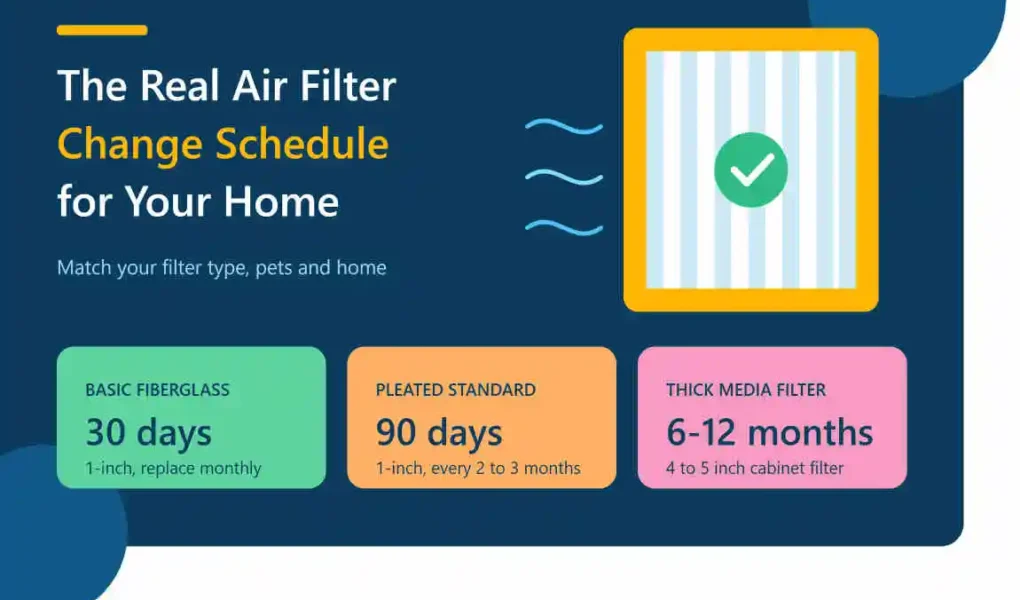
Air Filter Replacement Schedule by Filter Type
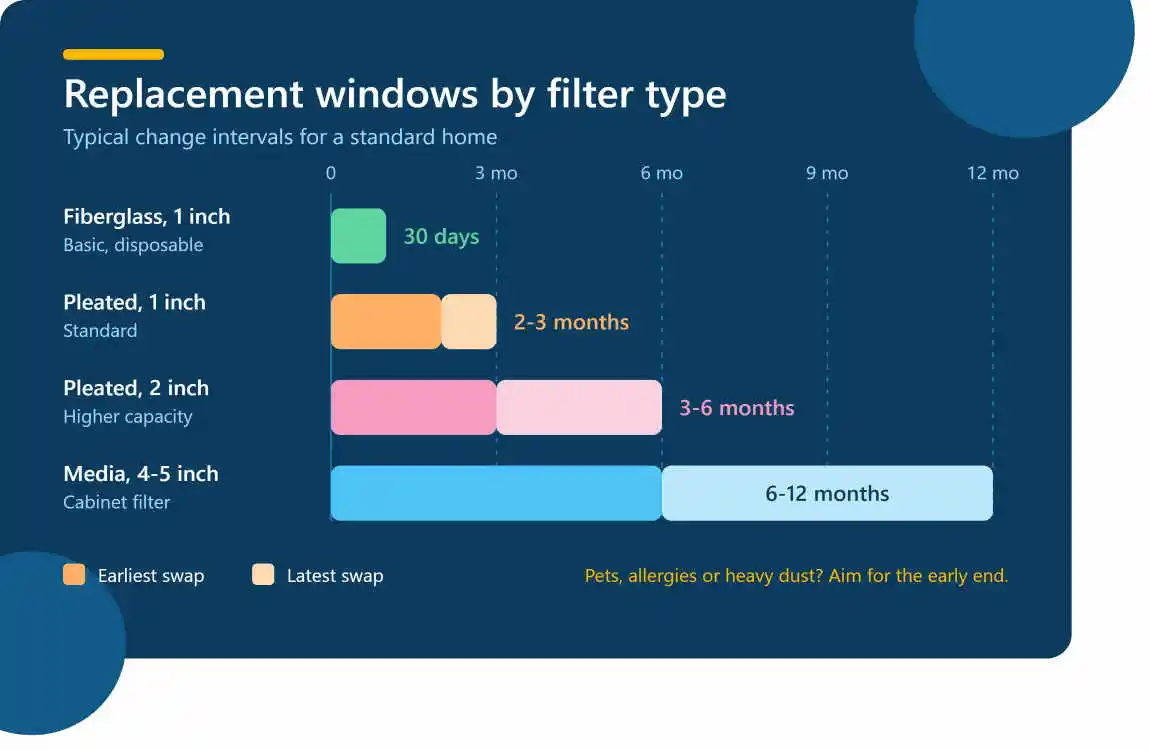
Different filters load up at different speeds. These are typical manufacturer and industry ranges. Your filter’s packaging and your smart system manual always win.
| Filter type | Typical replacement interval | Good to know |
|---|---|---|
| Fiberglass (thin, blue or white) | About every 30 days | Cheap, with basic filtration and low airflow resistance |
| Pleated (1–2 inch) | 60–90 days | The most common home filter; see Trane’s guidance on shortening the interval in pollen season |
| Thick media (4–5 inch) | Up to 6–12 months | Follow the manufacturer; check it every few months anyway |
| Washable | Clean on a regular schedule | Must be fully dry before reinstalling |
What Makes You Change Your Filter More Often?
The 3-month minimum assumes an average home. Shorten the interval if any of these apply:
- Pets. Hair and dander load a filter faster.
- Allergies or asthma. A fresher filter means fewer particles circulating.
- Heavy HVAC use. Summer heat waves and long cold snaps push more air through the filter.
- Wildfire smoke. The EPA says to replace the filter in your HVAC system more often than the manufacturer recommends during periods of heavy smoke.
- Dusty surroundings. Renovations, nearby construction, or higher outdoor pollution fill filters faster.
- A bigger household. More people means more dust, skin cells and activity.
7 Signs Your Air Filter Needs Changing Right Now
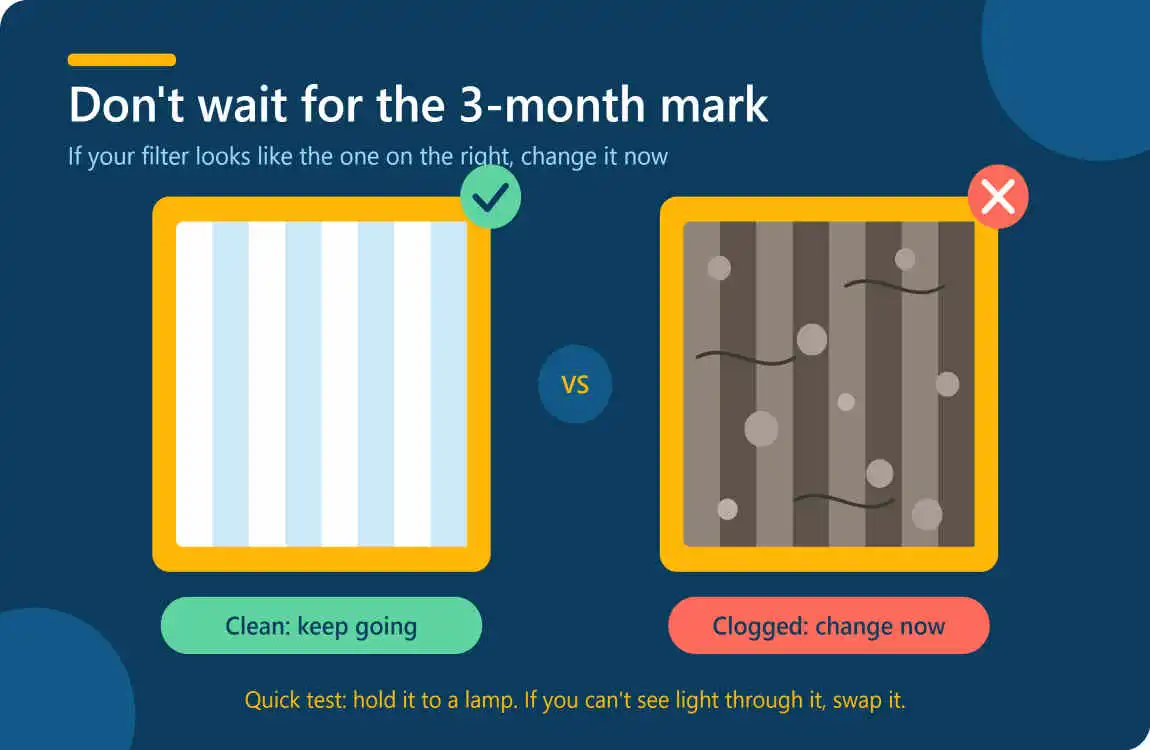
- You can see a gray, furry layer of dust on the filter surface.
- Hold it up to a light and very little light passes through.
- Airflow from your vents feels weaker than usual.
- Your system runs longer or cycles on and off more often.
- Dust settles on furniture faster than normal.
- Allergy symptoms flare up indoors.
- Your energy use creeps up for no clear reason. ENERGY STAR notes that a dirty filter can increase energy costs and damage equipment, leading to early failure.
Does Changing Your Air Filter Save Money?
It can help. The U.S. Department of Energy says replacing a dirty filter with a clean one helps your air conditioner run efficiently and protects it from dirt buildup that can cause premature failure. DOE’s consumer materials have long cited energy savings of 5–15% on air conditioner energy use from a clean filter. Treat that as a best-case estimate for a badly clogged filter, not a guaranteed discount on every bill. The more reliable payoff is a system that is not strained and lasts longer.
Which Air Filter Should You Buy? MERV Ratings Explained
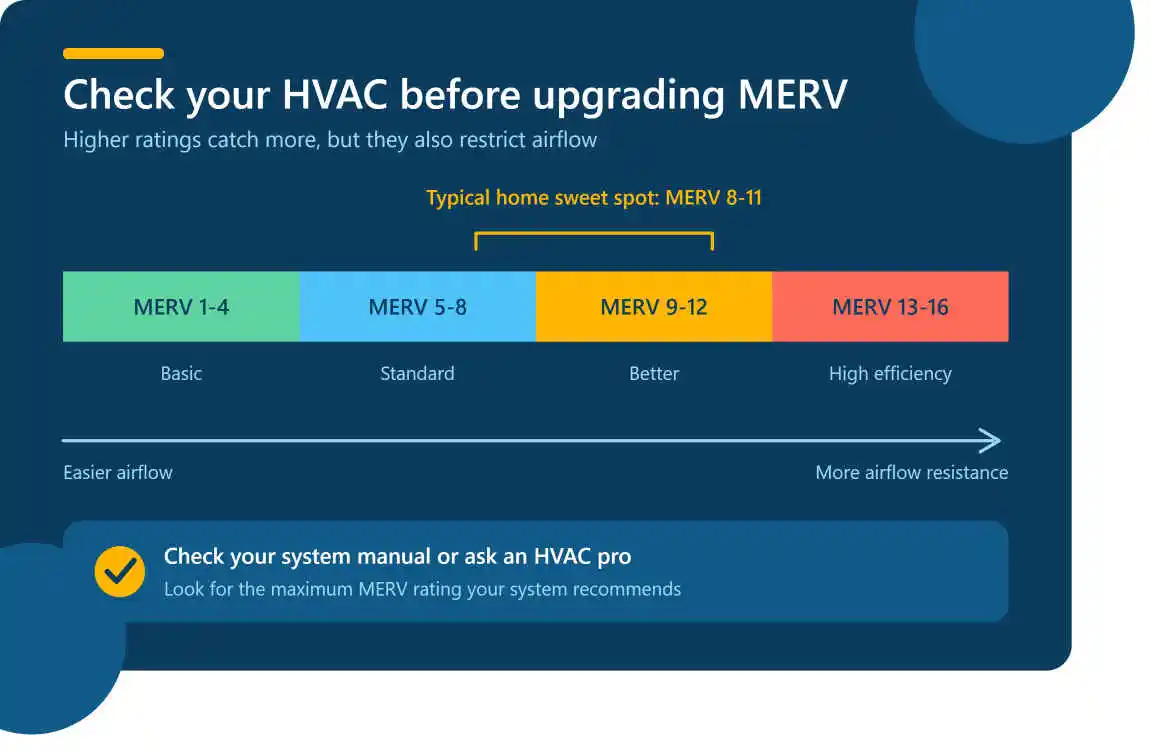
MERV (Minimum Efficiency Reporting Value) rates how well a filter captures particles. Higher numbers capture more and smaller particles. The EPA’s Guide to Air Cleaners in the Home advises choosing a furnace or HVAC filter rated at least MERV 13, or as high as your system will accommodate. The catch is that denser filters resist airflow more. Check your system’s documentation or ask an HVAC technician before you jump to the highest rating, and replace the filter on schedule so it does not clog.
How to Change a Home Air Filter in 5 Steps
- Turn off the system at the thermostat.
- Find the filter. In most homes it sits along the return duct, behind a return-vent grille in a wall or ceiling, or in the air handler or furnace.
- Note the size and arrow. The size is printed on the frame, and the airflow arrow shows which way the filter faces.
- Slide in the new filter with the arrow pointing toward the blower or furnace, away from the return grille.
- Write the date on the frame and turn the system back on.
A Simple Routine You Will Actually Keep
- Set a repeating phone reminder for the 1st of each month to look at the filter.
- Keep two or three spare filters of the correct size on hand so there is no excuse.
- Switch to monthly changes during peak summer, deep clean, pollen season and smoky days.
- Book an annual HVAC tune-up and ask the technician to confirm your filter size and rating.
Frequently Asked Questions
How often do you change air filters in your house?
Check monthly and replace every 1–3 months in most homes. ENERGY STAR’s minimum is every 3 months. Pets, allergies, heavy HVAC use and smoke call for more frequent changes.
Is it okay to change an air filter every 6 months?
Only for a thick, high-capacity media filter that the manufacturer rates for that long. A standard 1–2 inch pleated filter should be replaced at least every 3 months.
What happens if you never change your air filter?
Airflow drops, your system works harder, energy costs can rise, and the equipment can wear out early, according to ENERGY STAR and the U.S. Department of Energy.
How often should you change air filters with pets?
Check monthly, and expect to change it more often than the 3-month minimum. Replace it whenever it looks visibly dirty.
What MERV rating should a home air filter have?
The EPA advises at least MERV 13, or the highest rating your system can accommodate. Confirm compatibility with your system’s documentation or an HVAC professional.
Bottom Line
Look at your filter every month, replace it every 1–3 months, and never push a standard filter past 3 months. Adjust for pets, allergies, smoke and heavy use. That one small habit protects your air, your comfort and your HVAC system.