Losing a partner, parent, sibling or friend is hard enough without a property question hanging over you. If your name is on the deeds alongside theirs, you probably want a straight answer: do you keep the house, does it go to their family, or does it have to be sold?
The honest answer is that it depends on how the home is owned. Two people can look identical on paper and still end up with completely different outcomes. This guide explains the rules in plain English, covering England and Wales first, then the United States, so you know what to expect and what to do next.

The Two Ways to Own a Home Together
In England, Wales and Northern Ireland, co-owners hold real estate property either as joint tenants or as tenants in common. When you register a property, you tell HM Land Registry which one applies, as the UK government’s own guidance on joint property ownership (GOV.UK) explains.
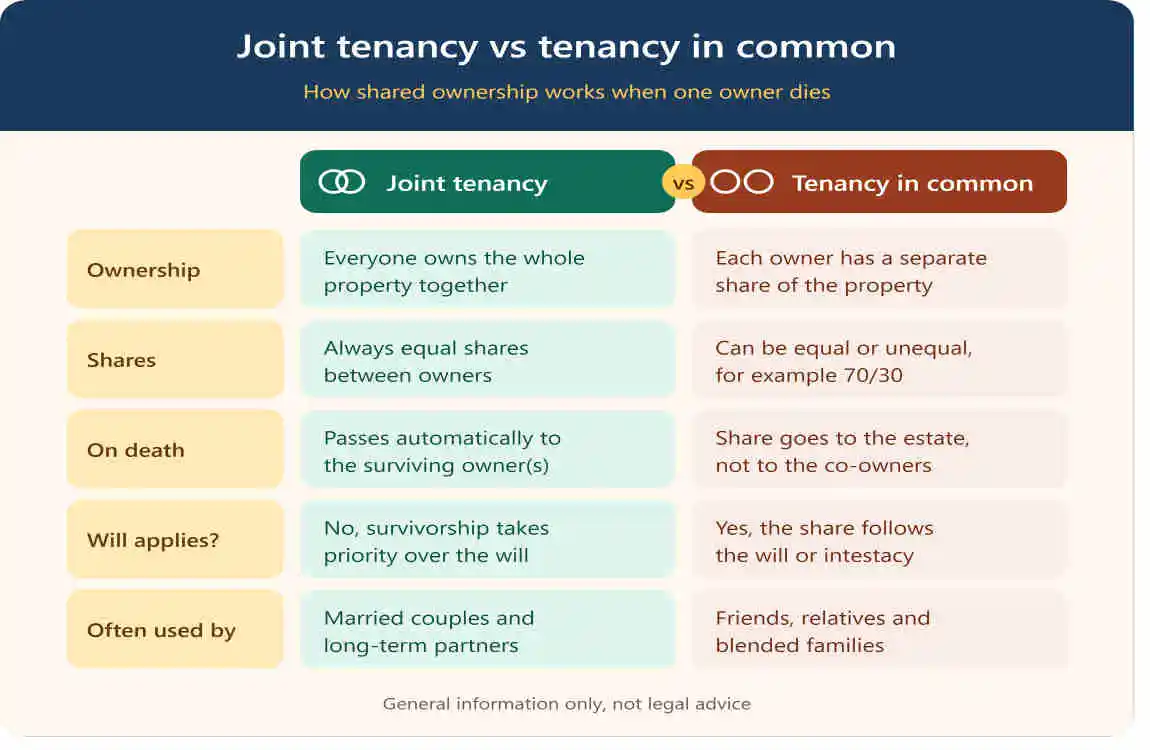
| Joint tenants | Tenants in common | |
|---|---|---|
| Who owns what? | Each owner holds the whole property together | Each owner holds a defined share (50/50 or any split) |
| When one owner dies | Their interest passes automatically to the survivor(s) | Their share passes under their will or intestacy rules |
| Does the will matter? | No, it cannot override survivorship | Yes, the will decides |
| Typical owners | Married couples and civil partners | Friends, siblings, business partners, second-marriage couples |
Joint Tenants: The Survivor Takes It All
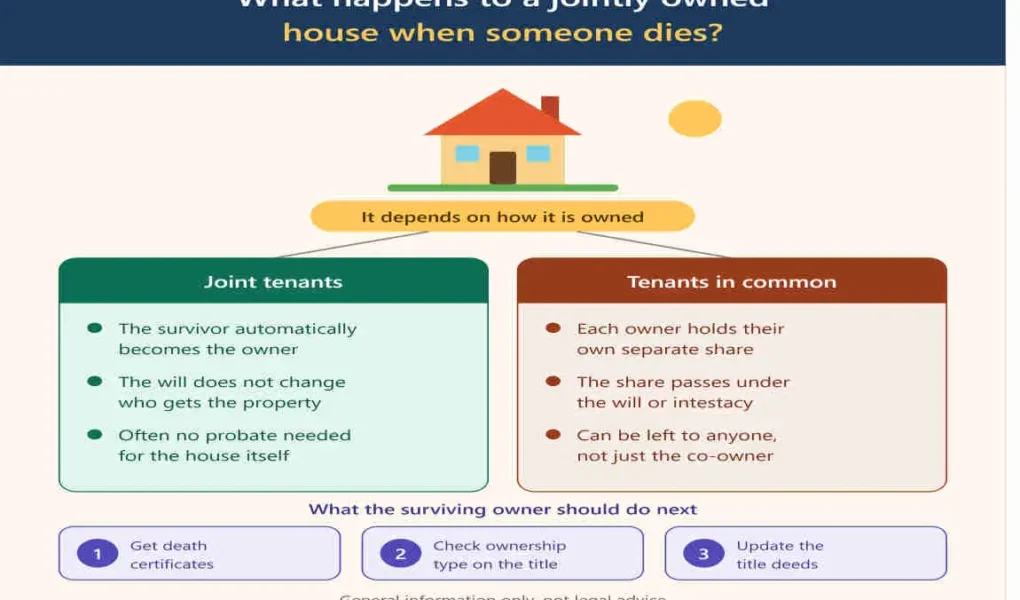
Under a joint tenancy, there is no such thing as “your half” and “their half” in the eyes of the law. Both of you own the entire property together. So when one of you dies, the survivor simply carries on as the sole owner. The Low Incomes Tax Reform Group gives a clear example: a father and son hold a house as joint tenants, the father dies, and the property passes straight to the son, regardless of any will.
This is known as the right of survivorship, and it has some important consequences:
- A will cannot change it. Even if the deceased left “my share of the house” to a child from a previous relationship, that gift usually has no effect on a joint tenancy.
- Probate is generally not needed for the property. A grant of probate is typically required for property cost held in a sole name or as tenants in common, but not for a joint tenancy, according to The Gazette.
- It is quick, but it can surprise families. Children or stepchildren who expected to inherit may find they receive nothing from the house.
Tenants in Common: Your Share Is Part of Your Estate
With a tenancy in common, each owner has a separate, identifiable share. The Gazette notes that this is often an equal split, but it can reflect different financial contributions. When an owner dies, their share does not go to the surviving owner automatically. Instead it forms part of the deceased person’s estate.
LITRG illustrates this with a husband and wife who own their home as tenants in common. When the husband dies, his will leaves his share to their son, and the son and his mother then co-own the house as tenants in common.
If there is no will, the share is distributed under the intestacy rules, which means a partner you are not married to may receive nothing. That is why unmarried couples and blended families are strongly encouraged to review their ownership and make a will.
How to Find Out Which Type of Ownership Applies
Many people honestly cannot remember how they signed the paperwork when they bought. Here is how to check:
- Look at the title register. In England house and Wales you can obtain official copies from HM Land Registry. A restriction on the register usually signals a tenancy in common.
- Check the transfer deed or purchase paperwork from your solicitor or conveyancer.
- Ask the solicitor who handled the sale. They will normally have a record of the choice you made.
Can Ownership Be Changed Before Someone Dies?
Yes. A joint tenancy can be “severed” so that it becomes a tenancy in common, for example after a divorce or separation when someone wants to leave their share to a different person. GOV.UK confirms you can switch between the two types, and there is no fee to do so. Reversing it, from tenants in common to joint tenants, is also possible, such as after a marriage when a couple want equal rights over the whole property.

What to Do Next: Step by Step (England and Wales)
- Register the death and order several certified copies of the death certificate.
- Confirm how the property was owned (see the section above).
- If you were joint tenants, send the death certificate to HM Land Registry so the register can be updated to show you as sole owner.
- If you were tenants in common, the executor named in the will (or an administrator, if there is no will) will usually need to apply for probate before the deceased’s share can be transferred or sold.
- Contact your mortgage lender. A mortgage does not vanish on death. The survivor generally continues to be responsible for it, so speak to the lender early.
- Think about inheritance tax. The Gazette points out that inheritance tax can apply to the value of the property, depending on the overall home size of the estate, whichever type of ownership applies.
What Happens in the United States?
The principles are similar, but the vocabulary and paperwork differ and the rules are set state by state. According to Nolo, there are three main forms of survivorship ownership: joint tenancy with right of survivorship (JTWROS), community property with right of survivorship, and tenancy by the entirety (available between spouses in some states).
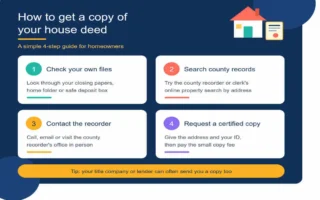
When a home is held this way, it passes automatically to the surviving owner without going through probate. Nolo’s guidance on avoiding probate with joint ownership adds that the survivor typically completes a straightforward form and presents it, with a death certificate, to the office that keeps ownership records, such as the county recorder.
A real-world illustration comes from Montana State University Extension: a woman became the owner of a house and land because it was titled in joint tenancy with her late husband, and his will leaving the property to his son did not override that. The same guide notes that in Montana the survivor also files a realty transfer certificate with a certified death certificate.
Tenants in common in the US
As in the UK, tenants in common each hold a separate share. That share does not pass to the other owner automatically. It goes through the deceased person’s estate, which usually means probate.
Common Mistakes to Avoid
- Assuming a will overrides joint tenancy. It does not.
- Forgetting to update the official record. Even when ownership passes automatically, you still need to update the title so you can sell or remortgage later.
- Leaving it too late to review ownership. Blended families and unmarried partners are most at risk of unintended outcomes.
- Ignoring the mortgage. Lenders need to be told, and home cost payments must continue.
Frequently Asked Questions
Does a jointly owned house automatically go to the surviving owner?
Only if it was held as joint tenants (or with a right of survivorship in the US). If it was held as tenants in common, the deceased person’s share goes under their will or the intestacy rules.
Do I need probate if my spouse dies and we owned the home jointly?
If you were joint tenants, probate is generally not needed for the house itself, though you will still need to update the title with the death certificate. Probate is more likely where the home was held as tenants in common or in the deceased’s sole name.
Can a will leave my share of a joint tenancy to someone else?
No. A will cannot override survivorship. To leave your share to someone else, you would need to sever the joint tenancy during your lifetime.
Is inheritance tax payable on a jointly owned home?
It can be, depending on the total value of the estate. The type of joint ownership does not change whether the property value counts toward the estate.
Final Thoughts
The single most useful thing you can do, whether you are planning ahead or dealing with a recent loss, is find out exactly how your home is owned. That one detail determines who inherits, whether probate is needed, and how quickly things can move. If you are unsure, a solicitor or estate attorney can confirm it and help you update your arrangements so they reflect what you actually want.