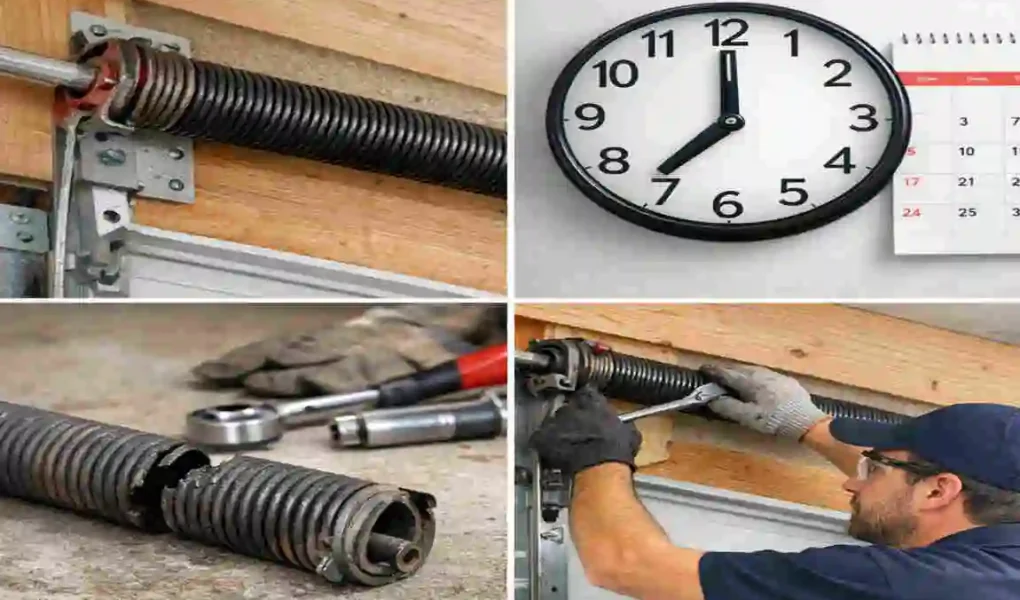
Frustrated by a stuck garage door? You are running late for work, you hit the button on the wall, and… nothing. Or worse, you hear a loud “BANG” that sounds like a firecracker going off in your garage. If this scenario sounds familiar, you are likely dealing with a broken spring.
The garage door is the largest moving object in your home, but the opener motor doesn’t actually do the heavy lifting. The real muscle behind the operation is the spring system. These tightly wound coils counteract gravity, allowing a 300-pound door to feel as light as a feather. But like any muscle, they eventually get tired and snap.
At mgapgarage, we receive calls every single day from homeowners asking the same question: “How long do garage door springs last?”
Types of Garage Door Springs and Their Lifespan
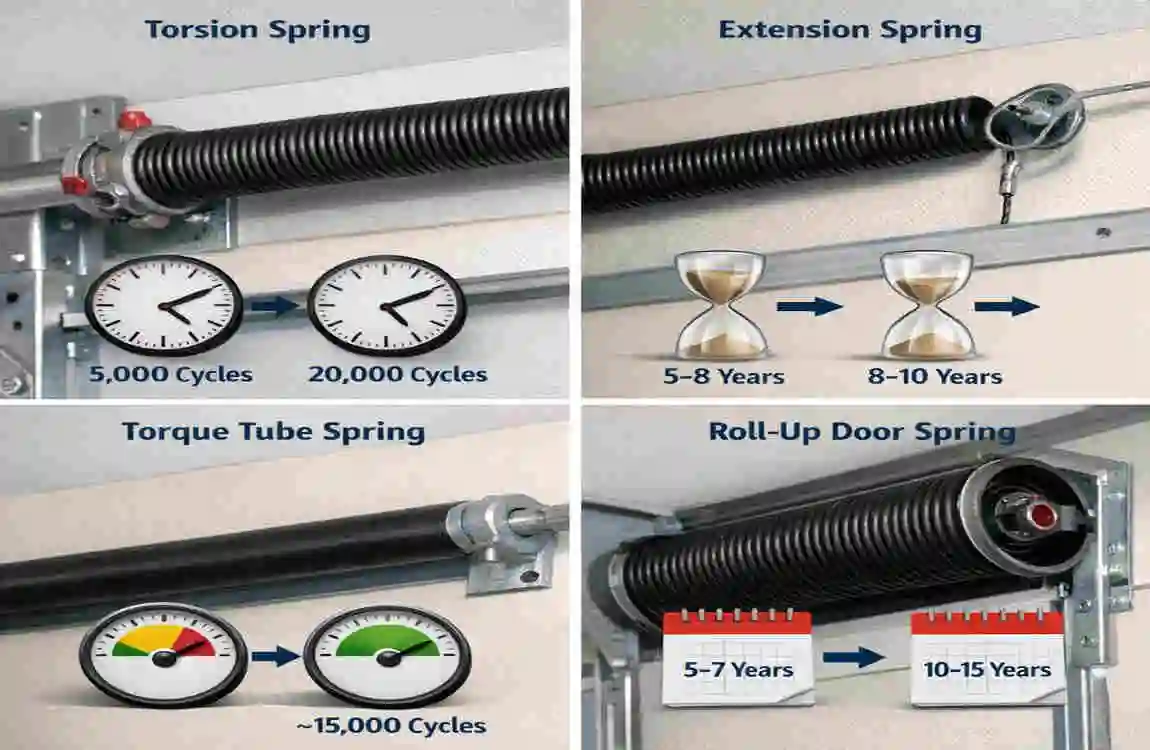
To understand how long your springs will last, you first need to identify which type of system you have. In the world of garage doors, there are two main heavyweights: Torsion Springs and Extension Springs. They both do the same job—lifting the door—but they work in very different ways.
Torsion Springs The Gold Standard
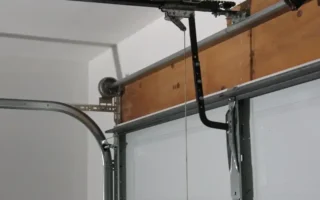
If you look up above your closed garage door and see a metal bar running horizontally across the header, with one or two springs wound around it, you have a torsion spring system.
- How they work: These springs twist (torque) to store energy. When the door comes down, the springs wind up tight. When the door goes up, they unwind to lift the weight.
- Lifespan: Standard torsion springs are rated for 10,000 to 15,000 cycles. For the average home, this translates to about 7 to 10 years. However, you can upgrade to “high-cycle” springs rated for 30,000 cycles, which can last 15 to 20 years.
Extension Springs The Old School Style
If you look at the horizontal tracks on the ceiling (the ones the door rolls back into) and see long, skinny springs running parallel to them, you have extension springs.
- How they work: These springs expand and contract (stretch) like a rubber band. When the door closes, they stretch out. When the door opens, they contract to pull the door up.
- Lifespan: These are generally cheaper and have a shorter life. They are typically rated for 5,000 to 10,000 cycles, which usually means about 7 to 9 years of use.
Here is a quick breakdown to help you identify what you are working with:
Spring Type Average Cycles: How Long Do They Last? Best Application
Extension (Clip-Ends) 5,000 – 10,000 7 – 9 Years Lighter, single-car doors
Standard Torsion 10,000 – 15,000 7 – 12 Years Standard residential homes
High-Cycle Torsion 25,000 – 50,000 15 – 20+ Years Heavy doors / High usage
mgapgarage Pro Tip: If you live in a region with extreme temperature shifts, upgrading to high-cycle torsion springs is the single best investment you can make for your garage.
Factors That Affect How Long Garage Door Springs Last mgapgarage
You might be wondering why your neighbor’s garage door springs lasted 15 years while yours snapped after just six. The answer lies in the variables. When we analyze how long garage door springs last, we look at four critical factors that accelerate wear and tear.
The “Cycle” Count Usage
Springs are not measured in years; they are measured in cycles. One full cycle is the door going up and coming back down one time.
- The Math: If you open your door to leave for work, close it, open it when you return, and close it for the night, that is 2 cycles per day.
- The Reality: Most families use the garage as the front door. You open it to get the bike, open it to let the dog out, open it for the kids. If you average 4 to 6 cycles a day, a 10,000-cycle spring might only last 3 to 5 years.
Climate and Corrosion The Rust Factor
This is particularly relevant if you live in a humid climate, such as Lahore or the Punjab region. Rust is the enemy of steel.
- Friction: Rust increases coil-to-coil friction. Instead of sliding smoothly, the coils grind against each other.
- Pitting: Oxidation eats into the metal, creating weak spots (pitting). When the spring is under maximum tension (door closed), these weak spots are where the break will happen.
- Heat: Extreme heat can cause the metal to expand, and rapid cooling causes contraction. Over time, this thermal fatigue alters the steel’s molecular structure, making it brittle.
The Weight and Condition of the Door
Your springs are calibrated to lift a specific amount of weight.
- Imbalance: If your garage door tracks are dirty or the rollers are rusted, the door becomes “heavier” due to friction. The springs have to work harder to lift it.
- Modifications: Did you add insulation to your door? Did you paint it with heavy coats? Adding even 10 pounds to a door for which the springs weren’t calculated can cut their lifespan by 30%.
Maintenance Habits
Neglect is the number one killer of garage door hardware.
- Dry Springs: A dry spring is a noisy, hot spring. Without lubrication, the metal heats up during operation, leading to premature snapping.
- Alignment: If the springs are not wound evenly (one has more tension than the other), the tighter spring carries the load and will break much faster.
Average Lifespan: Real-World Data from mgapgarage
We believe in data, not just guesses. At mgapgarage, we have tracked spring replacements over the last decade to give you a realistic look at what to expect.
The national average for spring life is often cited as 10 years, but that assumes perfect conditions. Here is the real-world data based on location and usage habits.
The “Cycle” Reality
Most homeowners underestimate how much they use their door.
- Light User (2 cycles/day): Expect 10–14 years.
- Average User (4 cycles/day): Expect 6–9 years.
- Heavy User (8+ cycles/day): Expect 3–5 years.
The Climate Impact
We have noticed a significant difference in lifespan across geographies.
Location / Condition: Expected Lifespan (Standard Spring): Why?
Cool & Dry (US North) 12 – 15 Years Less rust, consistent metal temp.
Hot & Humid (Pakistan/South) 7 – 10 Years Humidity causes rust; heat fatigue.
Coastal Areas 5 – 8 Years Salt air accelerates corrosion rapidly.
If you are asking how long garage door springs last, and you live in a hot climate with a heavy, insulated door, you should plan for a replacement every 7 years to be safe.
Signs Your Garage Door Springs Are Failing
Springs rarely break without giving you a warning first. If you know what to look for (and listen for), you can catch a failing spring before it snaps and traps your car in the garage.
The “Heavy Door” Test
If you pull the emergency release cord (the red handle) and try to lift the door by hand, it should feel relatively light—around 10 to 15 pounds.
- The Warning: If the door feels incredibly heavy or crashes down when you let go, your springs are losing tension and are near the end of their life.
The Squeak and Groan
Garage doors make noise, but springs shouldn’t scream.
- The Warning: A loud squealing sound usually means the steel is dry and grinding. A “groaning” sound when the door stops implies the spring is struggling to hold the weight.
Visible Gaps in the Coil
This is the most obvious sign.
- The Warning: Look at your torsion spring. If you see a 2-inch gap anywhere in the coil, the spring has already snapped. It might look like it is still in one piece from a distance, but that gap means the tension is gone.
Uneven Opening
- The Warning: If you have extension springs (one on each side) and one breaks, the door will try to lift unevenly. One side will go up, and the other will drag, causing the door to jam in the tracks.
The “Jerky” Movement
- The Warning: If the door moves a few inches, stops, moves again, and shakes, the springs are failing to provide smooth, consistent torque.
Maintenance Tips to Extend Garage Door Spring Life
You can’t change the weather, but you can change how you treat your door. Following these maintenance steps from mgapgarage can add years to your spring’s life.
Lubricate Every 3 Months
This is the holy grail of spring maintenance.
- What to use: Use a Lithium-based spray grease or a specific Garage Door Lube.
- What NOT to use: Do not use WD-40. It is a solvent, not a lubricant. It strips away existing grease and attracts dust, worsening the problem.
- How to do it: Spray a steady stream along the entire length of the spring. Let it soak in. This reduces friction and prevents rust.
Check the Balance Annually
Perform the “balance test” we mentioned earlier.
- Close the door.
- Pull the red emergency release cord.
- Lift the door halfway up (about waist height).
- The Goal: The door should stay there, hovering in place.
- The Fail: If it drops, the springs are weak. If it shoots up, the springs are wound too tight. Both require professional adjustment.
Keep the Tracks Clean
Dirty tracks cause resistance. Resistance kills springs.
- Wipe out the tracks with a damp rag. Do not grease the tracks! Grease attracts dirt, which turns into a grinding paste.
Schedule a Professional Tune-Up
For about PKR 5,000 to 10,000 (or $80-$150), you can have a pro inspect the tension, tighten loose bolts, and lubricate the entire system. Doing this every two years is a small price to pay to avoid a sudden breakdown.
Step-by-Step: When and How to Replace Springs
If you have determined your springs are shot, you are probably wondering about replacement. This section covers the timeline, the cost, and the process.
A Critical Warning from mgapgarage:
DANGER: Replacing torsion springs is dangerous. The tension stored in these coils is enough to break bones or sever fingers. If you do not have the proper tools (winding bars) and experience, please hire a professional.
The Timeline: Replace in Pairs
If one spring breaks, replace both. Why? Because they were installed at the same time and have done the same number of cycles. If the left one broke today, the right one is likely to break within 30 days. Paying for two service calls is a waste of money.
The Cost Breakdown
Prices vary by region, but here is what you can expect to pay for a professional replacement.
Service ItemAverage Cost (USD)Average Cost (PKR)
Torsion Spring Pair (Parts) $200 – $500 PKR 55,000 – 140,000
Extension Spring Pair (Parts) $100 – $200 PKR 28,000 – 55,000
Professional Labor $150 – $300 PKR 40,000 – 85,000
Total Project Cost $350 – $800 PKR 95,000 – 225,000
The Replacement Process (Overview)
While we recommend a pro, here is what the process looks like so you understand what you are paying for.
- Secure the Door: The door must be clamped down so it doesn’t fly up when tension is released.
- Unwind the Old Springs: Using steel winding bars, the technician slowly releases the tension from the unbroken spring. This is the most dangerous step.
- Disassemble the Shaft: The torsion tube is slid over to remove the old springs and slide on the new ones.
- Re-Winding: The new springs are wound tight. The number of “turns” must be precise based on the door’s height (usually 7-8 full turns for a standard door).
- Recalibration: The technician checks the balance and adjusts the tension until the door floats perfectly.
Garage Door Spring Replacement Costs & Savings
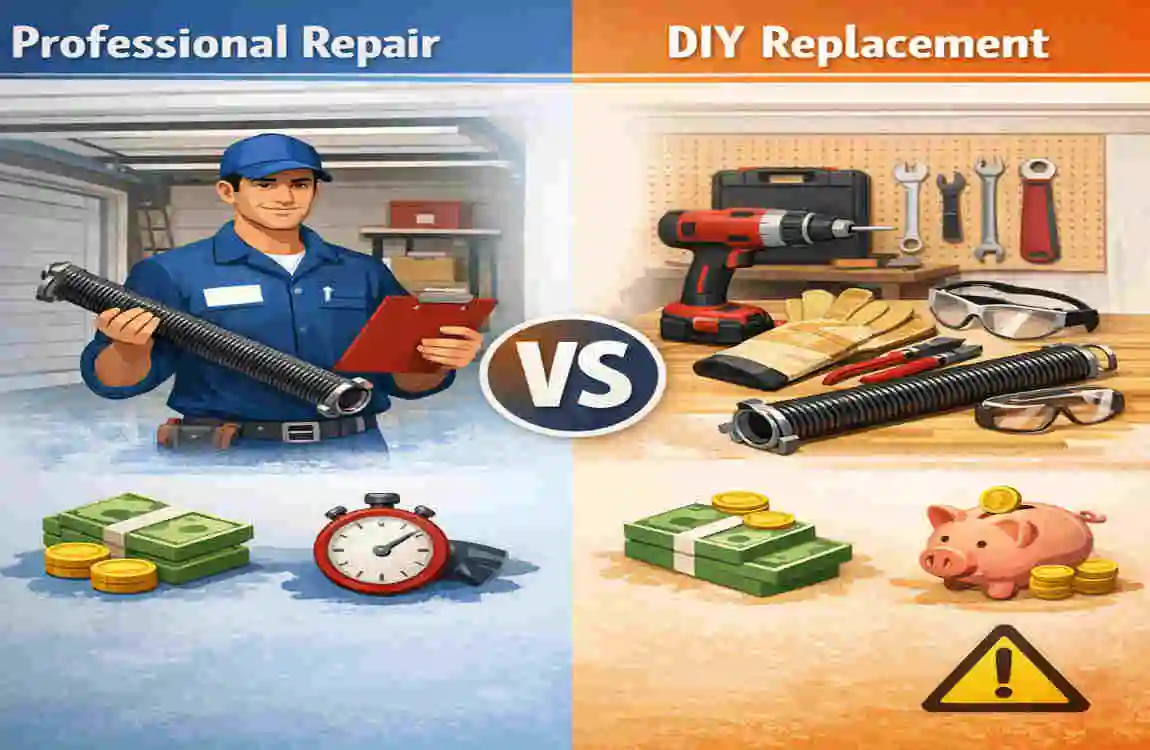
Everyone wants to save money, but saving on garage door springs can be costly in the long run.
The Hidden Cost of DIY
We see it all the time. A homeowner buys cheap springs online to save $100.
- The Risk: They buy the wrong size (wire gauge), so the door never balances. Or, the cheap steel snaps in 2 years.
- The Injury: Emergency room visits for garage door accidents are surprisingly common. The cost of a broken hand far outweighs the cost of a service call.
How to Actually Save Money
- High-Cycle Upgrade: Ask for “High-Cycle” springs. They cost about 20% more upfront but last twice as long. This cuts your long-term cost in half.
- Preventative Maintenance: A can of lithium grease costs $10. A new spring costs $400. Do the math.
- Bundle Services: If your opener is old, replace it along with the springs to save on labor costs.
FAQs: How Long Do Garage Door Springs Last? mgapgarage
How long do garage door springs last mgapgarage in hot weather? In hot climates like Lahore or the southern US, the expected lifespan drops to 7-9 years. Heat causes metal fatigue, and humidity accelerates rust, which significantly shortens the cycle life compared to cooler, drier regions.
Torsion vs. extension: Which lasts longer? Torsion springs are the clear winner. They are sturdier, carry weight more evenly, and generally last 10,000 to 20,000 cycles. Extension springs rely on a stretching motion that weakens the metal faster, typically lasting only 5,000 to 10,000 cycles.
Can I replace garage door springs myself? Technically, yes, but mgapgarage strongly advises against it for torsion springs. It requires specific tools and knowledge of torque ratios. Extension springs are safer to DIY, but even then, safety cables must be installed to prevent injury if they snap.