Have you ever walked into a luxury hotel lobby or a stunning modern villa and felt an immediate sense of calm and awe? The space feels “right.” The light hits the perfect spots, the flow from one room to another feels effortless, and the ceiling heights make you feel like you can breathe easier. You might think this is just good decoration, but it is actually something much deeper.
You are experiencing the magic of Interior Architecture.
Many homeowners spend thousands of dollars on expensive sofas, trendy rugs, and art, yet their homes still feel cluttered or disjointed. They are focusing on the “makeup” of the room without fixing the “bones.” This brings us to the golden question: What is interior architecture?
It is the professional secret that blends the structural logic of architecture with the human-centric focus of interior design. It is about shaping the space itself, not just filling it. According to a 2026 Houzz report, 35% of homeowners are now prioritizing interior architecture professionals for renovations, boosting property value by 20%.
Defining Interior Architecture: Core Concepts
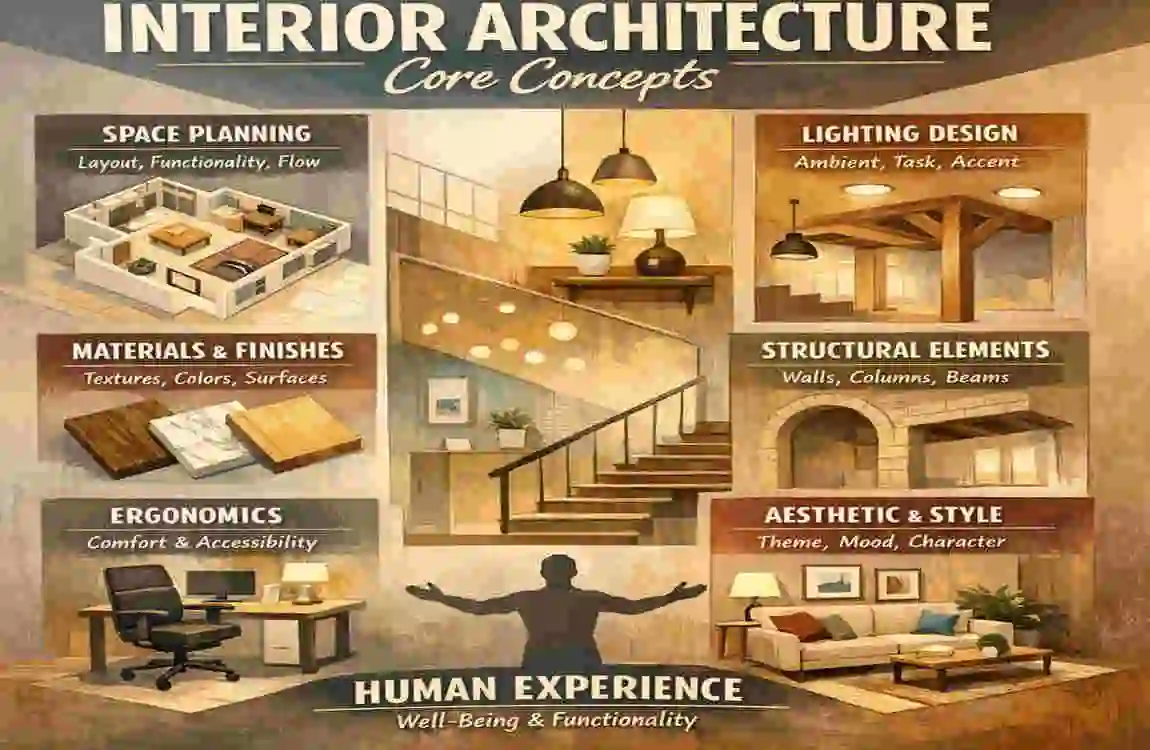
So, what is interior architecture exactly?
In the simplest terms, interior architecture is the design of a space created by structural boundaries and the human interaction within them. It is the bridge between the exterior shell of a building and the interior environment you live in.
While an architect designs the building’s outside structure, and an interior designer chooses the furniture, an interior architect manipulates the actual volume of the room. They deal with:
- The Shell: Modifying walls, ceilings, and floors.
- The Systems: Integrating lighting, ventilation, and acoustics into the design.
- The Function: Ensuring the space works for the people living in it.
The Principles of “Habitable Space-Crafting”
To understand this better, think of your house as a human body.
- Architecture is the skeleton.
- Interior Architecture is the muscles and organs that make the body function and move.
- Interior Design/Decoration is the clothing, jewelry, and makeup.
An interior architect looks at a room and asks questions about Scale and Proportion. Does this massive high ceiling make the room feel cold? Let’s add a false ceiling or beams to bring it down to a human scale. They look at Light. Is this corner too dark? Let’s knock a hole in the wall and add a window, or install recessed lighting.
The Evolution of the Craft
This isn’t a new idea. The Roman architect Vitruvius famously said good architecture must have “firmness, commodity, and delight.” However, interior architecture as a specific profession really took off after the 1950s. As open-plan living became popular, we needed experts who understood how to remove walls safely while keeping the house standing.
Today, it is all about “adaptive reuse”—taking an old structure (like a colonial house in Lahore or a brownstone in New York) and completely redesigning the inside for modern living without changing the historic exterior.
Interior Architecture vs. Interior Design: Key Differences
People often use these terms interchangeably, but they are very different disciplines. Understanding the difference will help you know who to hire or where to focus your DIY energy.
Interior Design focuses on “soft” finishes. It is about mood, color palettes, furniture selection, and textiles. Interior Architecture focuses on “hard” finishes and structural alterations. It is about safety, functionality, and building codes.
Here is a quick breakdown to help you visualize the difference:
AspectInterior ArchitectureInterior Design
Primary Scope: Structural changes (walls, stairs, windows), furnishings, fabrics, paint colors, art
The Goal: Safety, functionality, and spatial flow. Aesthetics, mood, and comfort
Professionals: Architects, Structural Engineers, Interior Designers, Decorators
Typical Cost (PKR) 5-20 Lakhs per room (renovation), 1-5 Lakhs per room (styling)
Example Project: Removing a wall for an open kitchen, choosing curtains and a rug for the lounge
If you want to change the feeling of a room, you need a designer. If you want to change the function or shape of a room, you are stepping into the world of interior architecture.
Historical Evolution and Iconic Examples
To truly grasp what interior architecture is, it helps to look at the masters. This field has a rich history of blending art with engineering.
From Palaces to Skyscrapers
In the Renaissance, there was no distinction. Michelangelo designed the structure of St. Peter’s Basilica and the interior painting. The interior architecture was part of the whole. Later, during the Art Deco period, buildings like the Chrysler Building in New York showed how the interior architecture (the elevators, the lobby marble, the lighting) was just as important as the spire on top.
The Modern Icons
Frank Lloyd Wright is the grandfather of residential interior architecture. In his famous house, Fallingwater, the furniture wasn’t just bought from a store; it was built into the walls. The stone floors of the living room mimicked the rocks of the waterfall outside. He blurred the line between the house and the nature around it.
Local Adaptation: The Lahore Context
In regions like Pakistan, interior architecture has a unique history. We see the colonial influence in high ceilings and thick brick walls designed to keep houses cool before air conditioning. Modern interior architects in Lahore are now reviving these concepts—using “Jali” (lattice) screens not just as decoration, but as architectural elements to control light and airflow, blending history with modern needs.
Trends: Biophilic Architecture
The biggest trend right now is “Biophilic Interior Architecture.” This means building nature into the structure. It’s not just putting a potted plant in the corner. It’s designing a courtyard in the center of the house or building a “living wall” with built-in irrigation systems.
Essential Features and Elements of Interior Architecture
If you want to apply these principles to your home, focus on five key elements. These are the building blocks of a well-designed space.
Spatial Flow and Zoning
This is the art of moving through a house. An interior architect hates “dead ends.” They design spaces that loop and connect. They use “zoning” to define areas without walls. For example, a change in floor level (a sunken living room) or a change in ceiling material can separate a dining area from a kitchen without a physical barrier.
Lighting Integration
Lighting in interior architecture is not about lamps. It is about “architectural lighting.” This includes:
- Cove Lighting: Hidden lights in ceiling recesses that wash the ceiling with a glow.
- Skylights: Cutting through the roof to bring daylight into dark corridors.
- Shadow Gaps: Creating small recesses where walls meet ceilings to create shadow lines.
Materials and Textures
Designers choose fabrics; architects choose materials. We are talking about the permanent stuff.
- Stone: Marble or granite flooring that runs from the inside to the outside patio to blur boundaries.
- Wood: Wall cladding that adds warmth and improves acoustics.
- Glass: Using glass partitions to block noise but keep the visual connection.
Built-Ins and Millwork
Furniture that is attached to the house is a hallmark of interior architecture. A custom bookshelf that goes floor-to-ceiling makes the ceiling look higher. A bench seat built into a bay window turns a structural feature into a functional one.
Acoustics and Ventilation
Have you ever been in a modern restaurant where you couldn’t hear your friend speak? That is bad interior architecture. Professionals use acoustic panels hidden behind fabric walls or textured ceilings to absorb sound. They also design “cross-ventilation” paths so fresh air moves through the house naturally.
Insider Secrets: Pro Techniques for Homeowners
You don’t need a degree to steal some of these tricks. Here are the secrets pros use to make a normal house look like a magazine cover.
The “Focal Point” Rule
Every room needs an architectural anchor. If your room is a plain box, build one.
- The Hack: Add a false chimney breast. You don’t need a real fire; you can install a modern electric insert or use it as a niche for a TV. This gives the eye a place to rest and orients the furniture.
Layer Your Lighting
Never rely on a single central ceiling light (the “big light”). It creates harsh shadows and makes rooms look small.
- The Hack: Use three layers.
- Ambient: Hidden strip lights or recessed cans for general glow.
- Task: Pendants over the kitchen island or reading lights.
- Accent: A spotlight on a piece of art or a textured stone wall.
Manipulate Proportion with Illusion
If your ceilings are low, paint your skirting boards (baseboards), walls, and cornices the same color. This blurs the edges and makes the wall look taller.
- The Hack: Hang curtains from the very top of the ceiling, not just above the window frame. This is a classic architectural trick that visually stretches the height of the room.
The Golden Ratio
Architects love math. The Golden Ratio (roughly 60/40) is visually pleasing.
- The Hack: When placing furniture, ensure your rug covers about 60% of the floor area. When hanging art, center it at eye level (approx. 57 inches from the floor). These mathematical harmonies make a space feel “right” subconsciously.
Room-by-Room Interior Architecture Ideas
Let’s look at how to apply what interior architecture is to specific rooms in your house.
The Living Room
- The Goal: Social connection and grandeur.
- The IA Fix: If you have a flat ceiling, consider adding “coffered” detailing (a grid of beams). This adds depth and character. If you have a small living room, use a large mirror that covers an entire wall section. This is an architectural intervention that doubles the perceived space.
The Kitchen
- The Goal: Workflow and hygiene.
- The IA Fix: Use the kitchen island as an architectural divider. Instead of a standard cabinet, clad the island in the same stone as the floor to make it look like it “grew” out of the ground. Integrate your appliances (fridge, dishwasher) behind cabinetry panels so they disappear into the walls.
The Bedroom
- The Goal: Rest and sanctuary.
- The IA Fix: Create a “headboard wall.” Build a fake wall behind your bed that stops 2 feet from the ceiling. Use the front side for the bed and the back side as a walk-in wardrobe. This creates a room-within-a-room.
The Bathroom
- The Goal: Spa-like luxury.
- The IA Fix: Go for a “wet room” design. Remove the shower curb and slope the floor tiles toward a linear drain. This seamless floor makes the bathroom look twice as big. Use a “floating” vanity (bolted to the wall) to show more floor space.
The Local Twist: The Courtyard Integration
In climates like Lahore or Karachi, the best interior architecture brings the outside in.
- The Idea: Replace a solid exterior wall with floor-to-ceiling folding glass doors. Turn a side alley into a “green slice” with vertical gardens. This transforms a dark corridor into a light-filled gallery.
Estimated Renovation Costs (PKR):
- Living Room Structural Update: 3-5 Lakhs
- Kitchen Architecture (Islands/plumbing move): 5-10 Lakhs
- Bathroom Wet Room Conversion: 2-4 Lakhs
Budgeting and Costs for Interior Architecture Projects
Changing the structure of your home is more expensive than painting it, but the return on investment (ROI) is much higher.
The Cost Ranges
- Minor Tweaks ($5,000 – $10,000): Adding architectural lighting, building custom bookshelves, or changing door frames to full-height doors.
- Major Renovation ($50,000+): Moving walls, adding windows, raising ceilings, or relocating plumbing for a new kitchen layout.
Savings Tips
- Phase Your Work: You don’t have to do it all at once. Fix the “shell” (walls/floors) first. You can buy expensive furniture later.
- Use Local Artisans: Custom woodwork in Pakistan is surprisingly affordable compared to importing Italian furniture. Hire a local carpenter to build built-in units that look high-end for a fraction of the price.
- Keep Plumbing in Place: Moving a toilet 3 feet can cost thousands. Try to design your new layout around existing pipe stacks.
Tools, Software, and DIY Starter Tips

You don’t need to hire a firm immediately. You can start planning for yourself.
Free Tools
- SketchUp (Free Version): This is the industry standard for 3D modeling. You can build your room virtually and see what happens if you remove a wall.
- Roomstyler: A simpler, drag-and-drop tool for visualizing layouts.
- Tape Measure & Masking Tape: The best analog tools. Use masking tape on your floor to outline where a new island or wall would go. Walk around it for a few days to see if it feels tight.
DIY Starter Tips
- Paint Tester Walls: Don’t paint small patches. Paint a huge sheet of cardboard and move it around the room to see how light hits it at different times of day.
- Rearrange for Flow: Before knocking down a wall, try moving furniture to mimic the new path. Does it feel better?
Frequently Asked Questions (FAQ)
What is interior architecture exactly? It is the design discipline that focuses on the structural interior of a building. It bridges the gap between architecture (the shell) and interior design (the decor), dealing with walls, plumbing, lighting, and spatial layout.
What is the difference between interior architecture and decoration? Decoration is surface-level: paint, cushions, rugs. Interior architecture is structural: moving walls, changing ceiling heights, and installing built-in joinery. Decoration is makeup; interior architecture is plastic surgery.
How much does interior architecture cost for a small apartment? In Pakistan, a structural revamp of a small apartment (flooring, false ceilings, lighting, open kitchen) can range from PKR 3 to 7 Lakhs. In the US, a similar project might cost $15,000 to $30,000.
Are there sustainable interior architecture options? Yes! Using reclaimed wood for flooring, installing energy-efficient LED architectural lighting, and using low-VOC paints are now standard practices. Designing for natural cross-ventilation also reduces AC costs.
Where can I find interior architects in Lahore? Many architectural firms in Gulberg and DHA specialize in residential interiors. Look for firms that describe themselves as “Design-Build” studios, as they handle both design and construction.