
Imagine waking up in your beautiful Florida home, brewing a fresh cup of coffee, and looking around your living room. You love your neighborhood, you adore the sunshine, and your property value has skyrocketed thanks to the massive 2026 housing boom. But there is one glaring problem: you are completely out of space.
Whether you are living in a crowded Miami suburb or a historic Tampa neighborhood, lot sizes are shrinking, and your family is growing. You cannot build outwards, so the only logical direction is up. But before you start sketching out your dream main suite or a new home office with ocean views, you are likely asking the ultimate question: how much does it cost to add a floor to a house in Florida?
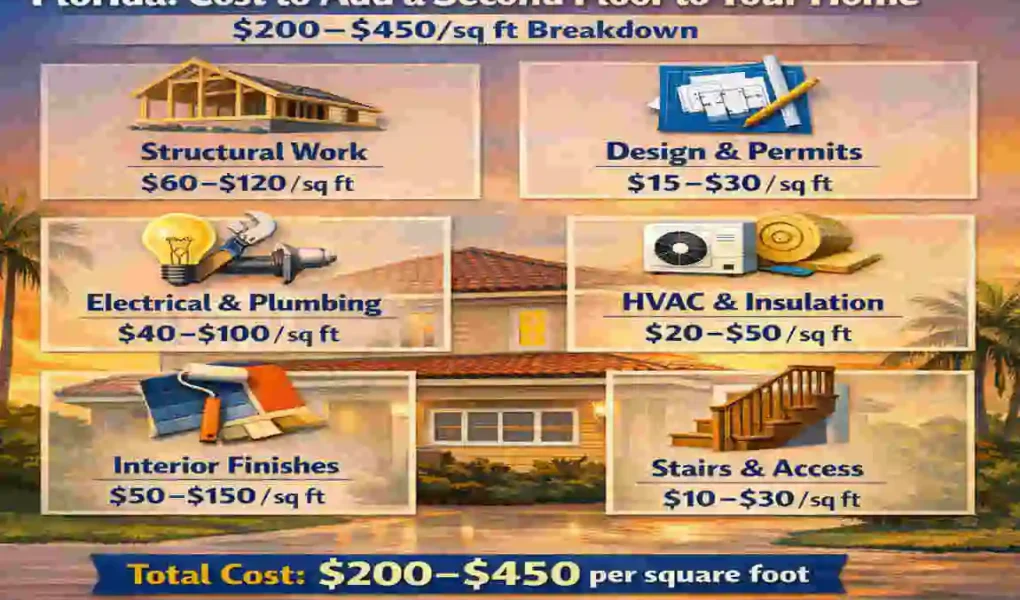
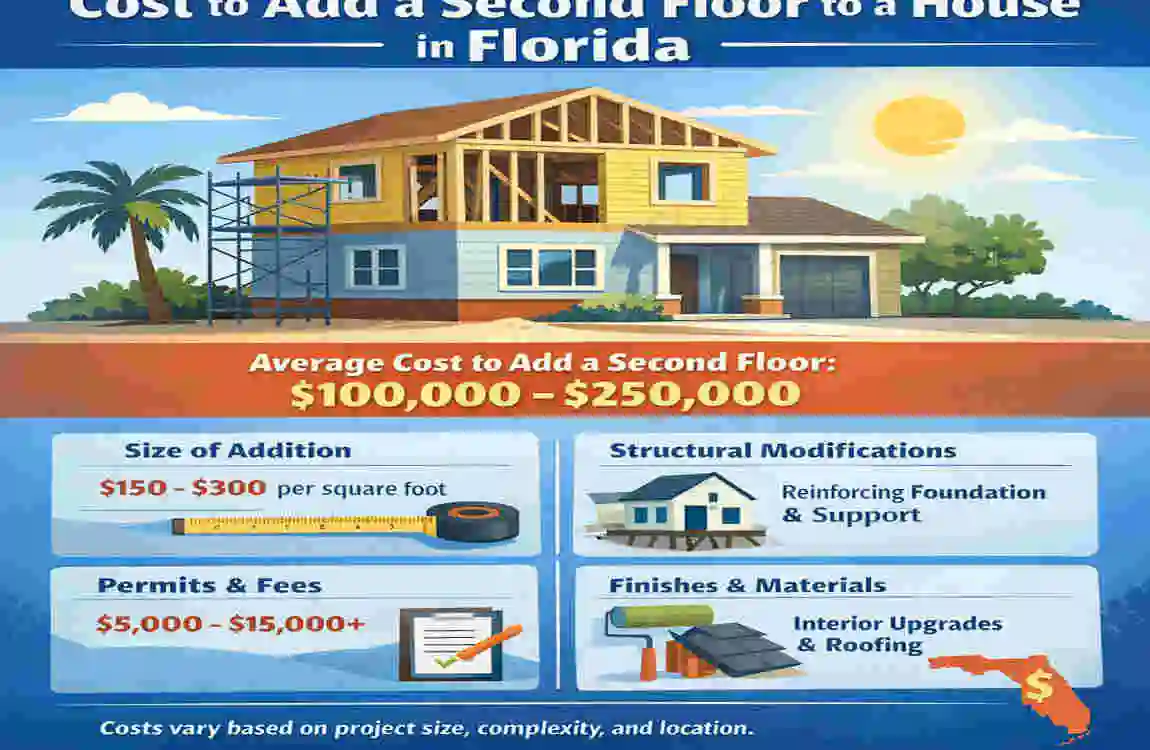
Let us get straight to the point and give you the direct answer. In 2026, the average cost to add a second floor to a Florida house ranges between $200 and $450 per square foot. If you are planning a standard 1,000-square-foot addition, you should expect to spend an average of $300,000 total.
Of course, this Florida second-floor addition cost is not just a random number pulled out of thin air. Your final bill will vary widely depending on your exact location, the structural needs of your current ground floor, and the level of luxury in your interior finishes.
| Component | Cost Range per Sq Ft | Key Factors |
|---|---|---|
| Structural (Foundation, Framing) | $70–$150 | Reinforcement for existing base; wind-load engineering |
| MEP (Electrical, Plumbing, HVAC) | $25–$50 | Code-compliant upgrades for Florida storms |
| Roofing & Exterior | $30–$60 | Impact-rated materials; full re-roofing |
| Interior Finishes | $80–$200+ | Flooring, walls; luxury options add more |
| Soft Costs (Permits, Engineering) | $25–$50 | Local fees vary by county (e.g., Miami higher) |
| Stairs | $15,000–$30,000 fixed | Essential; doesn’t scale with size |
Why Add a Second Floor in Florida?
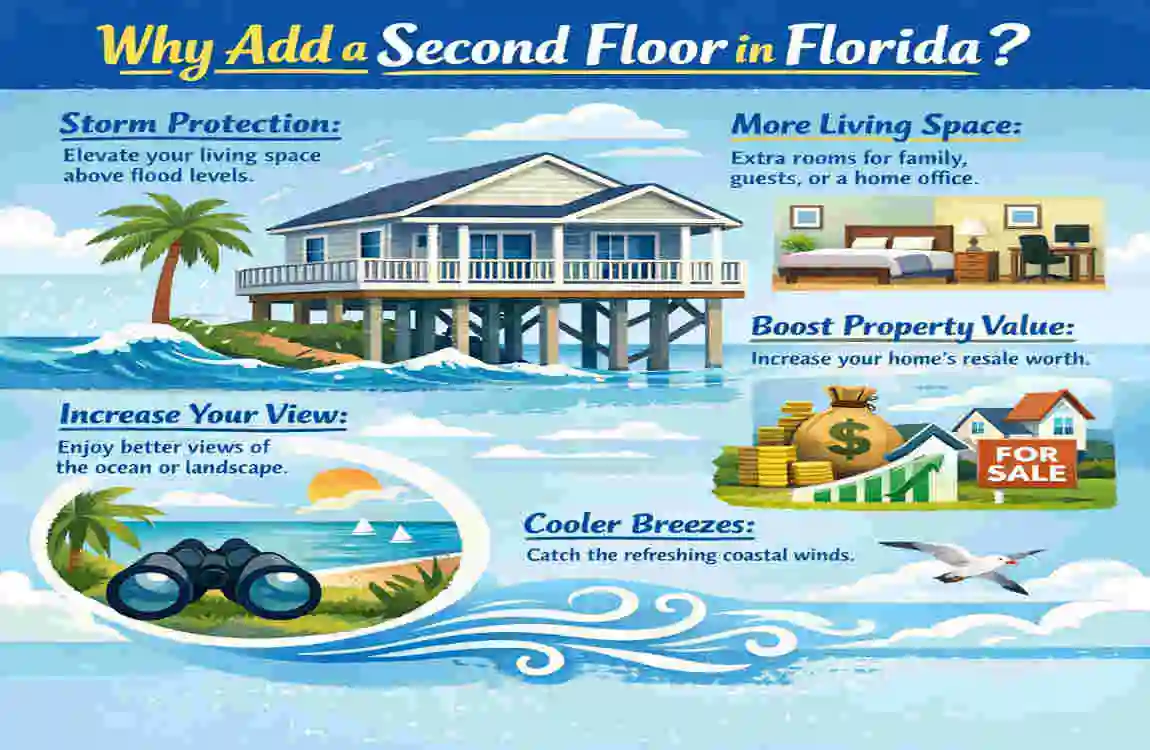
You might be wondering if going through the hassle of a massive renovation is truly worth it. Why not just sell your current home and buy a bigger one? Let us be honest: the Florida real estate market in 2026 is fiercely competitive. Let us explore exactly why adding a second story is becoming the go-to solution for thousands of homeowners across the Sunshine State.
The Reality of Population Growth and Tiny Lots
Florida is experiencing an unprecedented population boom. Families from across the country are flocking to the state for its weather, tax benefits, and lifestyle. Because of this massive influx of people, available land is disappearing fast.
If you live in a highly desirable area, your house likely sits on a relatively tiny lot. Furthermore, strict local zoning laws and setback rules often prevent you from extending your house into your backyard. Adding a ground-floor extension might mean sacrificing your swimming pool or your patio. By choosing to build vertically, you completely bypass these annoying zoning limits and preserve your precious outdoor living space.
Hurricane Codes Favor Vertical Builds
Living in Florida means dealing with extreme weather. The reality of hurricane season is something every homeowner must face. Modern building codes favor vertical builds in many coastal areas.
When you add a second story, your architectural team must bring the entire structure up to the rigorous 2026 wind-load standards. By building up, you elevate your most valuable living spaces—like bedrooms and expensive home offices—far above potential flood zones and storm surges. It is a proactive way to create a hurricane-proof build that keeps your family exceptionally safe.
The Post Remote Work Surge
The way we work has changed forever. Following the massive surge in remote work in 2025, the dining room table no longer cuts it as a home office. Families are expanding, but their professional needs are expanding, too.
Adding a second floor gives you the ultimate blank canvas. You can finally design that soundproof home office, a dedicated playroom for the kids, or a luxurious main suite that feels like a private vacation resort.
To help you weigh your options, take a look at this quick breakdown of the pros and cons of building a second story.
The Pros of Going Up: The Cons of Going Up
Cost Efficiency Doubles your interior space without forcing you to buy expensive new land. Requires high upfront structural work to support the new weight.
Value Add Delivers an incredible 75% ROI in hot real estate markets like Sarasota. Permitting and design delays can easily take 3 to 6 months.
Resilience Forces your home to meet the ultra-strict 2026 wind-load standards. Older homes will likely require expensive foundation upgrades.
Cost Breakdown Per Sq Ft ($200–$450)
Now that you understand the “why,” let us dive deep into the “how much.” When people ask, “How much does it cost to add a floor to a house in Florida?” the answer always comes down to the math. Let us pull back the curtain and look at the real numbers.
As we mentioned, you can expect a range of $200 to $450 per square foot. But why is there such a massive $250 gap? It all comes down to your city, your materials, and the hidden structural work hiding behind your walls.
Average Costs by Florida city
Where you live in Florida plays a massive role in your overall budget. Labor rates, local permit fees, and regional building codes vary dramatically from county to county.
For instance, building a home in the heart of Miami will always cost significantly more than building a similar home in a quiet Orlando suburb. Coastal cities face much stricter hurricane codes, which means your builders must use heavier, more expensive materials.
Take a look at this city-by-city breakdown to see where your hometown lands on the pricing scale.
Florida CityLow-End Estimate ($/sq ft)High-End Estimate ($/sq ft)Example 1,000 sq ft Total Cost
Miami $250 $450 $250,000 – $450,000
Tampa $200 $350 $200,000 – $350,000
Orlando $220 $380 $220,000 – $380,000
Sarasota $230 $400 $230,000 – $400,000
Detailed Per-Sq-Ft Components
You might be looking at that $300,000 average total and wondering where all that money actually goes. To truly answer “how much does it cost to add a floor,” we need to look at the build’s anatomy.
A second-story addition is basically building a brand new house right on top of your existing one. Let us break down the per-square-foot breakdown so you can see exactly how builders allocate your budget.
Construction Component Estimated Cost/Sq Ft% of Total Budget Crucial Florida-Specific Notes
Foundation & Structural $80 – $150 30% – 40% Must reinforce the ground floor for extreme hurricane wind loads.
Framing & New Roofing $50 – $100 20% Requires heavy-duty impact-resistant materials and steel tie-downs.
Plumbing, Electrical & HVAC $40 – $80 15% – 20% Must upgrade the main electrical panel to meet 2026 modern codes.
Finishes (Drywall, Floors) $30 – $70 15% Strongly recommend using moisture-resistant drywall for humidity.
Permits, Architect & GC Fees $25 – $50 10% – 15% Can easily exceed $10,000+ if you live in high-risk coastal zones.
Let us talk about what inflates your cost toward that $450 maximum. If your home sits directly in a coastal flood zone, the engineering required to keep your new roof attached during a Category 5 hurricane is staggering. Furthermore, if you demand luxury finishes—like imported Italian marble in the new main bathroom or a sweeping custom staircase—your costs will skyrocket.
However, you can find brilliant ways to save! For example, if your architect can design the new floor to seamlessly tie into your existing roofline rather than tearing the whole thing off, you can instantly cut your framing and roofing costs by 10% to 15%.
Size-Based Estimates
The size of your addition also changes the math. Because certain fixed costs (like hiring the architect or pulling the main permits) remain the same regardless of size, building a slightly larger addition often lowers your actual per-square-foot rate.
- For an 800 sq ft addition: This is perfect for two extra bedrooms and a shared bathroom. Expect a total range of $160,000 to $360,000.
- For a 1,500 sq ft addition, this effectively doubles the size of a standard home, giving you multiple bedrooms, bathrooms, and a massive loft. Expect a total range of $300,000 to $675,000.
When asking how much it costs to add a floor to a house in Florida, always remember that kitchens and bathrooms are the most expensive rooms to build. If your 800 sq ft addition is just open bedroom space, it will sit on the cheaper end. If it includes two luxury bathrooms with intricate plumbing, expect to pay top dollar.
Key Factors Driving Florida Costs
You cannot compare building a house in Florida to building a house in Ohio. The Sunshine State is unique. The environment, the laws, and the state’s history directly impact every single dollar you spend. Let us break these complex ideas into understandable segments, so you know exactly what is driving the cost of your Florida second-floor addition.
Structural Challenges of Older Homes
Here is a massive reality check for anyone living in an older property. If your home was built before the year 2004, you are facing a steep uphill battle. Why 2004? Because of the devastation caused by previous hurricanes, Florida completely overhauled its building codes.
Roughly 75% of homes built before 2004 were not designed to support the immense weight of a second story under modern wind-load conditions. If you own an older home, you will almost certainly need a full foundation lift or a major structural retrofit. Builders will have to tear open your first-floor walls to install heavy steel columns and reinforce the concrete foundation below.
This structural surgery alone can easily add $100,000 or more to your total bill. Wind-rated engineering is absolutely mandatory in 2026, and the building inspectors will not let you cut corners.
Location and Aggressive Building Codes
Your zip code dictates your rulebook. If you live in Miami-Dade County or Broward County, you are subject to the strictest building codes on the planet.
These southern counties require a Notice of Acceptance (NOA) for nearly every single material used on your home’s exterior. Because the risk of severe hurricanes is so high, you will pay a mandatory 20% Premium for specialized seismic and wind engineering.
Even if you live further north, the difference between living on the coast and living inland is massive. An inland home in Orlando will generally run $50 to $100 cheaper per square foot than a beachfront home in Sarasota, simply because the inland home faces less aggressive wind shear.
Material and Design Choices
Finally, your personal taste drives the budget. A hurricane-proof build does not have to be ugly, but the pretty materials certainly cost more. When you add a floor, you have to buy a brand-new roof and windows.
Take a look at this budget-versus-premium table to see how your choices affect the final price.
Design Choice, Budget Option, Premium Option, The Florida Impact
New Roofing Standard: Asphalt Shingles (approx. $20/sq ft), Standing Seam Metal Roof (approx. $50/sq ft). Metal offers unmatched durability against 150 mph winds and reflects brutal summer heat.
Windows Standard Vinyl Windows (approx. $300 each) High-End Impact Glass Windows (approx. $800 each) Impact glass is a 2026 mandatory upgrade for true hurricane-proof builds, eliminating the need for storm shutters.
Choosing Premium materials increases your upfront cost for a Florida second-floor addition. Still, they offer incredible peace of mind and significantly lower your homeowner’s insurance premiums.
Timeline & Process: What to Expect
Adding a floor is not a weekend DIY project. It is a major construction event that will disrupt your daily life. Setting realistic expectations for the timeline is just as important as setting your budget. Here is a clear, step-by-step look at how the process unfolds.
Design, Engineering, and Permits (2 to 4 Months)
Before a single nail is hammered, you must plan. You will hire an architect and a structural engineer to draw up the blueprints. They must prove to the city that your existing house can hold the new weight. Once the plans are complete, they are submitted to the local permitting office. Depending on your city, getting the green light can take 2 to 4 months. Expect to spend 10% of your total budget during this quiet, administrative phase.
Demolition and Lifting (1 Month)
This is the scary part. The construction crew arrives and literally tears the roof off your house. If you are doing a “partial” second floor, they might only open up half the house. During this phase, they will also dig into your ground floor to install the massive steel support beams that will hold up the new bedrooms. Your house will look like a disaster zone, but this chaotic phase usually lasts only about 4 weeks.
The Rebuild and Finishes (4 to 8 Months)
Once the new floor joists are laid, the new walls go up surprisingly fast. The crew will wrap the house in waterproof barriers and install your new impact windows to “dry in” the home. After the outside is sealed, the slow, meticulous inside work begins. Plumbers run pipes, electricians pull wires, and the drywall is hung. Finally, the painters, floor layers, and trim carpenters bring your vision to life.
The Hidden Cost: Temporary Relocation
Let us speak plainly. You cannot live in a house without a roof. The noise, the dust, and the lack of air conditioning make it impossible.
When calculating how much it costs to add a floor to a house in Florida, you must include temporary living expenses. You will likely need to rent a short-term apartment or stay at an extended-stay hotel for at least 4 to 6 months. Depending on your area, you should budget an extra $5,000 to $15,000 for these vital relocation costs.
Savings Tips & Smart Financing
Seeing a $300,000 price tag can induce sticker shock. However, smart homeowners know how to play the game. You can absolutely control your budget if you make strategic, highly informed choices along the way.
Master the Art of Value Engineering
Value engineering means achieving the same function for less money. Talk to your architect about ways to simplify the design. Do you really need an expensive residential elevator, or will a beautiful wooden staircase work just fine? If you are adding bathrooms, design the floor plan so the new upstairs bathrooms sit directly above the downstairs bathrooms. This allows plumbers to drop pipes straight down into the existing stacks, saving you thousands of dollars in labor. Furthermore, consider phasing your finishes. Leave the new upstairs bonus room as “unfinished space” and lay the flooring yourself next year.
Take Advantage of 2026 Florida Incentives
The state of Florida desperately wants homes to be energy efficient. In 2026, numerous green building rebates are available. If you install ultra-efficient HVAC systems, solar-reflective roofing, or high-grade insulation during your build, you can often claim tax credits and rebates that knock 5% to 10% off the cost of those specific materials.
Choose the Right Loan
Very few people have $300,000 sitting in a checking account. Financing is how you make this dream a reality. Instead of taking out a high-interest personal loan, leverage the massive equity you already have in your home. Home Equity Lines of Credit (HELOCs) generally offer much more favorable rates (around 7% to 9% in 2026) than complex, risky construction loans. Talk to a trusted financial advisor to lock down the lowest possible interest rate before you sign a contract with a builder.
ROI & Real Estate Case Studies
Is this massive headache worth it? Yes! Adding a second story is not just an expense; it is a major investment in your financial future.
The 2026 Comparables
When you add 1,000 square feet to your home, you completely change your property’s real estate “comps.” You move from the category of small starter homes into the category of Premium family estates. In bustling markets like Tampa and Orlando, data from 2026 shows that homes with high-quality second-story additions see an average 25% to 30% increase in total property value the moment the paint dries.
A Mini-Case Study: The Miami Compromise
Let us look at a real-world example. A young family in Miami needed more space but balked at the $400,000 price tag for a full second story. Instead of giving up, they worked with their builder to design a “partial addition.”
Instead of covering the entire ground-floor footprint, they built straight up over the garage only. This brilliant move saved the structural integrity of their main living room, reduced the need for massive foundation lifts, and provided exactly enough space for a massive main suite. By value-engineering the design, this Miami family saved over $40,000 while still getting the exact space they desperately needed.
FAQs: Your Quick Answers
You still have questions, and we have the quick, straightforward answers you need to feel confident moving forward.
How much does it cost to add a floor to a house in Florida? On average, expect to spend between $200 and $450 per square foot. For a standard 1,000-square-foot addition, the average total cost is roughly $300,000, depending on your city and material choices.
Can my current house support a second story? Not without help. Most Florida homes, especially those built before 2004, require significant structural retrofitting, including steel columns and foundation reinforcement, to support the new weight and meet modern hurricane codes.
How long does it take to add a second floor? From the day you hire an architect to the day you move your furniture back in, the entire process usually takes between 7 and 13 months.
Do I have to move out during the construction? Yes. Because the crew must remove your existing roof to build upwards, your home will be exposed to the elements and lack functioning air conditioning. You should budget for a temporary rental for about 4 to 6 months.
Does a second story add value to a Florida home? Absolutely. Adding high-quality, permitted square footage is one of the best ways to boost your home’s equity, often yielding an immediate 20% to 30% increase in your overall property value.