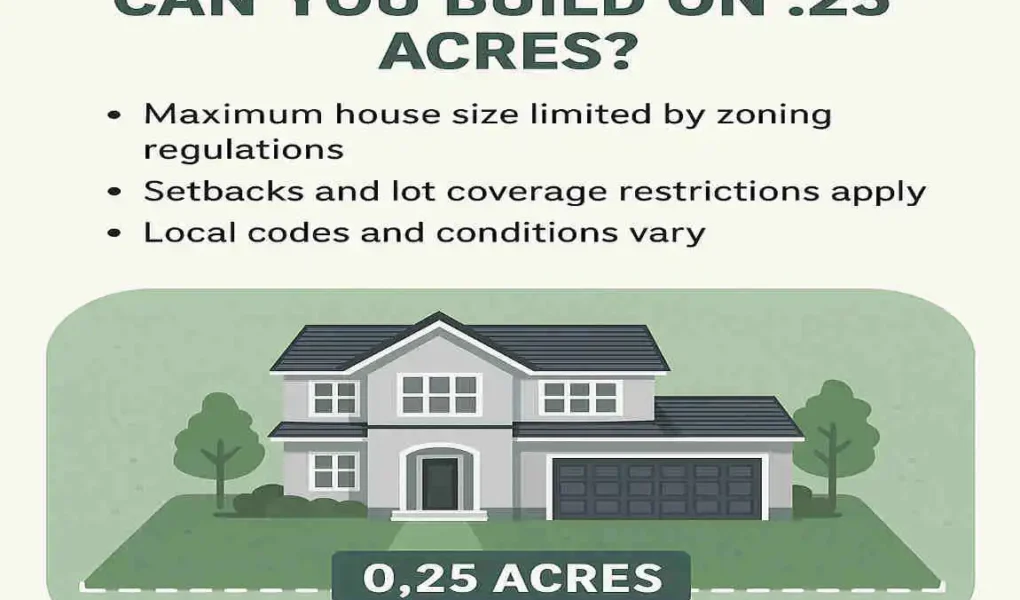
If you’re eyeing a quarter-acre lot and wondering, How big of a house can you build on .25 acres? — You’re in the right place. Building a home on a 0.25-acre lot (about 10,890 square feet) is a popular choice, especially in suburban areas. But the size of your future home depends on several important factors — from local building rules to smart design choices.
Understanding .25 Acres
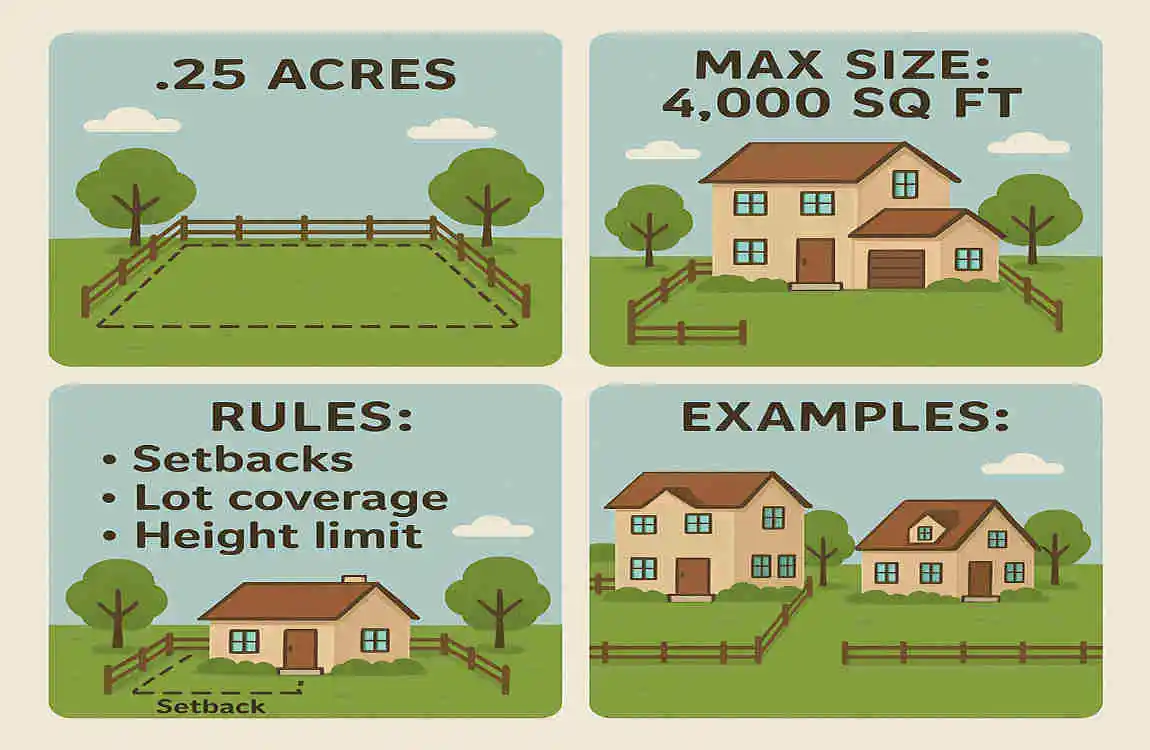
Before we get into house sizes, let’s picture what a quarter-acre really means.
- Size in numbers: One acre equals 43,560 square feet. A quarter-acre, therefore, is 10,890 square feet.
- Visual size: Imagine about three-quarters of a football field (minus the end zones) or a space that can park 4 to 5 average cars comfortably.
- Dimensions: Typical shapes are rectangular, roughly 100 feet by 109 feet.
How Does .25 Acres Compare?
- Urban lots: Smaller city lots might be 0.15 acres or less, often fitting homes around 1,500 square feet.
- Suburban lots: The quarter-acre fits nicely in many suburban neighborhoods.
- Larger lots: Half-acre or more can fit multiple homes or larger single-family homes.
This size offers a sweet spot for many homeowners — enough land for a comfortable home and outdoor space, yet small enough to maintain.
Key Building Rules and Regulations
Building your dream home on a .25-acre lot means you must follow local rules to keep the neighborhood orderly, safe, and beautiful. Here are the main regulations to understand:
Zoning Basics
Zoning laws regulate what you can build and where you can build it. Most urban residential zones require:
- Minimum lot sizes: Usually between 5,000 and 7,000 square feet. So, a 10,890 sq ft lot exceeds these minimums.
- Use restrictions: Some zones specify single-family homes only.
- Setbacks: Required distances from property lines (front, sides, back) to keep space between homes.
Lot Coverage Ratio
This is the percentage of your lot’s surface area that your house (plus other structures like garages and decks) can cover.
- Typical range: 25% to 40% on a .25-acre lot.
- Example: At 30% coverage, your maximum footprint is about 3,267 sq ft (10,890 x 0.3).
- Why it matters: It controls how much of your yard is built on, preserving green space and preventing overcrowding.
Floor Area Ratio (FAR)
FAR determines the total floor space you can build relative to your lot size, across all floors.
- Common FAR: Between 1.5 and 2.0 for residential areas.
- Calculation: For a 10,890 sq ft lot with FAR 2.0, the total floor area allowed is 21,780 sq ft.
- Multi-story advantage: You can build vertically to maximize space while staying within footprint limits.
Setbacks and Height Limits
- Setbacks: Usually 15-20 ft front, 5-10 ft sides, reducing your buildable footprint by 20-30%.
- Height: Often limited to 30-35 ft, allowing 2-3 stories.
Regulation: Typical Limit on .25 Acres: Impact on House Size
Lot Coverage 25-40% (2,722-4,356 sq ft) Limits the house footprint
FAR 1.5-2.0 Limits total floorspace across all levels
Setbacks 15-20 ft front, 5-10 ft sides Shrinks buildable area by up to 30%
Height 30-35 ft (2-3 stories). Allows vertical expansion
Note: Rules vary by location. Suburbs often have stricter limits than rural areas.
Maximum House Sizes Possible
How big can your house actually be on a quarter-acre lot?
Single-Story Homes
- Footprint limit: At 25-35% lot coverage, expect 2,700 to 3,800 sq ft of ground-level living space.
- This is a comfortable size for many families, with room for a garage and outdoor areas.
Multi-Story Homes
- Total size: If your footprint is 2,500 sq ft and you build two floors, you could have up to 5,000 sq ft of living space.
- Considerations: You must stay within height limits and FAR restrictions.
What Shrinks Usable Space?
Some features can reduce your building area, such as:
- Septic systems: May require 10% of your lot.
- Driveways and sidewalks: Take up space and influence setbacks.
- Pools and patios: Reduce yard space, but don’t always count against footprint.
Generally, you can expect 40-60% of your lot’s area to be usable for building.
Real Examples and Case Studies
Nothing beats concrete examples to understand possibilities. Here are some real-life scenarios:
Suburban 3-Bedroom Home
- Size: About 2,200 sq ft on a 10,000 sq ft lot.
- Coverage: Only 22%, leaving plenty of yard space.
- Design: Efficient layout with attached garage.
Custom Bungalow with Garage
- Size: A 5-bedroom home comfortably fits on a quarter-acre lot.
- Features: Garage, deck, and small garden.
High-Density Housing
- Theoretically, you could fit up to 4 homes of 2,500 sq ft each on 1 acre, so one quarter-acre lot usually supports one family home.
- This keeps neighborhoods from feeling crowded.
Design Tips to Maximize Space
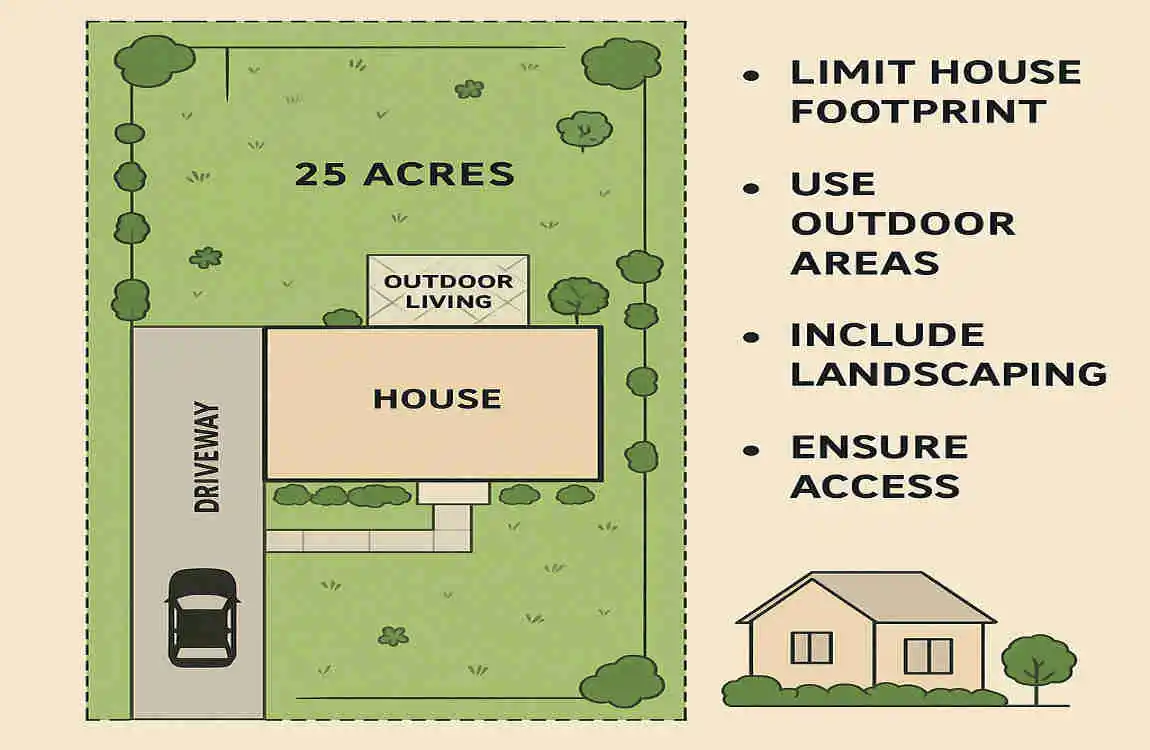
Want to get the most out of your .25-acre lot? Here’s how:
Build Up, Not Out
- Building 2 or 3 stories lets you add space without expanding the footprint.
- Great for keeping yard space while maximizing living area.
Efficient Layouts
- Use open floor plans to make rooms feel larger.
- Attach your garage or carport to save on lot coverage.
- Multi-purpose rooms reduce wasted space.
Consult Professionals
- A custom architect or builder familiar with your local codes can tailor plans perfectly to your lot.
- They can help navigate zoning, setbacks, and design challenges.
Costs and Practical Considerations
Building on a .25-acre lot isn’t just about size — it’s about cost and long-term value.
Construction Costs
- Average build cost ranges from $150 to $300 per square foot.
- For a 4,000 sq ft home, expect $600,000 to $1.2 million.
Permits and Fees
- Don’t overlook zoning permits, impact fees, and possible variance requests.
- These can add 5-10% to your budget.
Resale Value
- Building a home that fits the neighborhood ensures better resale.
- Oversized homes on small lots may face market challenges.