Have you ever looked around your current home and thought, “It would be easier just to knock the whole thing down and start from scratch?” If so, you are definitely not alone. Across the country, we are seeing a massive shift in how people view their aging properties. In fact, statistics show that UK home rebuilds have risen by a staggering 15% in 2025 alone.
A combination of severe housing shortages and a growing desire for modern, energy-efficient living spaces drives this boom. We all want homes that suit our actual lifestyles, rather than trying to force our lives to fit into awkward, outdated layouts.
You may be living in a drafty 1960s property that costs a fortune to heat. The floor plan may be completely mismatched to your family’s needs, or the foundations may be failing. Whatever your reason, the idea of clearing the plot and building a bespoke masterpiece is incredibly appealing. It allows you to stay in the neighborhood you love while upgrading to the home of your dreams.
Naturally, this brings up a very important question. You are likely wondering, ” Can I demolish my house and rebuild in the UK legally, safely, and within a reasonable budget?
The short answer is yes, absolutely! However, the process involves navigating a complex web of local bureaucracy, environmental rules, and construction standards. You cannot simply rent a bulldozer and get to work on a Saturday morning.
| Aspect | Requirements | Exceptions/Notes |
|---|---|---|
| Planning Permission | Full application needed for demolition + rebuild; prior notification for demo only. Submit via local council. | Permitted development rare for houses; not in conservation areas or for listed buildings (needs listed building consent). |
| Building Regulations | Full plans approval for structure, fire safety (Part B), energy (Part L). Post-Grenfell updates apply. | Building notice option for simpler works; net-zero standards in 2026. |
| Demolition Notice | 6 weeks prior notice to council; asbestos survey mandatory for pre-2000 homes. | Included in wider rebuild application; hire licensed contractors. |
| Party Wall Act | Notify neighbors 2 months before work if shared boundaries affected. | Avoids disputes; legal agreement required. |
| Costs & Timeline | £1,500-£2,500/sqm; approval 8-13 weeks; full project 6-12 months. | VAT reclaimable (zero-rated) on new build materials/services. |
| Risks | Fines up to £50,000 or stop orders for non-compliance; neighbor objections common. | Check Planning Portal early; consult RIBA architect. |
UK Planning Permission Rules
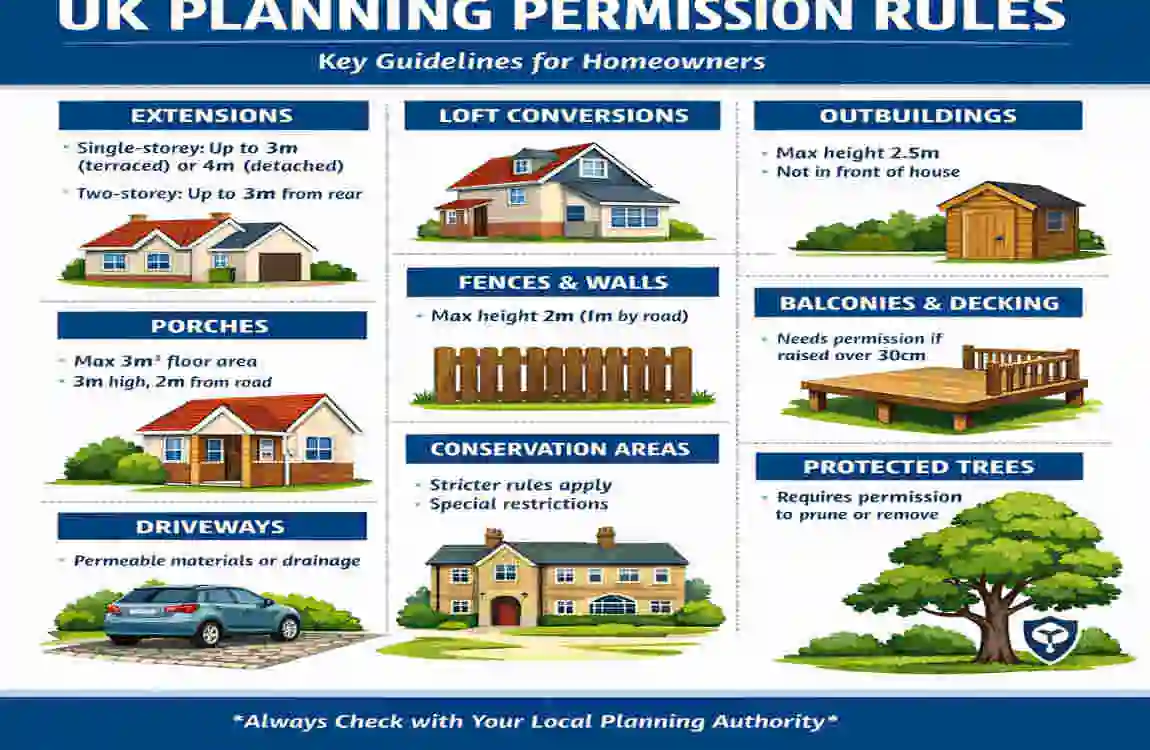
Before you even think about swinging a sledgehammer, you need to deal with the paperwork. The UK has very strict rules about what you can and cannot do to the buildings on your land. Navigating the local planning department is your very first hurdle, and it pays to be prepared.
When Do You Need Full Planning Permission?
If you want to knock down a complete residential dwelling, you almost always need to secure full planning permission from your local council. This surprises many homeowners. They assume that because they own the land and the house, they can do whatever they want with it.
Unfortunately, the law does not see it that way. While you might be able to tear down a small shed or a dilapidated detached garage without a mountain of paperwork, a primary residence is a completely different story. The council needs to ensure that your new proposed home fits the character of the street, does not block your neighbors’ sunlight, and meets local housing targets.
The Permitted Development Rights Exception
Now, there is a small silver lining called Permitted Development (PD) rights. These are essentially pre-approved permissions granted by Parliament that allow you to make certain changes without applying for full planning permission.
However, when it comes to demolition and rebuilding, PD rights are incredibly narrow. They generally only apply to very small-scale rebuilds or the demolition of minor outbuildings. Even if your project technically falls under Permitted Development, you still have to apply to the council for Prior Approval. This means you must formally notify them of your exact plans before you start, giving them a chance to assess the impact of the demolition on the local area.
Navigating Local Authority and Green Belt Restrictions
Your location plays a massive role in what you are allowed to do. Every local authority has its own unique set of rules and development plans. What gets approved in a modern suburb of Manchester might get immediately rejected in a historic village in Cornwall.
If your property sits within a Conservation Area, an Area of Outstanding Natural Beauty (AONB), or a National Park, the rules become significantly tighter. In these protected zones, councils are fiercely protective of the local aesthetic. You will face heavy scrutiny regarding the design and materials of your new build.
Similarly, if your house is located in the Green Belt, replacing it is notoriously difficult. The general rule in the Green Belt is that any replacement dwelling must not be materially larger than the one it replaces. If you want to knock down a tiny cottage and build a sprawling mansion on Green Belt land, your application will almost certainly be denied.
To start your research, you should always visit the official government Planning Portal. It is an incredibly useful, free online tool that helps you check the specific restrictions applied to your postcode and guides you through the application process step by step.
Building Regulations Compliance
Securing planning permission gives you the legal right to build a house on the plot. Building Regulations are entirely different. These regulations dictate exactly how that house must be built to ensure it is safe, highly efficient, and structurally sound.
Energy Efficiency and Part L Updates
The UK government is pushing hard toward a greener future, and home construction is at the forefront of this movement. The section of the building regulations that deals with the conservation of fuel and power is known as Part L.
In recent years, Part L has been drastically updated. If you are rebuilding a house today, you must adhere to incredibly strict insulation standards. You cannot simply build a house the way they did in the 1990s. Your new home must minimize heat loss, which means using high-performance windows, thicker wall insulation, and efficient heating systems. Many self-builders are now incorporating low-carbon technologies, such as air-source heat pumps and solar panels, to meet these rigorous demands.
Structural Integrity and Fire Safety Post-Grenfell
Safety is paramount. Part A of the building regulations covers structural safety, ensuring your new home can withstand heavy winds, heavy snowfall, and the sheer weight of its own roof. You will need a qualified structural engineer to calculate the precise load-bearing capacities of your foundations and walls.
Equally critical is Part B, which covers fire safety. Following the tragic events at Grenfell Tower, the government completely overhauled fire safety regulations across the entire construction industry. Your new build must utilize approved, fire-resistant materials, incorporate safe escape routes, and feature hard-wired smoke alarms. There is absolutely zero room for compromise here.
Full Plans Submission vs. Building Notice
To prove you are following these rules, you have two options when applying for building control approval.
You can use a Building Notice, which is generally a quicker process for smaller alterations. However, for a complete house rebuild, you must use the Full Plans submission route. This means your architect submits incredibly detailed, highly technical drawings of your proposed home to a building inspector before work begins. The inspector checks every single measurement and material choice against the rulebook.
Net-Zero Mandate
Looking ahead, the rules are only getting tighter. By 2026, the government will mandate new net-zero standards for all new home rebuilds. This means your new property must produce significantly fewer carbon emissions than older homes. Failing to comply with these rules is not an option.
To give you a clear picture of what is at stake, take a look at this table comparing the requirements and the severe penalties for ignoring them:
Building Requirement Description of the Rule Penalty for Non-Compliance
Part L (Energy) Mandatory thick insulation and low-carbon heating tech. Heavy fines up to £50,000.
Part B (Fire): Strict use of fire-resistant building materials and safe exits—immediate stop-work orders.
Part A (Structure): Engineer-approved foundations and load-bearing walls—forced demolition of unsafe work.
Demolition Process Explained
Once you have your planning permission approved and your building regulations signed off, the fun part actually begins. But bringing a house down safely requires military-level precision and planning. Let us walk through the physical act of clearing your plot.
Preparing for the Wrecking Ball
You cannot simply wake up one morning and start smashing walls. Legally, you must notify your local council at least six weeks (often two months) before any demolition work begins. The council will then issue a “demolition notice” outlining exactly how you must manage the site, restrict noise, and protect adjacent properties.
You also need to contact all your utility providers to safely cap off the gas, electricity, and water supplies at the street level. Hitting a live gas main with a digger is a disaster you want to avoid at all costs.
The Reality of Asbestos
If the house you are tearing down was built or renovated before the year 2000, there is a very high chance it contains asbestos. This highly toxic material was used in everything from floor tiles and ceiling textures to roof panels and pipe insulation.
Before a single brick is removed, you must hire a specialized surveyor to conduct a mandatory asbestos survey. If they find asbestos, you are legally required to hire licensed, highly trained contractors to safely remove and dispose of it before the main demolition crew can even set foot on the site. You cannot cut corners here; ignoring asbestos laws can lead to criminal prosecution.
Clearing the Site
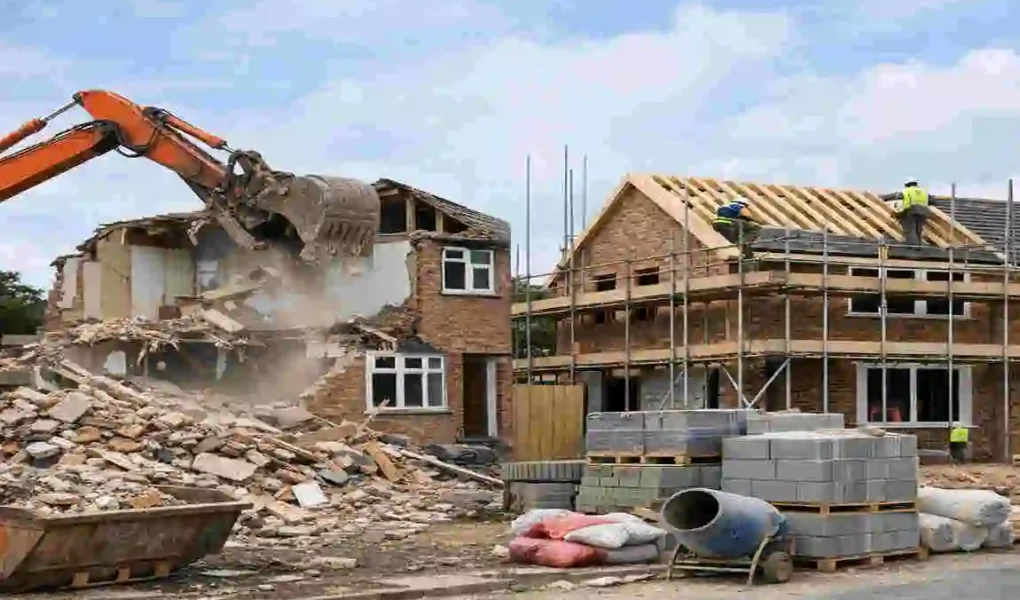
The actual demolition usually happens in two distinct phases. First is the “soft strip.” Workers go through the house by hand, removing doors, windows, kitchen cabinets, skirting boards, and copper pipes. Much of this material can be recycled or sold to reclamation yards.
Once the house is stripped back to its bare brick shell, the heavy machinery arrives. Using excavators, the crew will bring the walls and roof down in a controlled, safe manner. Finally, they will dig up the old concrete foundations, leaving you with a clean, flat patch of dirt.
You must manage all this waste legally. Under strict Environment Agency rules, your contractor must provide a clear paper trail showing exactly where the rubble was taken.
The Pros and Cons of Demolition
Before you commit, it helps to weigh the reality of the demolition phase:
- Pros:
- It clears the site incredibly quickly, giving you a perfect blank canvas.
- You avoid the hidden structural surprises that often ruin renovation projects.
- New builds are currently VAT-exempt in the UK, saving you 20% on construction costs!
- Cons:
- It generates a massive amount of dust and dirt.
- Heavy machinery will cause significant noise complaints if not managed properly.
- It frequently triggers fierce disputes with neighbors who hate the disruption.
Design and Rebuild Stages
Your plot is clear, the old house is a memory, and it is time to build the future. This is the most exciting, yet most exhausting, part of the journey. A complete house rebuild typically takes anywhere from 6 to 12 months, depending on the complexity of your design and the reliability of your contractors.
Drafting Your Dream with an Architect
The success of your entire project rests on your architect’s shoulders. You should hire a professional registered with the Royal Institute of British Architects (RIBA). They will take your rough ideas and turn them into practical, beautiful, and legally compliant blueprints.
During this design phase, which usually takes two to three months, you will make a thousand decisions. You will choose the layout of your kitchen, the direction your windows face to catch the morning sun, and the exact type of bricks you want to use. We highly recommend that you ask your architect to follow the PAS 2030 standards. This is a recognized framework that guarantees your home is built to the highest possible energy-efficiency levels, slashing your future heating bills.
Laying the Groundwork
When construction officially starts, the first step is the groundworks. Surveyors mark out the exact footprint of your new home. Excavators dig deep trenches, which are then filled with tons of reinforced concrete to create your new foundations. This phase is entirely dependent on the weather. A wet, rainy month can drastically delay your foundation pour. Once the concrete cures, the new drainage pipes and utility lines are installed in the ground.
Erecting the Frame and Fit-Out
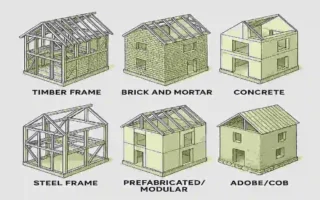
With the foundations set, your house will suddenly shoot up out of the ground. Bricklayers will build the exterior walls, or if you are using a modern method, a timber frame will be erected in a matter of days. Next, the roof trusses go on, and the roof tiles are laid. Once the windows and doors are fitted, the house is officially “watertight.”
Then, the internal fit-out begins. Plumbers and electricians run miles of pipes and wires through your empty walls. Plasterers smooth the walls, carpenters hang the doors, and finally, your beautiful new kitchen and bathrooms are installed.
A Realistic Budget Breakdown
To help you understand the flow of the project, here is a typical timeline and budget breakdown for an average three-bedroom rebuild:
Construction Stage Average Duration Avg Cost (3-bed house)
Design & Planning 2-3 months £10,000 – £20,000
Demolition & Groundworks 1-2 months £15,000 – £30,000
Main Build & Fit-Out 6-9 months £200,000 – £400,000
Cost Analysis and Financing
Let us talk about money. Tearing down a house and building a new one is a massive financial commitment. You need a rock-solid budget, and you must prepare for surprises.
Breaking Down the Price per Square Meter
In the UK construction industry, costs are almost always calculated by the square meter (sqm). In 2026, due to rising material costs and labor shortages, you should budget between £1,500 and £2,500 per square meter for a good-quality, standard home.
If you want luxury finishes—like imported Italian marble floors, smart-home automation systems, or a complex basement level—that number can easily jump to £3,000 or even £4,000 per square meter.
Furthermore, you must always include a 20% contingency fund. Building a house is unpredictable. You might hit solid rock when digging the foundations, or the price of timber might suddenly spike. Your contingency fund is your safety net; if you do not have one, a single surprise can halt your entire project.
Factors That Will Inflate Your Bill
Where you live heavily dictates what you will pay. If your plot is located in London or the surrounding Home Counties, your labor costs will be approximately 30% higher than if you were building the same house in the North of England or Wales.
The materials you choose also swing the budget wildly. A standard brick-and-block construction is predictable and cost-effective. However, if you decide to use vast expanses of structural glass, bespoke steel framing, or rare eco-friendly cladding, your costs will skyrocket.
Funding Your Rebuild Project
Unless you have a quarter of a million pounds sitting in a savings account, you will need to borrow money to fund your rebuild. Standard high-street mortgages cannot be used for this type of project.
Instead, you need a specialized self-build mortgage. Unlike a standard mortgage that gives you a lump sum on moving day, a self-build mortgage releases funds in stages. The bank will give you money to buy the land, then release more when the foundations are poured and more when the roof goes on.
If you already own the existing house outright but need cash to tear it down, you might consider a bridging loan. This is a short-term, high-interest loan designed to bridge the gap until the new house is finished and you can secure a normal mortgage against its new, higher value.
The Return on Investment (ROI)
While the costs are high, the financial rewards are often spectacular. Rebuilding a poorly designed, failing house into a highly efficient, modern masterpiece can boost the overall value of your plot by 20% to 50%. You are creating massive equity by forcing the land to reach its full potential.
Risks and Legal Pitfalls
Please succeed, which means we have to warn you about the dangers. Many enthusiastic self-builders rush into demolition without ticking every legal box, leading to catastrophic delays and massive fines.
The Party Wall Act Explained
If you live in a semi-detached or terraced house, or if you are building very close to your property boundary, you must comply with the Party Wall Act 1996. This law exists to protect your neighbors’ homes from damage caused by your building work.
You must formally notify your adjoining neighbors in writing at least two months before starting any demolition or structural work on a shared wall. If they dispute your plans, you must hire an independent Party Wall Surveyor to draw up a legal agreement before you can touch a single brick. Ignoring this act can lead to your neighbor taking out a court injunction that stops your building site dead in its tracks.
Tree Preservation Orders and Nature
Do not assume you can chop down that annoying oak tree in your front garden to make room for a bigger driveway. Local councils use Tree Preservation Orders (TPOs) to protect specific trees or woodlands. If you cut down or damage a tree with a TPO without explicit council permission, you can face an unlimited fine and a criminal record.
You also need to survey your plot for protected wildlife. If your old roof is home to roosting bats, or if there are badgers on your land, you must halt work and hire ecologists to relocate them safely. You cannot simply demolish their habitat.
Learning from Past Mistakes
To highlight how serious this is, consider a recent case study in Surrey. A homeowner decided to demolish a beautiful, historic 1920s property before their final planning permission was approved. They assumed the council would wave it through retrospectively.
The council was furious. They ordered the homeowner to halt all work, issued a massive financial penalty for unpermitted demolition, and demanded that the new house be built to replicate the exact 1920s design they had just destroyed.
How to Mitigate Your Risks: The absolute best way to protect yourself is to surround yourself with professionals. Hire certified RIBA architects, engage a specialized planning consultant to handle the council, and use a dedicated construction solicitor to review all your contracts.
Case Studies: Success Stories
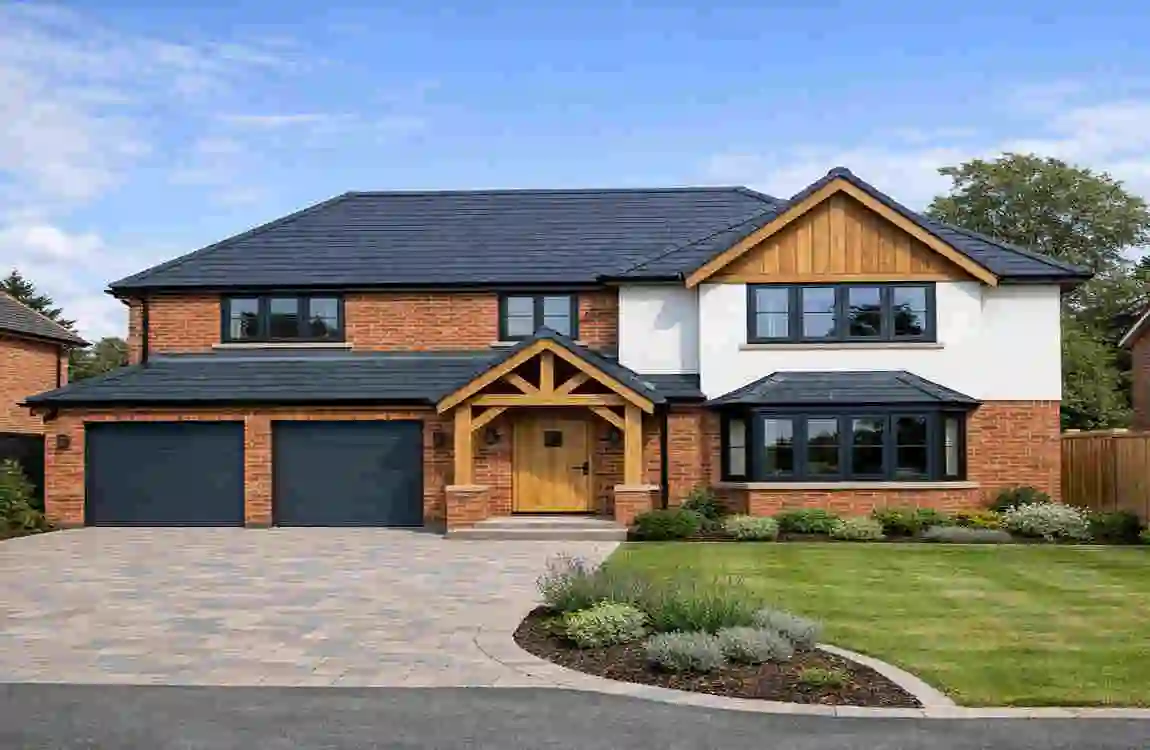
Reading about rules and regulations can feel overwhelming, so let us look at some real-world inspiration. When done correctly, rebuilding your home is a truly life-changing experience.
The Kent Eco-Home Transformation
Take the story of a young couple living in a damp, poorly insulated 1950s bungalow in rural Kent. Their heating bills were astronomical, and the house suffered from severe structural dampness. They initially considered renovating, but realized they would be throwing money into a sinking ship.
They made the bold decision to demolish. Working closely with an architect who specialized in sustainable design, they cleared the plot and built a stunning, two-story eco-home. They used a highly insulated timber frame, installed a ground-source heat pump, and covered the south-facing roof with solar panels.
Not only did they gain an extra bedroom and a beautiful open-plan living space, but their energy bills dropped by 80%. Because they secured a strong structural survey early in the process, they avoided costly surprises in the ground, saving nearly 10% on their overall budget.
The Manchester Multi-Generational Teardown
In the bustling suburbs of Manchester, a family faced a different problem. They needed to move elderly parents into their home to provide daily care, but their standard 1970s semi-detached house was far too small.
Instead of trying to bolt an awkward extension onto an aging house, they applied for permission to demolish the entire property. They worked with their neighbors through the Party Wall Act, ensuring everyone was comfortable with the plans.
They rebuilt the home with a slightly larger footprint, dedicating the entire ground floor to an accessible, self-contained annex for their parents. At the same time, the younger family lived comfortably upstairs. By starting from scratch, they created a perfectly tailored multi-generational home that a simple renovation could never have achieved.
These stories highlight a crucial lesson: taking the time to conduct early surveys, engaging with your neighbors respectfully, and hiring excellent professionals leads to spectacular results.
Frequently Asked Questions (FAQs)
As you plan your project, you likely have some rapid-fire questions. Here are the clear, concise answers to the most common queries we hear from UK homeowners.
Can I demolish my house without any permission? Very rarely. While some minor outbuildings fall under permitted development, demolishing a primary residential dwelling requires you to formally notify the local council and, in almost all cases, secure full planning permission for the replacement house before you start tearing things down.
What is the average timeline for planning approval? Once you submit a complete planning application to your local authority, they are legally supposed to give you a decision within 8 weeks. However, for complex residential rebuilds or applications in conservation areas, this process frequently stretches to 13 weeks or longer.
How much does asbestos removal actually cost? The cost depends heavily on how much asbestos is found in the old property. For a standard UK home, a comprehensive survey and safe, licensed removal usually costs between £5,000 and £15,000. Do not skip this; it is a legal and health necessity.
Do I have to pay VAT on a new house rebuild? One of the biggest financial benefits of a total rebuild is that the construction of a completely new dwelling is currently VAT-zero rated. This means you do not pay the standard 20% VAT on the construction labor and building materials, saving you tens of thousands of pounds compared to a standard home extension.