
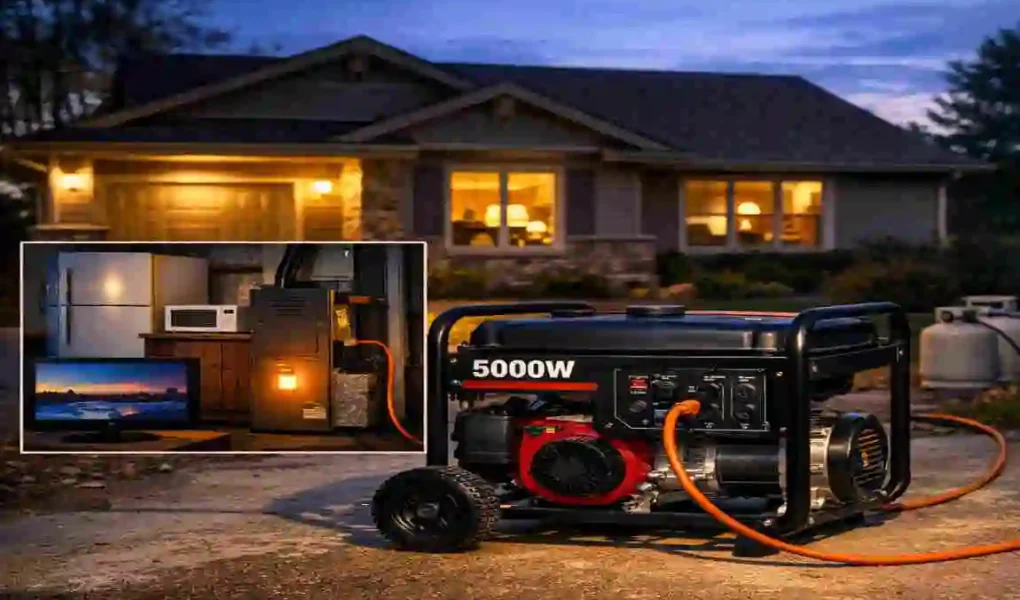
It is a stormy evening in 2026, and suddenly, the lights flicker and die. The neighborhood goes completely dark. Your refrigerator stops humming, the Wi-Fi drops, and your home quickly starts to feel uncomfortable. As power outages become more frequent across the globe, you might be looking into backup power solutions. If you are currently shopping for a portable power station, you are probably asking one major question: Can a 5000W generator run a luxury house?
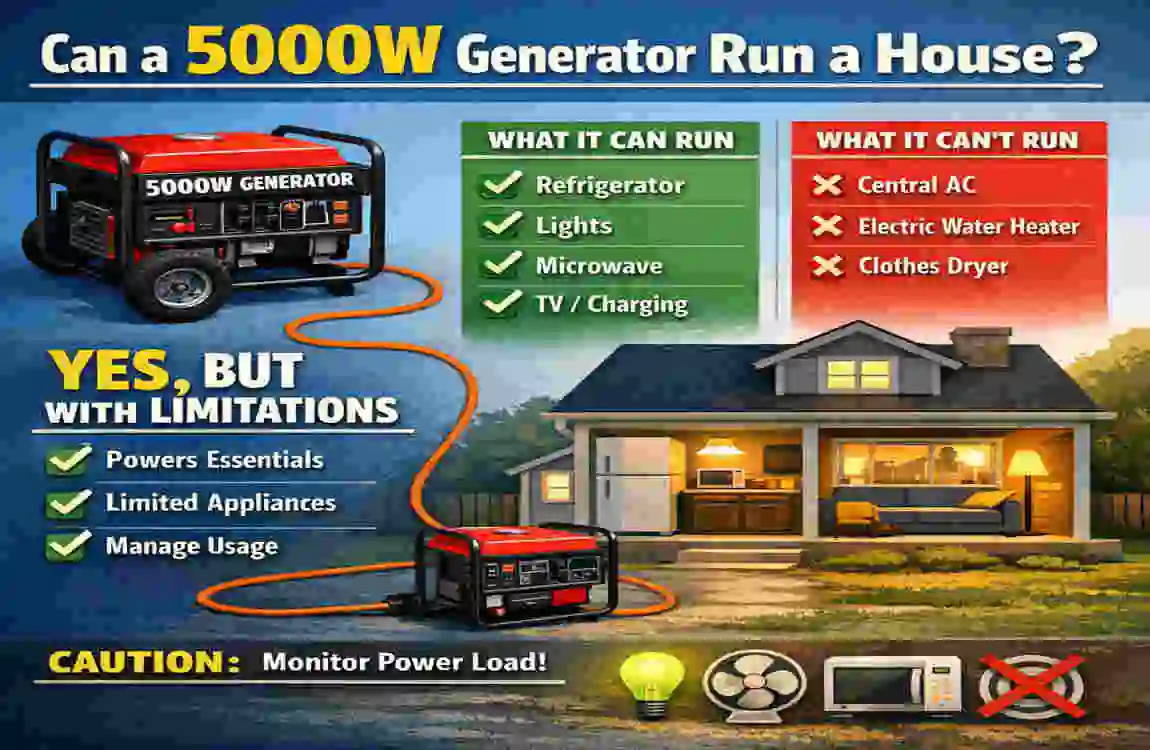
The short answer is yes, but with a few conditions. A 5000-watt generator can absolutely keep your household running, provided you understand the difference between powering your essential items and trying to power every single thing you own. To make this work, you need to understand the difference between “running watts” and “surge watts.” Typically, a 5000W generator provides 5000 watts of continuous running power, but it can handle a temporary surge of 6000 to 7000 watts when large motors start.
Understanding 5000W Generator Specs
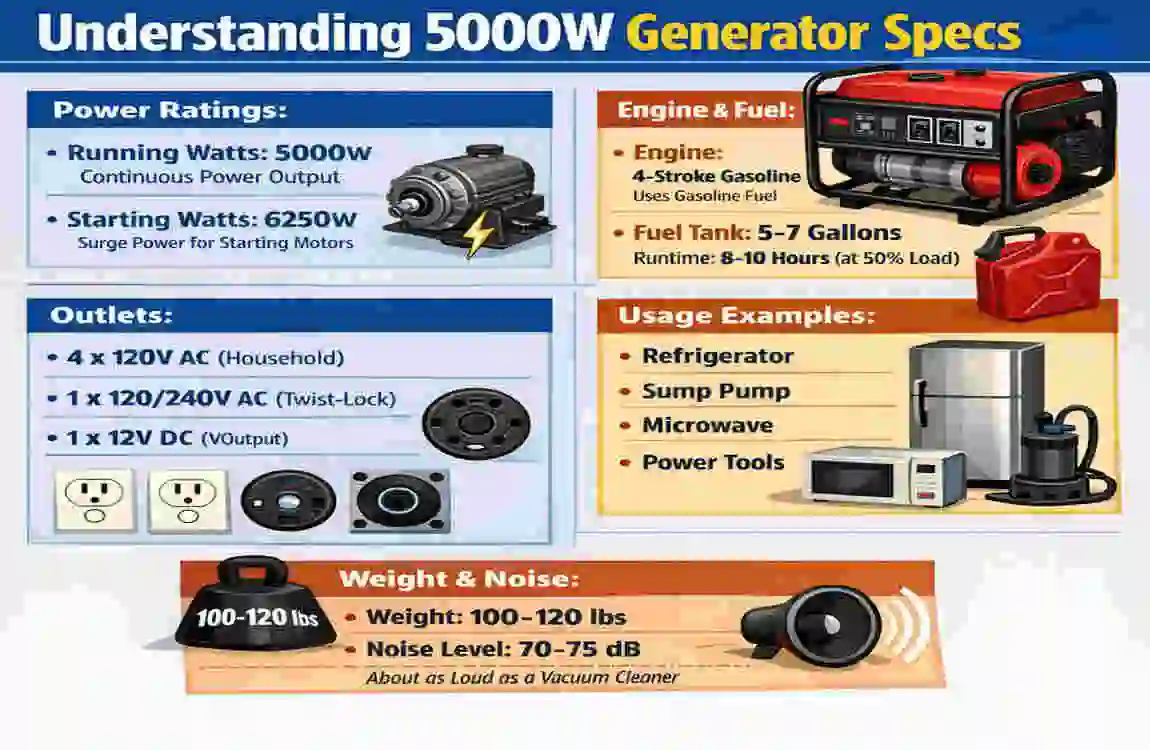
Before you purchase a generator, you need to know exactly what the numbers on the box mean. Let us break down the technical jargon into everyday language so you can make an informed decision.
When you see a machine labeled as a “5000W generator,” the manufacturer is usually referring to its rated or continuous power. This means the machine can comfortably supply 4000 to 5000 watts of electricity all day long without overheating. However, it also features a surge capacity (or starting watts). When an appliance with a motor—like your refrigerator or a window air conditioner—first clicks on, it needs a massive, split-second gulp of power to get moving. A good 5000W generator will briefly provide 6000 to 7000 watts to accommodate this sudden spike.
Conventional Versus Inverter Models
You will generally choose between two types of technology. Conventional generators are traditional, heavy-duty machines that run on gas or liquid propane. They are powerful and budget-friendly but can be quite loud. On the other hand, inverter generators take that raw power and refine it into clean, stable electricity. Inverters are significantly quieter, much more fuel-efficient, and perfectly safe for sensitive electronics like your laptop or television.
Take a look at this breakdown of standard specifications to see how they apply directly to your home:
SpecTypical 5000W GeneratorHome Relevance
Running Watts: 4000-5000W. Comfortably runs essentials like your fridge, lights, and fans.
Starting Watts: 6000-7000W. Easily handles the heavy startup surges from air conditioners.
Runtime (Half Load) 8-12 hours. Provides reliable overnight backup without needing a refill.
Outlets : 120V/240V, 15-30A.. Matches standard house plugs and transfer switches.
Understanding Electrical Output
Let us talk about the actual electrical current. A standard 5000W generator provides roughly 41 amps of power when running on a standard 120-volt circuit. To put that into perspective, most standard wall outlets in your home run on 15-amp or 20-amp breakers. This means your new generator has more than enough electrical muscle to power multiple household circuits simultaneously, provided you make safe connections.
Average Household Power Needs
To truly answer the question, ” Can a 5000W generator run a house, we need to look at how much power your family actually consumes daily.
Whether you live in the United States or elsewhere, the average modern home consumes 10 to 30 kilowatt-hours (kWh) of electricity every day. However, you do not use that power all at once. During the quiet hours of the morning or late at night, your house is likely just “sipping” electricity—maybe 500 to 1000 watts to run the refrigerator, a few standby electronics, and your internet router.
The Difference Between Essentials and Luxuries
Your power usage only spikes to 5000 watts or higher when you start turning on heavy-duty appliances. There is a massive difference between essential Survival items and modern luxuries. For instance, keeping your food safe is essential; a modern refrigerator only needs about 700 watts to run. Keeping your family out of the dark is essential; a few LED lights consume a tiny 200 watts.
Conversely, tossing a load of jeans into your electric clothes dryer is a luxury during a blackout. An electric dryer can easily demand 5000 watts all by itself, instantly maxing out your generator.
The secret to making a 5000W generator work for your whole house is simple load management. You cannot run everything at the same time. If you want to use the microwave to heat dinner, you might need to turn off the space heater for ten minutes. By treating your electricity like a budget, a 5000-watt machine offers plenty of power.
What Can It Power? Essential Appliances
Let us get highly specific. When the grid fails, what exactly can you plug in? You will be thrilled to know that a 5000W generator is a powerhouse for covering your absolute basics.
Yes, it will easily handle your primary kitchen appliances. It will run your refrigerator and a separate deep freezer simultaneously (using roughly 1200 watts total). It will effortlessly power the lights in your main living areas, keep your television on for the evening news, and run your Wi-Fi router so you can stay connected (using about 500 watts total). Do you need water? If you live in a rural area, a 5000W generator has enough starting power to kick on a standard 1/2-horsepower well pump (roughly 1000 watts running).
Your Reliable Power Checklist
Here is a quick look at the everyday household items you can safely run at the same time on a 5000W home backup system:
- Standard Refrigerator: 700W running (Requires about 2000W to start).
- Window Air Conditioner (10,000 BTU): 1200W running (Requires about 1800W to start).
- Sump Pump: 800W running (Crucial for preventing basement floods during stormy blackouts).
- Microwave Oven: 1000W running (Used in short bursts).
- Entertainment and Lighting: 400W running (LED bulbs, laptop chargers, and a TV).
Imagine running all of these items at once. Your total running load is roughly 4100 watts. Even if your air conditioner cycles on and demands a temporary surge of power, your 5000W generator (with its 6000W surge capacity) can easily handle it.
The Importance of a Transfer Switch
To make this seamless, we highly recommend prioritizing your essential circuits through a manual transfer switch. Instead of running dozens of messy extension cords through your living room windows, a transfer switch connects the generator directly to your home’s main electrical panel. You flip a switch to power your kitchen, living room, and well pump, instantly transforming your house into a functional oasis during a blackout.
Limitations: What It Can’t Run Fully
While we love the versatility of a 5000-watt machine, we must be completely honest about its limitations. You cannot live exactly as you would on a normal Tuesday when running on a mid-sized portable generator.
The biggest boundary you will face is heat-generating appliances. Anything that uses electricity to create massive amounts of heat—or cool an entire house—is going to drain your power budget instantly. You must say a firm “no” to running a central air conditioning unit. Even a modest central AC system requires 3000 to 5000 watts just to run, and its startup surge will immediately trip your generator’s internal breaker.
You must also skip the electric water heater. A standard electric tank demands 4500 watts of continuous power. If you try to take a hot shower while your refrigerator is running, your generator will stall out and shut down to protect itself.
The “No-Go” Appliance List
Here is a helpful table of high-draw household items that you should avoid plugging into a 5000W home backup system:
Appliance Running Watts: Why Not?
Central Air Conditioning 3000-5000W. The massive surge in startups will instantly overload the generator.
Electric Oven/Stove 2000-5000W Exceeds your continuous power budget; use a camp stove instead.
Electric Clothes Dryer 4000-5000W leaves zero room for essential items like your fridge or lights.
Whole-House Simultaneous Use 10,000W+ Requires a permanent 7000W+ or 10kW+ standby generator.
You will also need to be careful during peak dinner hours. If your family tries to use a toaster, a coffee maker, and a hairdryer all at the same time, you will easily exceed 5000 watts. If you own a massive, 4,000-square-foot home and need to run your central AC during a summer blackout, you will need to advise your electrician to upgrade to a larger standby unit.
Calculating Your Home’s Power Load
Do you want to know for sure if this machine fits your specific lifestyle? You need to perform a quick power load calculation. Do not worry; you do not need to be an electrician to do this math.
Here is a highly effective, step-by-step method to calculate your home’s power load.
List Your Non-Negotiables
Grab a piece of paper and write down the appliances you absolutely refuse to live without during a blackout. For most people, this includes the kitchen fridge, a few bedroom lights, the internet router, a fan, and maybe a chest freezer.
Find the Wattage
Look at the manufacturer’s sticker on the back or bottom of these appliances. Write down the “Running Watts” for each item. Next to that, write down the “Starting Watts” (or surge watts). If the sticker only lists starting watts for items with motors like your fridge, write that down.
Do the Math
Add up all the Running Watts for the items you plan to run simultaneously. Then, take the single highest Starting Watt number from your list (usually the refrigerator or window AC) and add it to your running total. We also recommend adding a 20% surge buffer just to be safe.
The Golden Formula: Total Running Watts + Single Highest Surge + 20% Buffer ≤ 5000W.
Let us look at a real-world scenario. You have a medium-sized home. Your fridge uses 700W, your lights use 200W, your TV uses 100W, and your deep freezer uses 500W. Your total running load is 1500W. Your fridge has the highest startup surge at an extra 1300W. Your absolute peak demand is 2800 watts. Even with a generous safety buffer, you are sitting at roughly 3800W.
Congratulations! By actively managing your loads, a 5000W generator will easily and safely run your home.
Installation and Safety for Home Backup
Powering your home with a portable machine is incredibly empowering, but it also demands a deep respect for safety. Electricity and combustible fuels are not to be taken lightly. Let us walk through the safest ways to install and operate your new system.
Choosing Your Transfer Switch
As mentioned earlier, a transfer switch is your best friend. Think of it as a dedicated traffic cop for your electricity. You have two choices: manual or automatic. An automatic switch detects a power outage and instantly fires up a permanent standby generator. For a portable 5000W machine, you will install a manual transfer switch. When the grid goes down, you roll your generator outside, plug a single heavy-duty cord into the side of your house, and manually flip the switches on your panel to power your chosen circuits. This eliminates the dangerous mess of indoor extension cords.
The Silent Killer: Carbon Monoxide
We cannot stress this enough: never, ever run a gas-powered generator indoors. Do not run it in your living room, basement, or attached garage with the door open.
Combustion engines produce carbon monoxide (CO), an invisible, odorless gas that can be deadly within minutes. Always place your generator at least 20 feet away from your house. Ensure the exhaust pipe points away from any open windows, doors, or fresh-air intake vents.
Grounding and Legal Requirements
To protect your expensive appliances from electrical shorts, your generator needs to be properly grounded. Many modern inverter models have grounding mechanisms built into their design, but traditional units may require you to drive a copper grounding rod into the earth. Always read your user manual.
Finally, do not forget the legal side of things. Depending on where you live—whether you are pulling permits for an electrical upgrade in the United States or navigating urban housing regulations in cities like Karachi or Lahore, Pakistan—you must consult a licensed electrician. Connecting power directly to your home’s breaker panel usually requires a local city permit to ensure the work is up to code and will not back-feed dangerous electricity onto the public power lines.
Top 5000W Generators
If you are ready to make a purchase, the market is currently flooded with incredible options. Technology has advanced rapidly, bringing us machines that are quieter, cleaner, and more reliable than ever before. Here is a look at the best portable power solutions currently leading the pack in 2026.
EcoFlow and Jackery: The Inverter Kings
If you despise the roar of a gas engine, modern battery-powered inverter systems are changing the game. Brands like EcoFlow and Jackery offer massive 5000W power stations that run entirely on large lithium-ion battery banks. You can charge them via the wall when the grid is up, or attach solar panels to recharge them during an extended blackout. They are completely silent and produce zero emissions, making them the only type of generator safe to operate in your living room.
Predator: The Budget Workhorse
If you prefer traditional fuel and want to save money, the Predator dual-fuel line is highly respected. Dual-fuel means the machine can run on standard liquid gasoline or hook up to a standard barbecue propane tank. Propane burns cleaner and does not go stale in the tank over the winter, making it a fantastic emergency fuel source.
Quick Comparison Guide
Use this handy table to compare your top choices based on your specific household needs:
Model Running Watts Estimated Price Noise Level (dB)Best Suited For
Jackery Explorer 5000 5000W $1,500 58 dB Portable home use, silent operation.
Bluetti AC500 Solar 5000W $2,000 55 dB Off-grid solar backup, eco-friendly.
Predator Dual-Fuel 5000W $800 65 dB Budget-friendly, long-term propane storage.
Cost Analysis and ROI
Purchasing a home backup system is a significant financial investment. You may wonder if spending this kind of money is truly worth it. Let us break down the real-world cost analysis and look at your Return on Investment (ROI).
Your upfront costs will vary wildly based on the technology you choose. A traditional gas-powered 5000W generator will run you between $500 and $800. A high-end solar inverter system will cost between $1,500 and $2,500. Additionally, if you hire an electrician to install a manual transfer switch, expect to add another $300 to $500 to your total bill. Once running, a gas generator typically consumes about $5 to $10 of fuel for every eight hours of operation.
Calculating Your Savings
However, you must weigh those upfront costs against the massive financial losses of a prolonged power outage. If your power goes out for three days, you will likely have to throw away an entire refrigerator and deep freezer full of groceries—a loss that easily exceeds $300 to $500 today. If you work from home, losing your internet connection could cost you hundreds of dollars a day in lost productivity. Furthermore, if your sump pump fails during a storm, a flooded basement could cost thousands in water damage repairs.
When you factor in the money saved by preventing food spoilage, protecting your home, and maintaining your ability to work, a 5000W generator typically pays for itself (achieves full ROI) after just two or three major power outages. Compared to buying a massive 7000W unit that costs 20% more at retail and consumes 20% more fuel, the 5000W option is a financial sweet spot for the average homeowner.
Maintenance Tips for Longevity
You would not buy a brand-new car and never change the oil, right? Your new generator requires the same level of care. If you want your machine to start on the very first pull during an emergency, you must stick to a strict maintenance routine.
First, keep a close eye on the engine oil. For a brand-new gas-powered generator, change the break-in oil after the first 20 hours of use. After that, plan to change the oil every 50 to 100 hours of operation.
Second, treat your fuel carefully. Gasoline goes stale remarkably fast. If you leave untreated gas sitting in your generator’s tank for six months, it will turn into a sticky varnish that clogs the carburetor. Always add a high-quality liquid fuel stabilizer to your gas cans, or drain the carburetor bowl entirely before putting the machine away for the season.
Finally, prepare your equipment for the climate. If you experience harsh, freezing conditions—whether you are dealing with blizzards in the American Midwest or the surprisingly biting winter nights in cities like Lahore—you must winterize your machine. Keep it stored in a dry, covered shed. To ensure absolute reliability, pull your generator out of the garage three or four times a year, plug a heavy heater into it, and let it run for thirty minutes. This keeps the engine parts lubricated and ensures the alternator continues to produce power.
Alternatives if 5000W Isn’t Enough
We have spent this entire guide proving that a 5000W machine is a fantastic tool for the average family. But what if you read the limitations section and realized it simply will not cut it for your lifestyle? If you run a large homestead, have a massive central air conditioner, or house multiple families under one roof, you have a few powerful alternative options.
Leveling Up to 7000W or 10kW
If you want to run a well pump, multiple space heaters, and a smaller central AC unit simultaneously, you need to step up to at least a 7000W or 8000W portable generator. These larger units offer the heavy surge capacity needed to start major air conditioning compressors without stalling the engine.
Whole-House Standby Generators
If you do not want to drag a machine out into the rain in the middle of the night, a permanent whole-house standby generator is the ultimate luxury. These massive units sit permanently on a concrete pad outside your house, much like an AC condenser. They are directly hooked into your modern home‘s natural gas lines or a massive buried propane tank. Ranging from 10kW up to 24kW, these systems turn on automatically the second the grid drops, powering your entire house—electric ovens, water heaters, and central AC included—without you ever lifting a finger.
Hybrid Solar-Gas Setups
Finally, many modern homeowners are embracing hybrid setups. You can purchase a 5000W solar battery station to run your silent, indoor electronics and your refrigerator at night, while keeping a smaller 2000W gas generator outside purely to recharge the solar batteries on cloudy days. This gives you the ultimate flexibility of fuel and the peace of silent power!
Frequently Asked Questions
To wrap up our 2026 home backup guide, let us answer a few of the most common questions homeowners ask before making a purchase.
Can a 5000W generator run a house? Yes, it can run the essential appliances of a typical house. It will easily power your refrigerator, freezer, well pump, lights, and small window AC units. It cannot, however, power a whole house simultaneously if you are using heavy heating elements like an electric furnace or oven.
What is the runtime on a full tank of fuel? While it varies by brand, a standard gas-powered 5000W generator with a 5-gallon tank will typically run for 8 to 10 hours when operating at a 50% electrical load. This makes them perfect for running overnight without the need for dangerous midnight refueling.
Are generators safe to use indoors? Absolutely not! If your generator burns any fuel—gasoline, diesel, or propane—it produces lethal carbon monoxide. You must never run a gas generator indoors, in a garage, or near an open window. The only “generators” safe for indoor use are battery-powered solar power stations.
Are you ready to secure your home against the next blackout? Please sit down tonight, list your essential appliances, and do your own power load calculation. If you found this guide helpful, leave a comment below with your personal household watt calculation, and be sure to subscribe to our blog for more crucial tips on keeping your home safe, powered, and prepared for whatever 2026 brings!