If you are asking “what is a house cost in England” in 2026, the short answer is this: the average house price in England is now around £290,000. That number alone tells an important story. For many first-time buyers, it shows how difficult it can feel to step onto the property ladder. For investors, it signals a market that still holds value but demands careful planning and local knowledge.
House prices in England do not move in one straight line. They change by region, property type, local demand, transport links, job growth, and mortgage costs. A flat in a northern city can cost less than half the price of a detached home in parts of the South East. In London, the difference can be even more dramatic. This is why a national average is helpful, but it never tells the full story on its own.
So, why have prices stayed high? The answer comes down to a few simple forces. Demand remains strong, especially in areas with jobs, schools, and good commuter routes. At the same time, housing supply is still limited. New homes are being built, but not fast enough to fully close the gap. On top of that, interest rates, inflation, wages, and tax changes continue to shape what buyers can afford and how sellers price their homes.
Current Average House Costs

National Average House Prices in England
In early 2026, the average house price in England sits at roughly £290,000. That headline figure is useful, but it becomes far more meaningful when you break it down by the type of home you are actually looking for.
Different homes serve different buyers. A first-time buyer may focus on a flat or a smaller terraced house. A growing family may want a semi-detached or detached home with more space. An investor may compare yield, rental demand, and future resale value. So, understanding prices by property type matters just as much as knowing the overall average.
Average Cost by Property Type
At a broad national level, the market looks something like this in 2026:
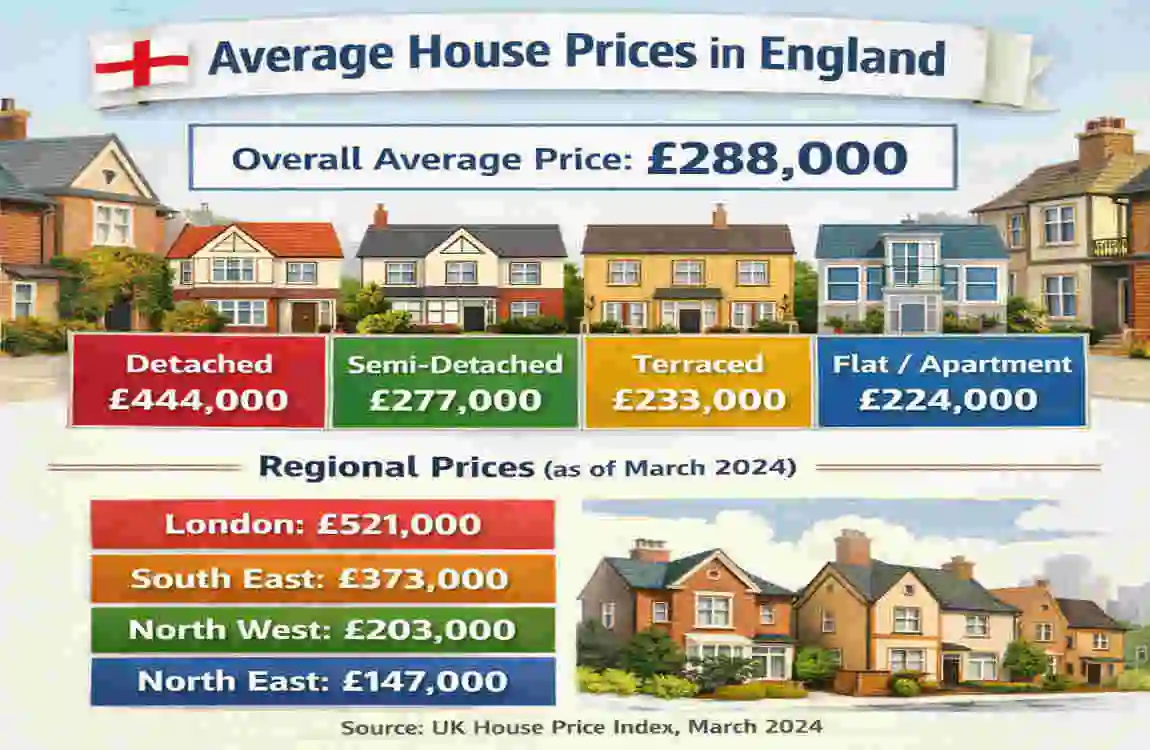
- Detached houses: around £370,000
- Semi-detached houses: around £280,000
- Terraced houses: around £240,000
- Flats and apartments: around £210,000
- Luxury estates and Premium homes: often £1 million and above, depending on location
Detached homes remain the most expensive mainstream property type. That is no surprise. They usually offer more land, more privacy, and more internal space. They are especially popular with families who want gardens, parking, and room to grow.
Semi-detached homes are often seen as the middle ground. They are still expensive in many areas, but they are generally more reachable than detached houses. They remain one of the most common targets for households moving up from a flat or starter home.
Terraced houses continue to attract a wide mix of buyers. In many towns and cities, they provide a more affordable route into homeownership. They can also offer strong value in areas where detached and semi-detached homes are priced out of reach.
Flats are still, on average, the cheapest entry point into the market. However, that does not always mean they are simple bargains. Buyers must consider service charges, lease terms, ground rent rules, and building maintenance costs. In some cases, these extra costs can make a cheaper flat feel less affordable than it first appears.
At the top end, luxury homes are their own market. Prime properties in London, elite countryside estates, and Premium coastal homes can rise into the millions very quickly. These properties are shaped by wealth, prestige, and international demand rather than by normal buyer affordability.
Affordability in Real Terms
The real question most people ask is not just “what is the average price?” but “can I afford it?” That is where affordability metrics come in.
In many parts of southern England, the price-to-earnings ratio has reached around 8 to 9 times average income. In plain terms, that means house prices can be eight or nine times a typical person’s annual income. In London and some high-demand commuter areas, the ratio can be even higher.
This creates pressure for buyers. Even when wages rise, they often do not increase fast enough to keep pace with home values. Add mortgage rates of around 4% to 5%, and monthly repayments can become a major hurdle.
That said, affordability is not equally stretched everywhere. In the Midlands, North, and North East, buyers often find better value relative to local earnings. You may still need a solid deposit and a stable income, but the path to ownership can feel more realistic there.
Why Averages Can Be Misleading
It is important to remember that averages hide a lot of detail. England is not one market. It is a group of local markets, each with its own pace and pressure. An average of £290,000 does not mean every home costs that much. It means the final number sits in the middle of a very wide range.
So, when you look at house costs, always think in layers:
- National average
- Regional average
- Town or city average
- Property type
- Street-level demand
That layered view gives you a far more useful picture than a single national figure ever could.
Key Pricing Trends
Year-on-Year Growth Remains Positive
One of the main themes in 2026 is that house prices in England are still rising, but at a steady pace rather than a dramatic one. Across much of the market, year-on-year growth is sitting around 3% to 5%. That is enough to show resilience, but not so fast as to look like an overheated boom.
This steadier growth matters. It suggests that buyers and sellers are adjusting to current borrowing costs and wider economic conditions. Instead of sharp spikes, the market is showing more measured movement. For many people, that creates a better environment for planning.
Political Stability and Global Trade Effects
Another influence in 2026 is political and economic confidence. The market has responded to a more stable post-election mood, and global trade signals have also shaped expectations. In particular, President Trump’s trade policies have affected sentiment in sectors tied to investment, manufacturing, and business confidence.
While trade policy does not directly set house prices, it can affect the wider economy. If businesses feel more confident, the job market can strengthen. If households feel more secure in their income, they are more likely to buy. Property markets often respond to confidence almost as much as they respond to numbers.
Inflation Still Matters
Inflation remains a major background force in 2026. While it has eased from some earlier peaks, it still affects everything from construction materials and labour costs to everyday household budgets.
When building costs rise, developers may pass some of those costs on to buyers. When household costs rise, buyers may find they have less room in their budgets for mortgage repayments. This creates a balancing act. Supply becomes more expensive to deliver, but demand becomes more careful.
This is one reason why prices are still rising in some areas, while activity feels more cautious in others.
Stamp Duty and Tax Changes
Tax policy continues to shape buyer behaviour. Stamp duty changes in recent periods have influenced transaction timing, especially among buyers trying to complete before the thresholds shift. Even small tax adjustments can have a noticeable effect on market momentum.
For first-time buyers, these changes matter a lot. A difference of a few thousand pounds in upfront costs can delay a purchase or reduce the amount available for a deposit. For investors and second-home buyers, tax changes often influence whether a purchase still makes sense as a long-term decision.
Remote Work Keeps Supporting Rural and Semi-Rural Areas
Remote and hybrid work continues to affect pricing patterns. While the biggest work-from-home rush has already passed, its aftereffects are still clear in 2026. Buyers remain interested in rural villages, market towns, and outer commuter areas where they can get more space for their money.
This has helped support prices in places that once sat outside mainstream demand. Homes with office space, gardens, strong broadband, and access to rail links remain especially attractive.
In contrast, some dense urban hotspots have seen slower growth. Demand has not disappeared, but buyers are being more selective. They want value, flexibility, and lower monthly pressure.
Comparing
Compared with 2025, the 2026 market feels more balanced and more predictable. Last year, many buyers were still testing what they could afford in a higher-rate environment. This year, expectations have become more settled.
A few key differences stand out:
- Prices are still rising, but the pace is more even.
- Mortgage affordability is still tight, though buyers are adapting.
- Regional value gaps remain strong, with northern areas gaining more attention.
- Top-end urban markets have cooled slightly, especially where prices were already stretched.
This means 2026 is neither a crash year nor a runaway boom year. It is a year of adjustment, discipline, and local opportunity.
Regional Breakdown: London & South East
London: High Prices, Strong Demand, Slower Growth
London remains the most expensive housing market in England by a wide margin. In early 2026, the average house price in London is around £520,000. That number alone shows how far the capital stands above the national average.
But London is not one simple market. It includes ultra-prime neighbourhoods, fast-changing regeneration zones, outer borough family areas, and more affordable pockets. In Premium boroughs such as Kensington, average prices can exceed £1.2 million, and many individual homes sell for far more.
Areas like Islington, Richmond, Camden, and parts of Westminster continue to attract buyers who value location, transport, schools, and prestige. Yet even in London, the market is not moving at the same speed everywhere. Prime areas have stayed valuable, but growth has become more modest. Many buyers are pushing harder in negotiations and seeking better value per square foot.
Why London Still Commands a Premium
London’s pricing power comes from a few long-standing strengths. It remains the country’s biggest hub for finance, media, law, technology, and international business. That keeps demand broad. It also has world-class transport, universities, and global recognition.
At the same time, the city faces classic supply pressure. Land is limited, planning is slow, and new development often targets higher-value segments. That keeps prices elevated.
However, affordability remains the central challenge. For ordinary buyers, London prices are often many multiples above average earnings. This is why many people who work in the capital now buy farther out, either in Greater London or in the wider South East.
South East: Expensive, Popular, and Driven by Commuter Demand
The South East averages around £380,000 in 2026, making it one of the priciest regions outside London. Demand remains strong because the region offers a blend of commuter access, green space, better value than central London, and strong local schools.
Counties such as Surrey, Kent, Berkshire, and parts of Hampshire continue to attract buyers seeking more space without giving up access to the capital. Surrey in particular remains one of the standout commuter belt markets, with many towns seeing steady interest from professionals and families.
Some areas in the South East have also benefited from hybrid work. Buyers are more willing to live farther from central offices if they only commute a few times a week. That has widened the search map and supported prices in towns that offer a good mix of lifestyle.
Regional Snapshot Table
RegionAvg. Price YoY Change Popular Areas
London £520,000 +2% Kensington, Islington
South East £380,000 +4% Surrey, Kent
What Buyers Should Keep in Mind
If you are buying in London or the South East, the main issue is not just price but value for money. You need to think carefully about space, commute time, school catchment areas, future resale appeal, and monthly mortgage stress.
Many buyers are now asking a more practical question: Would I rather buy smaller in a prime area, or larger a bit farther out? In 2026, that trade-off matters more than ever.
Regional Breakdown: Midlands & North
The Midlands: Strong Growth and Better Balance
The Midlands continues to attract attention in 2026 because it offers a more balanced mix of price, growth, employment, and city regeneration. The average house price across the region is around £250,000, making it far more affordable than London and much of the South East.
Birmingham remains a key market, with average prices around £230,000. It continues to benefit from business investment, transport upgrades, urban redevelopment, and a large working population. Buyers who have been priced out elsewhere are increasingly looking at Birmingham for both residential value and long-term potential.
Nottingham is another standout area. It has shown healthy growth thanks to a strong local economy, university demand, and an active housing market that appeals to both buyers and landlords. Derby, Leicester, and Coventry also continue to attract attention, especially among buyers who want city convenience without southern-level prices.
Why the Midlands Appeals to Buyers
The Midlands is well-suited to many kinds of buyers. First-time buyers often find it more reachable. Families can get more internal space and outdoor space than they might in southern regions. Investors see opportunity in rental markets linked to universities, transport, and employment growth.
Another strength is flexibility. The region includes city centres, suburban family zones, and nearby towns that still offer good value. That gives buyers room to match their lifestyle to their budget.
The North: Value, Regeneration, and Rising Interest
Northern England remains one of the most-watched parts of the market. While prices are lower than in the South, growth in several northern cities has been strong because value is still attractive.
In the North West, the average sits around £210,000. Manchester, with average prices of roughly £220,000, continues to draw buyers with its strong economy, growing population, and major regeneration story. It is one of the clearest examples of a city where jobs, culture, and inward investment are supporting housing demand.
Liverpool remains one of the most affordable larger-city options, with average prices around £180,000. It offers value for buyers, decent rental demand for investors, and a lower entry point than many competing urban areas.
Northern Cities Still Offer Better Value
What makes the North stand out in 2026 is simple: buyers can still find homes at prices that feel realistic. Even with rising demand, many areas remain far closer to local earnings than southern hotspots.
That does not mean every northern market is cheap or risk-free. Some areas have seen fast growth, and some neighbourhoods vary sharply from street to street. But overall, the North continues to offer stronger affordability and stronger upside than many high-priced southern locations.
Regional Snapshot Table
RegionAvg. Price YoY Change Popular Areas
Midlands £250,000 +5% Birmingham, Derby
North West £210,000 +6% Manchester, Liverpool
Why These Regions Matter
The Midlands and North matter because they show where value and growth can coexist. In more expensive regions, buyers often have to choose between affordability and future upside. In these markets, it is still possible to find both.
If you are asking what a house costs in England and want a practical answer rather than just a headline number, these regions are where the conversation becomes most useful. They show that your buying options can change dramatically depending on where you search.
Factors Influencing House Costs
Supply Shortages Continue to Push Prices Up
One of the biggest reasons house prices remain high in England is a simple shortage of homes. There are still more people looking to buy than there are suitable homes available in many areas. This supply gap has been part of the market for years, and it has not gone away in 2026.
Even when demand cools slightly, limited stock helps keep prices supported. Sellers with good properties in desirable areas often still attract strong interest.
Mortgage Rates Shape Buyer Power
Mortgage rates in the 4% to 5% range remain a major affordability pressure. Higher borrowing costs reduce what buyers can comfortably offer. A home that looked manageable at a lower rate may now feel too expensive once monthly repayments are calculated.
This does not remove demand, but it changes it. Buyers become more careful, compare more options, and negotiate harder.
Government Schemes and Buyer Support
Support schemes, including versions of Help to Buy-style assistance and shared ownership routes, still influence parts of the market. These options can make buying more realistic for people with limited savings, especially in lower to mid-priced areas.
However, they do not solve the wider affordability issue on their own. Buyers still need to look closely at total long-term costs.
Brexit Effects and Green Building Rules
The longer-term aftermath of Brexit continues to shape labour, materials, and investor sentiment in some parts of the housing and construction market. Alongside that, 2026 green energy mandates and sustainability rules are raising the cost of building new homes. Better insulation, cleaner heating systems, and stronger energy standards are important. Still, they can increase development costs in the short term.
Overseas and Investor Demand
England, and especially London, still attracts overseas buyers and domestic investors. In prime areas, this can keep prices firm even when local affordability is stretched. In growing regional cities, investor demand can also support values, particularly where rental yields remain attractive.
Future Predictions & Market Outlook
What Could Happen Through
Looking ahead, a reasonable expectation is around 4% growth across England as a whole into 2027. That does not mean every region will rise by the same amount. In fact, the market is likely to become even more uneven by location.
The strongest relative performance may come from northern regions and selected Midlands cities, where affordability is better, and room for catch-up growth remains. Buyers continue to look for value, and many of those markets provide it.
North May Outperform the South
The South is unlikely to collapse, but the North may outpace it in terms of growth. That is not because the South lacks demand. It is because prices there are already high, which limits how quickly they can keep rising without creating a bigger affordability strain.
In contrast, lower-priced regions still have more headroom. If employment remains stable and transport and regeneration projects continue, those areas could remain among the market’s strongest performers.
Risks Buyers Should Watch
There are still risks. The biggest one is interest rates. If borrowing costs rise again, some buyers may step back or reduce what they can pay. That could slow price growth, especially in expensive markets.
Market analysts, including those whose views are often reflected in Rightmove and the ONS, generally point to a market that remains active but selective. Well-priced luxury homes in good locations should continue to attract demand. Overpriced homes may take longer to sell.
The Big Picture
The wider outlook for England housing in 2026 and into 2027 is steady rather than dramatic. Expect movement, but not a frenzy. Expect growth, but not equally everywhere. Most of all, expect the local picture to matter more than the national headline.
Buyer Tips & FAQs
Practical Steps Before You Buy
If you are trying to answer what a house costs in England for your own move, the smartest approach is to focus on your own budget first and the national average second. The average gives context. Your budget gives reality.
Here are some practical steps to follow:
- Work out your budget clearly. Use a price-to-income approach and include all monthly costs, not just the mortgage.
- Check your deposit early. In most cases, you will need between 10% and 20% for a stronger mortgage position.
- Compare regions, not just homes. The same budget can buy very different properties in London, Leeds, Birmingham, or Liverpool.
- Look at emerging areas. Cities like Leeds, Nottingham, and parts of Greater Manchester can offer better long-term value than already overheated zones.
- Think beyond the purchase price. Include legal fees, surveys, stamp duty where relevant, repairs, and moving costs.
- Get a mortgage agreement in principle. This helps you understand your true buying range and shows sellers you are serious.
- Do not ignore energy performance. Newer or upgraded homes may save you money over time.
Areas Worth Watching
If you want growth potential without the highest southern prices, several places stand out in 2026. Leeds, Manchester, Nottingham, and parts of Birmingham continue to attract attention because they combine local demand, business activity, and relatively better affordability.
That does not mean you should unthinkingly chase growth. Instead, think about what creates lasting value:
- Good transport
- Strong local jobs
- Schools and amenities
- Regeneration plans
- Rental demand, if you may let it in the future
FAQ: What Is an House Cost in England?
What is the cheapest region in England?
The North East is often the cheapest region overall, with average prices around £160,000. That makes it one of the most affordable places for buyers looking to enter the market on a smaller budget.
How much deposit do I need to buy a house in England?
Most buyers should expect to need a 10% to 20% deposit. Some products allow lower deposits, but a bigger deposit usually gives you better mortgage rates and lower monthly repayments.
Is a detached house much more expensive than a flat?
Yes. In 2026, a detached house averages around £370,000, while a flat averages around £210,000. The gap is large because detached homes offer more land, more privacy, and more family space.
Are house prices still going up in England?
Yes, in most areas they are. National growth in 2026 is broadly around 3% to 5% year on year, although the pace varies by region. Some urban hotspots have slowed, while value-driven regional markets are performing more strongly.
Is London still worth buying in?
That depends on your goals. London remains expensive, but it also offers strong long-term demand, a huge jobs market, and global appeal. If you value space and affordability more than central location, other regions may suit you better.
Are northern cities a better option for first-time buyers?
For many buyers, yes. Cities like Manchester, Liverpool, and Leeds often offer lower entry prices than the South, while still providing jobs, transport, and lifestyle benefits. They can be a strong starting point if your budget is limited.
Should I buy now or wait?
There is no perfect answer for everyone. If you have a stable income, a workable deposit, and a home that suits your needs, buying now can make sense. Waiting may help if rates fall, but prices may also keep rising. The key is to buy when your finances are ready, not when headlines tell you to.