Imagine this: You’ve just settled into bed after a long, exhausting day. You’re seconds away from drifting into a peaceful sleep when—thump, thump, thump. Your neighbor has decided that 11:00 PM is the perfect time to practice their electronic dance music set. Or maybe it’s the constant roar of traffic from the new highway nearby, or the sound of your teenager’s video games vibrating through the living room wall.
Whatever the source, noise pollution isn’t just annoying; it’s a thief that steals your peace of mind. If you’ve reached your breaking point, you’re likely asking the big question: How much does it cost to soundproof a house?
Why Soundproof Your House? Key Benefits

Before we talk about the “how much,” let’s talk about the “why.” Is it really worth spending thousands of dollars to make things a bit quieter? For most homeowners, the answer is a resounding yes. Recent surveys show that nearly 40% of homeowners cite noise as a top issue affecting their quality of life.
Protecting Your Mental Health
Constant noise keeps your body in a state of “high alert.” It raises cortisol levels, disrupts sleep cycles, and can even lead to long-term stress and anxiety. Soundproofing turns your luxury home back into a sanctuary where you can actually recharge. Think of it as an investment in your own well-being.
Boosting Property Value
A quiet home is a Premium home. If you live near a busy road or an airport, soundproofing can give you a significant edge when it’s time to sell. Buyers are often willing to pay a 5% to 10% Premium for a house that feels like a quiet retreat from the outside world.
Privacy and Productivity
With more people working from home than ever, privacy is a major concern. You don’t want your boss to hear your toddler crying in the next room, and you probably don’t want your family to hear every word of your private meetings. Soundproofing creates those necessary boundaries.
Factors Influencing Soundproofing Costs
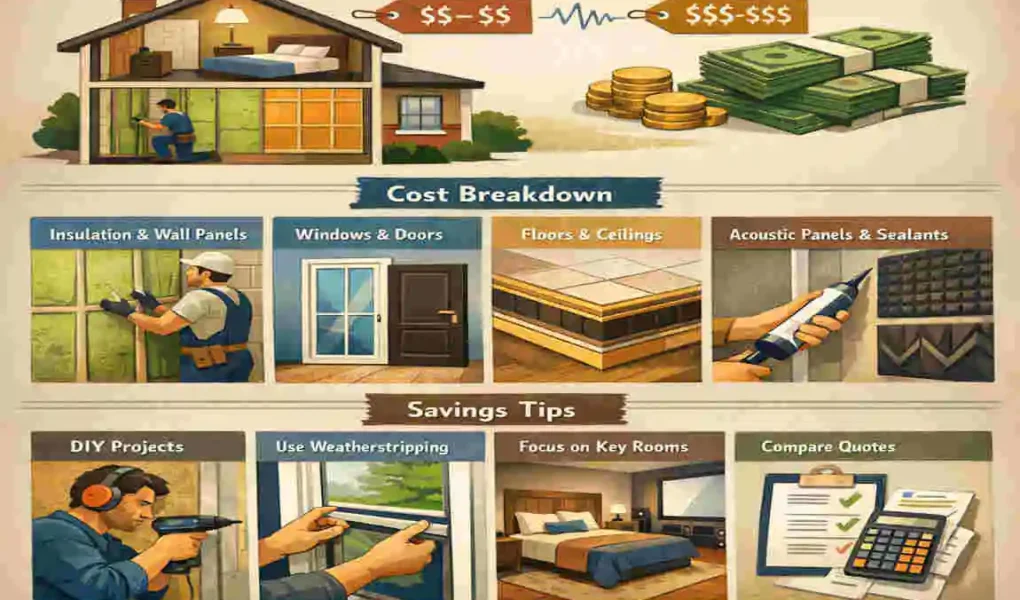
When you start looking at the the cost breakdown for soundproofing a house, you’ll notice prices vary wildly. This isn’t because contractors are trying to trick you; it’s because every house is a unique puzzle. Here are the main variables that will drive your final bill.
House Size and Layout
This is the most obvious factor. Soundproofing a 1,000-square-foot apartment is a completely different beast than tackling a 3,500-square-foot multi-story home. The more square footage you have, the more materials you need. Furthermore, multi-story homes often require “impact noise” treatment for the ceilings, which is more expensive than simple wall treatment.
The Type of Noise
Are you trying to block out “airborne noise” (like voices and TV) or “impact noise” (like footsteps and vibrating machinery)? Airborne noise is generally cheaper to fix. Impact noise requires “decoupling” your floors or ceilings, which involves more labor and specialized hardware.
Material Quality
You can buy budget acoustic foam for a few dollars, or you can invest in high-end Mass-Loaded Vinyl (MLV) and specialized soundproof drywall—the more effective the material, the higher the price tag.
Labor Rates
If you’re a handy DIYer, you can save about 50% of the total cost. However, if you hire pros, expect to pay between $50 and $150 per hour. In major urban centers like Lahore or New York, these rates can climb even higher due to demand.
FactorLow-End Impact (Budget)High-End Impact (Premium)
House Size Under 1,000 sq ft: $1,000–$3,000 3,000+ sq ft: $15,000+
Location Rural/DIY: Save 30% Urban Professional: Add 20%
Noise Type Airborne (Voices): $2–$5/sq ft Impact (Footsteps): $15–$30/sq ft
Building Type Wood-Frame: Standard Cost Concrete/Brick: Higher Labor Cost
Soundproofing Methods and Their Costs
Let’s get into the nitty-gritty. How do we actually stop the sound, and what will it cost you per square foot? We’ve broken these down from the simplest fixes to the most complex renovations.
Acoustic Panels and Foam (The Entry Level)
Cost: $2–$8 per square foot ($200–$1,000 per room). You’ve probably seen these in recording studios—those grey, egg-carton-looking foam squares. These are great for stopping echoes inside a room, but they aren’t great at stopping sound from entering a room. They are perfect for home offices or gaming rooms where you want to improve the sound quality of your own voice.
Mass-Loaded Vinyl (MLV) Barriers
Cost: $3–$10 per square foot installed ($500–$2,000 per room). Think of MLV as a very heavy, flexible rubber blanket. It is incredibly dense, making it an excellent sound blocker. You usually hang it inside the walls before the drywall goes up, or you can staple it to existing walls and cover it with a second layer of drywall. It’s one of the most effective ways to add “mass” to a room without taking up much space.
Double Drywall with Green Glue
Cost: $10–$20 per square foot ($1,500–$4,000 per room). This is the “gold standard” for many homeowners. You take a special damping compound called Green Glue and sandwich it between two layers of drywall. The glue stays slightly flexible forever, turning sound energy into tiny amounts of heat. It can jump your noise reduction rating (STC) by 10 to 15 points, which is a massive difference to the human ear.
Resilient Channels and Sound Clips
Cost: $5–$15 per square foot ($800–$3,000 per room). This method is all about “decoupling.” Instead of screwing your drywall directly to the wooden studs, you attach it to metal “channels” or clips. This creates a small air gap. When sound hits the wall, the vibration stops at the gap instead of traveling through the wood into the next room. It’s highly effective for ceilings where people walk upstairs.
Full Wall/Ceiling Assemblies
Cost: $15–$40 per square foot ($3,000–$10,000 per room). This is the “nuclear option.” It involves building a second wall a few inches in front of your existing wall (a “staggered stud” or “double stud” wall). It takes up a few inches of floor space, but it is the only way to achieve near-total silence.
Room-by-Room Soundproofing Cost Breakdown
Not every room needs the same level of quiet. You should care more about your bedroom being silent than your laundry room. Here is how to budget for specific areas of your home.
Bedrooms: Your Quiet Haven
Average Cost: $1,000–$5,000. To soundproof a bedroom, you usually focus on the “weak points.” This includes the door and the windows. A solid-core door (around $200–$400) is much better than a hollow-core one. Adding soundproof curtains to the windows can cut traffic noise by 30% for just a few hundred dollars.
Home Theaters and Media Rooms
Average Cost: $3,000–$12,000 Here, you aren’t just trying to keep noise out; you’re trying to keep the “boom” of the bass in. This requires heavy mass (MLV) and decoupling (clips). You might also need “bass traps” in the corners, which can add another $500 to $1,000 to your budget.
Home Offices and Nurseries
Average Cost: $800–$3,500. For these rooms, you can often get away with “mid-range” solutions. Adding a second layer of drywall or using high-quality acoustic panels can make a world of difference for your Zoom calls or your baby’s nap time.
Whole-House Soundproofing
Average Cost: $15,000–$50,000 (for a 2,000 sq ft home). If you want the entire house treated—walls, floors, ceilings, and windows—you are looking at a major renovation. This usually costs between $10 and $25 per square foot. While expensive, it completely changes the “feel” of the home, making it feel solid, private, and incredibly high-end.
Room TypeDIY Cost RangeProfessional Cost RangeTypical Sq Ft
Bedroom $800 – $2,000 $2,000 – $5,000 150–250
Home Theater $2,000 – $6,000 $6,000 – $12,000 300+
Home Office $500 – $1,500 $1,500 – $3,500 120–200
Nursery $400 – $1,200 $1,200 – $2,500 100–150
Average Total Costs: Realistic Budget Ranges
So, let’s bring it all together. How much does it cost to soundproof a house in total? Most people fall into one of these three buckets:
- The Budget/DIY Tier ($500 – $2,500): You focus on sealing gaps, adding heavy curtains, and maybe installing a solid-core door. You do the work yourself on weekends.
- The Mid-Range Tier ($5,000 – $15,000): You hire a pro to soundproof two or three key room by rooms (like the main bedroom and the office) using double drywall or MLV.
- The Luxury/Whole-Home Tier ($20,000 – $50,000+): You go for a full structural soundproofing of the entire property, including high-end windows and decoupled walls.
A Note on Regional Pricing: If you are in Pakistan, specifically in cities like Lahore or Islamabad, your labor costs will be significantly lower than in the U.S. or UK. You might find that a professional installation costs 20% to 40% less due to lower local labor and masonry material costs.
Practical Savings Tips for Soundproofing
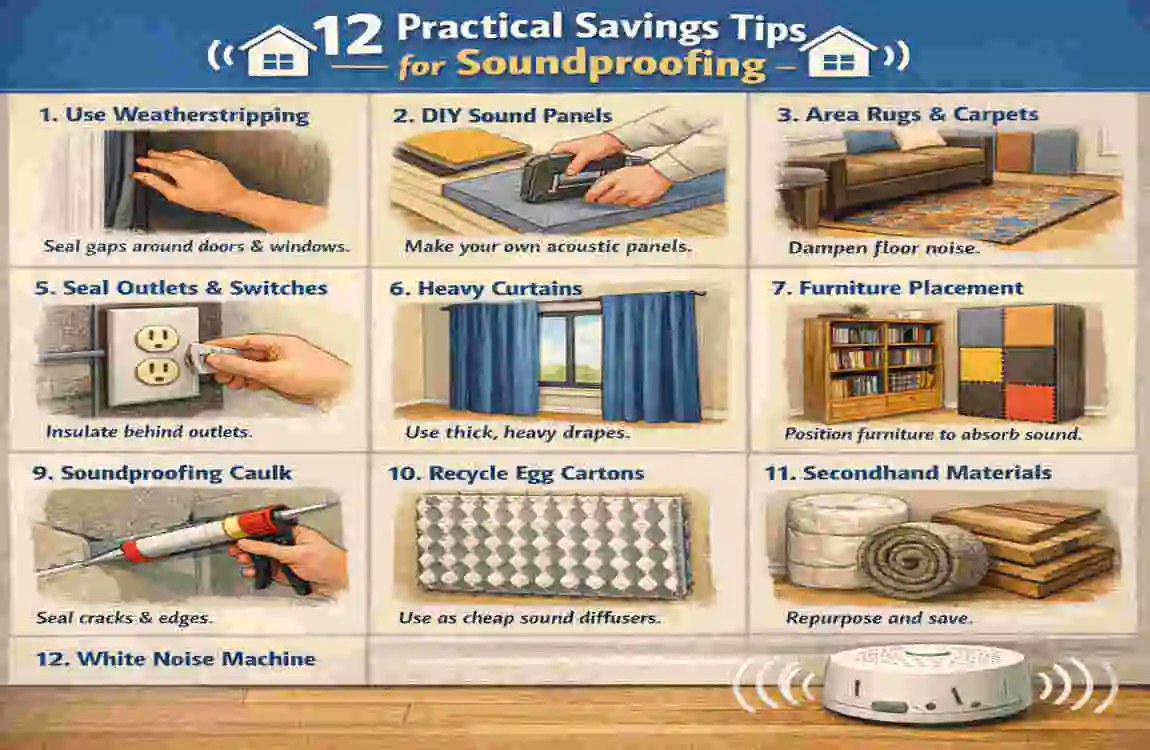
You don’t have to go broke to get some peace. Here are 12 ways to slash your house soundproofing expenses without sacrificing too much performance.
- Seal the Gaps First: Sound is like water; it will find the smallest hole. Use acoustic caulk ($15 a tube) to seal gaps around outlets, baseboards, and window frames. This can cut noise by 20% for almost no money.
- Weatherstripping is Your Friend: Put rubber seals around your doors. If air can get through, so can sound.
- Start with DIY: You don’t need a pro to hang acoustic panels or install a door sweep. Doing these yourself can save you 50% on labor.
- Use “Soft” Decor: Thick rugs, heavy velvet curtains, and even large bookshelves filled with books act as natural sound absorbers.
- Prioritize High-Impact Rooms: Don’t try to do the whole house at once. Start with the bedroom. You’ll feel the benefits immediately, and it spreads the cost out over time.
- Get Multiple Quotes: Always get at least three bids from local contractors. Prices can vary by thousands of dollars for the same work.
- Look for Second-Hand Panels: Check online marketplaces. Many home studios close down and sell their acoustic panels for pennies on the dollar.
- Soundproof Paint: While not a miracle worker, soundproof paint ($30–$60 per gallon) can help dampen mid-range frequencies, such as voices. It’s a cheap “extra layer” of protection.
- Bundle with Other Renovations: If you’re already repainting or fixing drywall, that is the time to add Green Glue or MLV. The incremental cost is much lower.
- Energy-Efficient Windows: If you’re upgrading your windows for energy savings, look for “triple-pane” or “laminated” options. They double as incredible sound barriers.
- Use Noise-Testing Apps: Before you spend a dime, use a free decibel meter app on your phone to find exactly where the noise is coming from. You might find it’s just one poorly sealed window!
- Check for Tax Credits: In some regions, if your soundproofing also improves energy efficiency (like new windows or insulation), you might qualify for luxury home improvement tax credits.
FAQ Section
How much does it cost to soundproof a house?
For a single room, expect to pay $1,000 to $4,000. For a whole house, the range is typically $10,000 to $30,000, depending on the materials used and whether you hire professionals.
Is soundproofing worth the cost?
Most homeowners say yes. Beyond the immediate peace, it can increase your home’s resale value by 5% to 10% and significantly improve your sleep and mental health.
What is the cheapest way to soundproof walls?
The most cost-effective method is sealing gaps with acoustic caulk and adding “mass” using a second layer of drywall with Green Glue. If you are on a very tight budget, heavy blankets and bookshelves can help.
How long does installation take?
A single room can usually be soundproofed in 2 to 3 days. A whole-house project can take 2 to 4 weeks, depending on the complexity of the structural changes.
Does soundproofing increase home value?
Yes, especially in noisy urban areas. It is considered a high-end upgrade that appeals to buyers looking for privacy and a quiet work-from-home environment.
Can I soundproof my house myself?
You can certainly handle the “surface” treatments, such as panels, curtains, and door seals. However, structural work like installing resilient channels or double-stud walls is usually best left to the pros to ensure it meets building codes.