Imagine this: It is the coldest night of the year. You have your thermostat set to a cozy 72 degrees, but for some reason, the furnace keeps clicking off. You head to the kitchen to boil some water for tea, and the flame on your stove is a weak, flickering blue ghost of what it should be. You check your propane tank, and it is half full. So, what gives?
The culprit is often something hidden right beneath your feet or behind your walls: an improperly sized gas line. If your pipe is too small, your appliances starve for fuel. If you are planning a new install or upgrading your home, the question of what size copper line from the propane tank to the house is one of the most critical decisions you will make.
Why Copper for Propane Lines?
When you look at gas installations, you might see black iron pipe, stainless steel, or even plastic (PE) piping. However, copper remains a top choice for residential propane systems. But why?
The Benefits of Using Copper Tubing
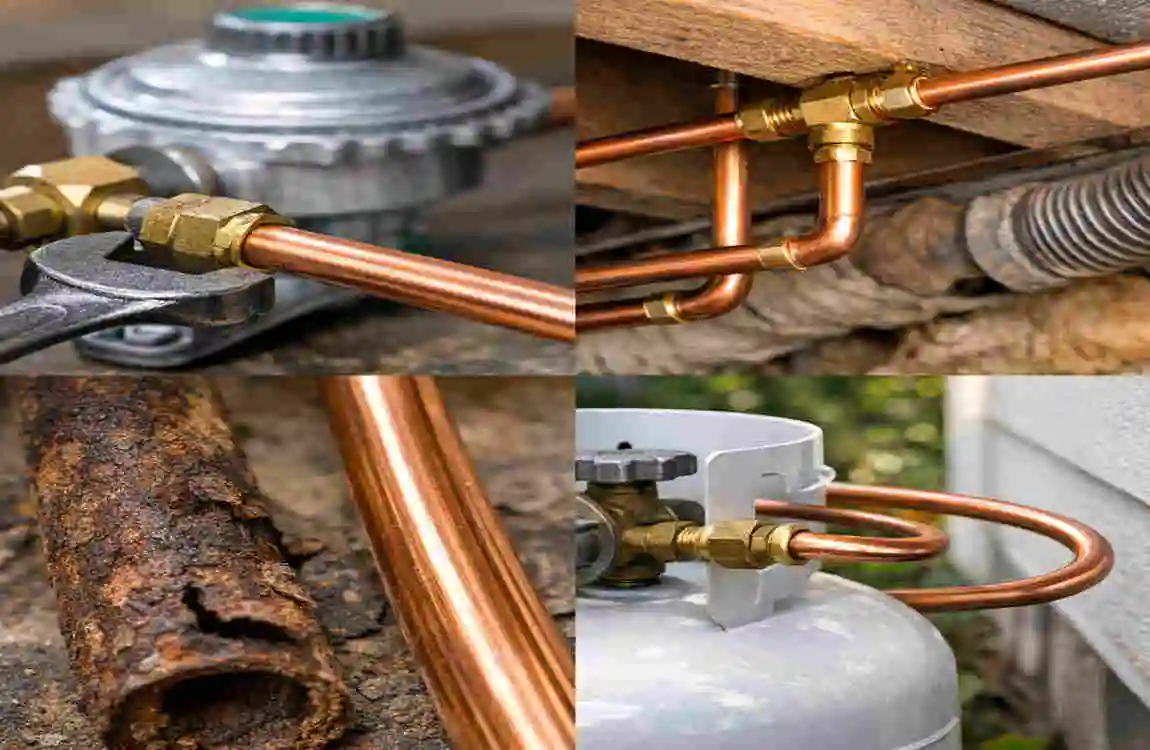
Copper is incredibly durable and corrosion-resistant. Unlike black iron pipe, which can rust if exposed to moisture, copper handles the elements quite well. It is also flexible. This flexibility is a huge “pro” because it allows installers to snake the line around obstacles without needing dozens of individual fittings. Fewer fittings mean fewer potential leak points.
Copper also has a very smooth interior wall. This smoothness reduces friction as the propane gas flows through the pipe. Lower friction means a more consistent pressure delivery to your home.
Understanding Copper Types: K, L, and ACR
Not all copper is created equal. When you head to the hardware store, you will see different “types” labeled with letters.
- Type K: This has the thickest walls. It is heavy-duty and is often used for underground lines where the pipe may face greater external pressure.
- Type L: This is the most common type used for residential gas lines. It has a medium wall thickness and offers an outstanding balance between strength and cost.
- ACR Tubing: Standing for “Air Conditioning and Refrigeration,” this tubing is cleaned and dehydrated. It is often measured by its Outside Diameter (OD), which is how propane professionals usually size their lines.
Copper vs. Other Materials
While copper is great, it is helpful to know what else is out there. Black iron is strong but heavy and prone to rust. CSST (Corrugated Stainless Steel Tubing) is very flexible but can be expensive and requires specific grounding to prevent damage from lightning strikes. Plastic (PE) is only for underground use and cannot be brought into the luxury house. Copper sits in that “sweet spot” of being versatile enough for both indoor and outdoor use in many jurisdictions.
Key Factors Determining Copper Line Size
You cannot just pick a size because it “looks right.” Sizing a gas line is a matter of physics and safety. If the line is too small, you get a “pressure drop,” meaning the gas loses its “push” before it reaches your stove. Here are the four significant factors that determine the size of the copper line from the propane tank to the house you actually need.
Total BTU Demand
Every gas appliance in your home has a BTU (British Thermal Unit) rating. This represents how much energy (gas) it consumes per hour when running at full blast. To size your line correctly, you must add up the BTUs of every appliance connected to that line.
Example Calculation:
- Furnace: 100,000 BTU
- Tankless Water Heater: 199,000 BTU
- Gas Range: 65,000 BTU
- Gas Fireplace: 30,000 BTU
- Total Load: 394,000 BTU
In this scenario, your copper line must be large enough to carry nearly 400,000 BTUs simultaneously. If you size for only the furnace, your water heater will likely fail to ignite when the stove is running.
The Distance of the Run
Distance is the enemy of pressure. The longer the gas has to travel, the more “drag” it encounters as it moves through the pipe. A 1/2-inch line might be perfect for a 20-foot run, but if your tank is 150 feet away from the house, that same 1/2-inch line will be completely inadequate.
High Pressure vs. Low Pressure
Propane systems usually work in two stages.
- High Pressure: The gas leaves the tank at a high pressure (often 10 psi or more) and travels to a “first-stage” regulator.
- Low Pressure: The regulator reduces the pressure to about 11 inches of water column (roughly 0.4 psi) for use inside the house.
Because high-pressure gas is more “densely packed,” you can use a smaller pipe (like 3/8-inch OD) to move a lot of fuel from the tank to the house regulator. However, once the pressure is dropped for home use, you need a much larger pipe to move the same amount of fuel.
Elevation and Fittings
Do you have many 90-degree elbows? Are you running the pipe up to a second story? Every bend and every foot of vertical rise adds “equivalent length” to your pipe run. Think of a 90-degree elbow as adding about 2 to 3 feet of “invisible” pipe to your total distance.
Copper Line Size Chart for Propane
To make things easy, professionals use sizing charts. These charts tell you exactly how many BTUs a specific size of copper tubing can carry over a particular distance.
The following table shows the capacity for Type L Copper Tubing (measured by Outside Diameter) at a standard low-pressure setting (11″ Water Column with a 0.5″ pressure drop).
Propane Capacity Table (Thousands of BTUs per Hour)
Outside Diameter (OD)10 Feet40 Feet80 Feet150 Feet
3/8″ 39 19 13 9
1/2″ 92 44 30 21
5/8″ 199 94 64 45
3/4″ 329 156 107 75
7/8″ 501 238 163 115
1-1/8″ 946 448 307 218
How to Read This Chart
Let’s say your propane tank is 80 feet from your house. You have a furnace and a stove that together require 100,000 BTUs.
- Look at the “80 Feet” column.
- Follow it down until you find a number higher than 100.
- You will see that 3/4″ OD copper can handle 107,000 BTUs at that distance.
- Therefore, 3/4″ is your minimum size.
High-Pressure Lines (The Tank to the Regulator)
If you are running a line from the tank to a second-stage regulator mounted on the side of your house, you are dealing with “high pressure.” In these cases, a 3/8-inch OD or 1/2-inch OD copper line is almost always sufficient, as high-pressure propane can move massive amounts of energy through a tiny tube.
Codes and Regulations You Must Know
Before you start digging or buying coils of copper, you need to understand that gas is not a “guess and check” type of project. There are strict codes, such as NFPA 54 (National Fuel Gas Code), that govern how these lines are installed.
Burial Depth and Protection
If you are running your copper line underground, you can’t just toss it in a shallow trench. Most local codes require a burial depth of at least 12 to 18 inches.
Furthermore, copper in the ground should ideally be “coated” or placed inside a conduit (like a PVC pipe) to protect it from physical damage and soil chemicals that might cause “pitting” or corrosion over several decades.
The “No Solder” Rule
This is a big one. Since 1996, many codes have prohibited the use of “soft solder” (the kind used for water pipes) on gas lines. Why? Because in the event of a house fire, soft solder melts at a relatively low temperature. If the joints melt, you have a flamethrower fueled by your propane tank.
Instead, you must use flare fittings or brazed joints. Flare fittings use a mechanical “squish” to create a gas-tight seal that can withstand much higher temperatures and pressures.
Permits and Inspections
Almost every municipality requires a permit for a new gas line. A city inspector will come out to perform a “pressure test.” They will pump air into the line and watch a gauge for 15 to 30 minutes. If the needle moves even a tiny bit, you leak, and you fail. This is for your safety—don’t skip it!
Step-by-Step Installation Guide
If you have determined the size and checked your local codes, here is the general flow for a professional installation.
Calculate the Load
Don’t just count the appliances you have now. Are you planning to add a gas dryer next year? A heated pool? Size the pipe for the future maximum load so you don’t have to dig it up again later.
Select Your Tubing
For most residential jobs, Type L ACR Copper is the standard. It comes in long coils (50 or 100 feet), which allows you to run a single continuous piece from the tank to the house. This eliminates underground joints, which is a significant safety advantage.
Dig the Trench
Ensure the path is clear of other utilities. Call your local “dig safe” number before you put a shovel in the ground. The trench should be level and free of sharp rocks that could pinch the copper.
Run the Line
Unroll the copper carefully. Avoid “kinking” the pipe. If you kink copper, you create a permanent weak point and a flow restriction. If a kink happens, that section must be cut out and replaced.
install Flare Fittings
Using a flaring tool, you will create a “bell” shape at the end of the copper tube. This bell sits against a brass fitting, and a nut tightens it down. It is a metal-to-metal seal. Never use Teflon tape or pipe dope on the threads of a flare fitting. The seal happens at the flare, not the threads.
Pressure Testing
Once everything is hooked up (but before the gas is turned on), a pressure test is performed. Professionals often use a “Manometer” or a high-pressure gauge to ensure the system is 100% airtight.
Common Mistakes and Troubleshooting
Even with the best intentions, things can go wrong. Here are the most common blunders homeowners and even some “pro” installers make.
Using “Plumbing” Copper
Many people assume the copper used for a sink is the same as the copper for propane. While the metal is the same, the cleanliness is not. ACR copper is factory-capped to prevent moisture and dust from entering. Standard plumbing pipe may contain oil or debris that can clog the tiny orifices in your gas appliances.
Undersizing for “Simultaneous Use”
A common mistake is thinking, “I’ll never run the furnace, the water heater, and the stove at the same time.” In reality, on a cold Thanksgiving morning, you likely will have all of them running. If the line is undersized, your tankless water heater might throw an “Error Code” because it isn’t getting enough fuel to maintain a flame.
Improper Flare Connections
If you don’t flare the pipe correctly—if the flare is too small, too large, or cracked—it will leak. About 80% of gas leaks in copper systems occur at a poorly made flare joint. It takes practice to get it perfect.
Symptoms of a Poorly Sized Line:
- Whistling Noises: If the pipe is too small, the gas has to move at a very high velocity, which can cause a high-pitched whistle.
- Yellow Flames: This indicates incomplete combustion, often caused by low gas pressure.
- Appliance “Lockout”: Modern appliances have sensors. If they detect low pressure, they will shut down for safety.
Cost Breakdown: What to Expect

Pricing can vary wildly based on your location and the price of raw copper, but here are some “ballpark” figures to help you budget.
ComponentEstimated CostNotes
3/4″ Copper Tubing $3.00 – $5.00 per foot. Prices fluctuate with the metal market.
Regulators (Two-Stage) $150 – $300 Includes first and second stage.
Labor (Professional) $500 – $1,500 Depends on trenching and complexity.
Permits & Inspection $50 – $200 Varies by city/county.
While a 100-foot run might cost you between $1,500 and $3,000 for a professional install, remember that this is a 30-year investment in your home’s safety and comfort.
Frequently Asked Questions (FAQ)
What size copper line do I need for a 100-foot run?
For a typical home with a furnace and water heater (approx. 150k-200k BTUs), a 3/4-inch OD copper line is usually the minimum. If you have a high-demand tankless water heater, you might need to jump up to 7/8-inch or 1-inch.
Can I use copper underground for propane?
Yes, copper is approved for underground use, but it should be Type L or Type K. Many installers prefer to use “plastic-coated” copper or run it through a sleeve to prevent the soil from eating away at the metal over time.
Is a 1/2-inch copper pipe big enough for a propane stove?
If the stove is the only thing on that line and the run is under 30 feet, 1/2-inch is usually fine. However, if that 1/2-inch line has to supply other appliances, it will likely be too small.
Why does my propane line whistle?
Whistling is usually a sign that your pipe is too small for the amount of gas trying to push through it. The gas is moving so fast that it creates harmonic vibrations. It is a clear sign that you need a larger-diameter pipe.
Can I use compression fittings on propane?
Generally, no. Most codes forbid compression fittings (the kind with a small brass ring) on gas lines because they can vibrate loose over time. Flare fittings are the required standard for copper gas lines.