Have you ever closed your eyes and perfectly visualized your dream home? You can probably picture the beautiful wrap-around porch, the massive kitchen island, and the sunlight streaming through oversized living room windows. But before you can pick out the perfect paint colors or arrange your furniture, you have to start with the absolute basics: the wooden skeleton that holds the entire dream together.
Welcome to the harsh reality of home construction in 2026. Over the last few years, we have seen building material prices ride a wild rollercoaster. Rising lumber costs mean that a simple miscalculation can completely derail your entire construction budget before the foundation is even fully poured. You cannot afford to guess how many wooden boards you need.
That is exactly why figuring out how much lumber is needed to build a house is the single most important step in your pre-construction planning phase. By getting your house framing lumber quantity right the first time, you save massive amounts of time, reduce job site stress, and keep your budget firmly in the green.
Factors Affecting Lumber Needs
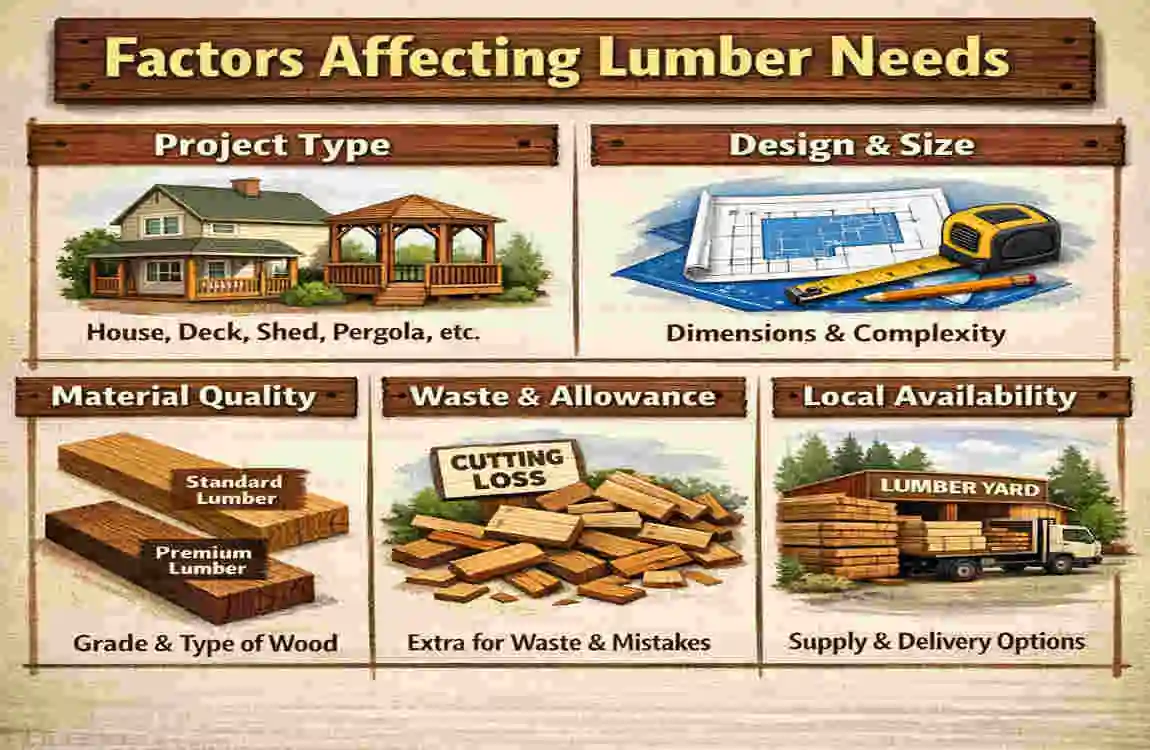
You might be wondering if there is a magic number. Can you say, “I am building a house, send me one house’s worth of wood, please!” Unfortunately, it is never that simple. Every single custom home is a unique puzzle. The exact amount of wood you need will vary widely depending on several major factors. Let’s break down the complex variables into understandable segments, so you know exactly what is driving your material list.
The Size of Your House
This is the most obvious factor, but it is worth examining closely. The total square footage of your floor plan is the baseline for your entire lumber estimate. The average American home typically ranges from 1,500 to 3,000 square feet.
Naturally, a 3,000-square-foot sprawling mansion is going to require significantly more wall studs, floor joists, and roof rafters than a cozy 1,500-square-foot cottage. More rooms mean more interior dividing walls. More square footage means longer floor spans, which require thicker, heavier beams to prevent them from bouncing when you walk.
Your Specific Design Type
The architectural style you choose plays a huge role in your final materials list. Let’s look at the difference between a single-story home and a multi-story home.
If you build a 2,000-square-foot single-story ranch house, you have to build a massive, sprawling foundation and a gigantic roof to cover all that ground-level space. However, if you build a 2,000-square-foot two-story house, the footprint is sliced in half. You need half the foundation wood and half the roof wood, but you add a heavy-duty wooden floor system in the middle to support the second story.
You also need to consider your construction method. Are you doing a traditional stick-built home where every board is measured and cut on your actual dirt lot? Or are you using prefab construction, where massive wall panels are built in a climate-controlled factory? Factory-built framing often uses advanced software that minimizes scrap, resulting in a slightly lower overall raw lumber requirement.
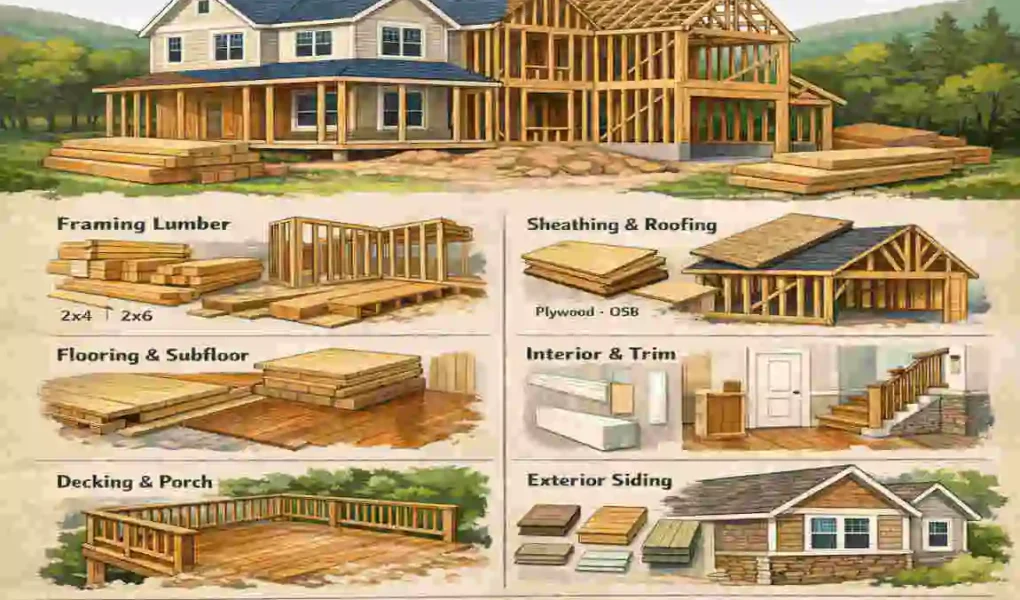
Lumber Dimensions: The 2×4 vs. 2×6 Debate
When you look at your blueprints, what are the exterior wall sizes? Historically, almost all houses were built using 2×4 wall studs. They are cheap, reliable, and get the job done.
However, in 2026, energy efficiency is king. Many local building codes now require or strongly encourage the use of 2×6 studs for exterior walls. Why? Because a 2×6 board is deeper, it creates a wider gap inside your wall cavity. This allows you to stuff significantly more thick, fluffy insulation into the walls, keeping your home cooler in the summer and warmer in the winter.
While 2×6 walls will save you money on your electric bill, they require substantially more wood to build. A 2×6 board contains 50% more wood fiber than a standard 2×4. This brings us to a critical concept you must understand: board feet. We do not buy wood by the pound; we buy it by volume. We will dive deeper into board-foot calculations shortly, but know that thicker walls mean a much larger lumber bill.
Local Building Codes and the Unavoidable Waste Factor
You cannot just build however you want. Your local city or county building inspector has strict rules, known as building codes, that dictate how strong your house must be. If you live in a hurricane zone, your codes will require more roof trusses placed closer together. If you live in a heavy-snow zone, your roof needs thicker lumber to withstand the weight of winter blizzards.
Finally, we have to talk about human error. No matter how perfect your math is, you are going to make mistakes. A board might arrive warped or heavily knotted. You might measure a wall incorrectly and cut a board two inches too short. Because of this, professional builders always calculate their precise needs and then add a strict 10% to 15% waste factor on top. Buying this extra buffer upfront saves you from paying massive rush-delivery fees later when you inevitably run short.
Standard Lumber Breakdown by House Component
To truly grasp how much lumber is needed to build a house, you need to dissect the home into its core structural components visually. Think of your house like a human body. You have the feet (foundation), the legs and torso (walls), and the hat (roof).
Each component uses different wood sizes and requires completely different mathematical formulas. To give you a clear baseline, let’s look at a standard estimate for a typical 2,000-square-foot, single-story home.
The Component Breakdown Table
House Component: Typical Lumber Required (Board Feet for a 2,000 sq ft House)Crucial Construction Notes
Foundation Framing 1,000 – 1,500 Board Feet. This includes treated sill plates that touch the concrete and heavy support beams.
Floor Joists 3,000 – 4,000 Board Feet. These are the horizontal boards under your feet. Standard spacing is exactly 16 inches apart.
Walls (Exterior & Interior) 5,000 – 7,000 Board Feet Includes vertical wall studs spaced at 16″ OC (On Center) and thick headers above doors.
Roof Trusses / Rafters 4,000 – 6,000 Board Feet. Highly dependent on how steep the pitch (angle) of your roof is.
Total House Estimate 13,000 – 18,500 Board Feet. This total will vary based on your specific architectural design and ceiling heights.
Understanding the Components in Detail
Foundation Framing: Before the walls go up, you have to anchor the house to the concrete foundation. You will use pressure-treated lumber (wood infused with chemicals to prevent rot and bug damage) for the “sill plates.” These boards bolt directly into the concrete, serving as the critical bridge between the cold stone and the rest of your wooden house.
Floor Joists: If you have a basement or a crawlspace, you need a wooden floor system. Floor joists are the long, heavy horizontal boards that stretch across the foundation. They do the heavy lifting, ensuring your living room floor does not collapse when you host a Super Bowl party. Typically, you will place these joists exactly 16 inches apart.
Walls (Exterior and Interior): This is where the bulk of your wood goes. Your walls are built using vertical boards called “studs.” Just like floor joists, standard building practices require you to place these studs 16 inches “On Center” (which means measuring 16 inches from the exact middle of one board to the middle of the next). You also have to account for “headers,” which are the incredibly thick, heavy mini-beams placed horizontally over every single door and window to carry the weight of the roof above the opening.
Roof Trusses and Rafters: Finally, we put the hat on the house. Your roof framing consumes a massive amount of lumber. If you want a flat, modern roof, you will use less wood. If you want a steep, dramatic, vaulted ceiling, your lumber requirements will skyrocket because the wooden triangles supporting the roof must be significantly larger.
The Golden Formula: Understanding Board Feet
If you walk into a commercial lumber yard and ask for “five thousand feet of wood,” they will look at you like you have two heads. The construction industry operates on a measurement called the Board Foot.
A board foot is a unit of volume, not just length. It represents a piece of wood that is exactly 1 inch thick, 12 inches wide, and 1 foot long.
To figure out how many board feet are in any given piece of lumber, you use this simple formula: (Thickness in inches x Width in inches x Length in feet) / 12 = Board Feet.
Let’s do a quick, real-world example. Say you are buying a standard 2×4 wall stud that is 8 feet long.
- Multiply the thickness (2) by the width (4) = 8.
- Multiply that by the length in feet (8) = 64.
- Divide by 12 = 5.33 Board Feet.
Every time you calculate a piece of framing material, convert it back to this standard board-foot measurement to estimate your costs accurately.
Lumber Calculator Step-by-Step
Doing the math by hand for tens of thousands of individual boards is a fantastic way to give yourself a migraine. Thankfully, we live in the digital age. You do not need a degree in advanced mathematics to figure out the quantity of house framing lumber. You need to know how to feed the right numbers into a digital tool.
Let’s walk through the exact, step-by-step process of using a lumber estimator to get a reliable, accurate number.
Measure Your Square Footage and Define Your Stories
First, you need to pull the hard data from your architectural blueprints. You cannot guess here. Grab a calculator and find the exact heated (livable) square footage of your home. Next, identify the perimeter length (the total linear footage of all the outside walls). Finally, count your stories. A single-story ranch processes differently in a calculator than a three-story townhome.
Input Data into Free Digital Tools
There are countless free framing wood calculators available online from major hardware stores and lumber suppliers. Open one up. The calculator will ask you for specific data points. You will enter your total wall length, your desired wall height (standard is 8 or 9 feet), and the spacing of your studs (usually 16 inches). The software will instantly do the heavy lifting, converting your linear measurements into a precise count of individual boards.
Adjust for Wall Openings and Sheathing
Your walls are not solid wood. You have doors and windows. A great calculator will ask you for the square footage of your openings so it can subtract the studs that would have gone there, and automatically add the heavy header boards needed above them. You will also need to calculate your sheathing (the large 4×8 plywood or OSB sheets that wrap the outside of the studs to make the walls rigid).
Apply the Universal Rule of Thumb Equation
If you are standing on an empty dirt lot and want a fast, rough estimate in your head before you sit down with professional software, you can use the industry’s favorite back-of-the-napkin equation.
Total Board Feet = (Wall Square Footage x 1.5) + (Floor Square Footage x 2) + Roof Factor
Let me translate that into everyday language. Multiply your wall square footage by 1.5. This accounts for the studs and the top/bottom horizontal plates. Then, multiply the square footage of your floors by 2. This accounts for the heavy joists holding you up. Finally, add your roof factor (which usually mirrors your floor square footage unless you have a crazy, complex roof design).
Add those three numbers together, and then—never forget this—multiply the final number by 1.15 to add your 15% waste buffer! This simple equation will get you incredibly close to your final required volume.
Cost Estimates
Now that you know how much wood you need, let’s talk about the part that makes everyone a little nervous: the budget. In 2026, the global supply chain, housing demand, and environmental regulations have created a fascinating and sometimes frustrating lumber market.
Right now, the average cost of structural framing lumber is hovering between $4 to $8 per board foot, depending on your exact region and the specific grade of wood you are buying.
What does that look like when we zoom out to view the entire house? If we take our average 2,000-square-foot home from the table above—which required roughly 15,000 board feet of lumber—you are looking at a total raw framing material cost of anywhere from $50,000 to $100,000.
Please remember that this price applies only to the house’s skeleton. This does not include the drywall, the fancy kitchen cabinets, the roof shingles, or the labor required actually to swing the hammers. This is purely the cost of the raw wood dropped in a pile on your driveway.
Factoring in Inflation and Sustainability
When planning a house build, you must account for inflation. If you calculate your lumber costs today but do not plan to start pouring concrete for another eight months, you need to add a 5% to 10% contingency fund to your budget. Lumber is a traded commodity, meaning the price changes every single day based on global markets.
Furthermore, you have to consider the type of wood you are buying. Many modern homeowners are opting for FSC-certified wood (Forest Stewardship Council). This certification guarantees that the trees were harvested from responsibly managed forests that protect local wildlife and water quality. While FSC-certified wood might push your budget toward the higher end of that $8 per board foot range, it is an investment in the health of our planet.
Types of Lumber for House Framing
Not all wood is created equal. You cannot just chop down a random tree in your backyard and use it to build a safe, structurally sound home. Modern residential construction relies on a carefully engineered mix of different lumber types. Let’s look at the materials you will actually be ordering.
Dimensional Lumber
This is the classic, everyday wood you see stacked high in the aisles of your local home improvement store. Dimensional lumber includes your standard 2x4s, 2x6s, 2x8s, and 2x10s. It is typically cut from softwood trees like pine, spruce, or fir.
You will use dimensional lumber for almost all of your vertical wall studs and standard roof rafters. It is relatively affordable, easy to cut on-site, and incredibly reliable for standard weight-bearing tasks.
Engineered Lumber
While dimensional lumber is great, a solid piece of cut pine has its limits. If you want a massive, open-concept living room with a huge 20-foot ceiling and no ugly support columns ruining the view, a standard wooden board is not strong enough to hold up the roof over that wide a span. It would bend and eventually snap.
This is where engineered lumber steps in. The most common type is the LVL (Laminated Veneer Lumber) beam. Think of an LVL like a giant, super-thick piece of plywood on steroids. Manufacturers take incredibly thin layers of wood, coat them in industrial-strength glue, and press them together under massive pressure.
Because the wood grain is alternating, an LVL beam is significantly stronger, straighter, and more reliable than a solid piece of timber. You will use engineered beams for long spans over garage doors, massive picture windows, and wide-open living rooms.
Pros and Cons: Dimensional vs. Engineered Wood
- Dimensional Lumber Pros: Highly affordable, easy for any carpenter to cut and work with, readily available at any local hardware store.
- Dimensional Lumber Cons: Prone to warping or bowing if left out in the rain, cannot span long distances without breaking.
- Engineered Lumber (LVL) Pros: Insanely strong, perfectly straight every single time, capable of spanning massive distances for open-concept designs.
- Engineered Lumber (LVL) Cons: Very heavy, difficult to cut without specialized heavy-duty saws, and significantly more expensive per foot than standard wood.
By strategically mixing cheap dimensional lumber for your basic walls and strong engineered lumber for your wide-open spans, you can build a safe, gorgeous house without blowing your budget.
Optimize Layouts with Digital Software
Before you buy a single board, run your blueprints through an advanced 3D framing software tool. These digital programs allow you to virtually build the skeleton of your house on a computer screen. The software will identify areas where you have “redundant” wood—like extra studs shoved into a corner that serve no structural purpose—and eliminate them. By optimizing your framing layout digitally, you can often slash your total lumber order by 5% to 8%.
Use Metal Studs Where Possible
Who said your wooden house has to be 100% wood? While you generally want strong wood for exterior load-bearing walls, you can use lightweight steel studs for interior dividing walls. Metal studs are perfectly straight, they never rot, termites will not eat them, and they are often cheaper than Premium pine. Using metal for non-load-bearing walls (like the wall separating your bedroom from your closet) can save a massive amount of lumber.
Buy Pre-Cut Framing Packages
Instead of buying long, random lengths of wood and cutting them all yourself in the driveway, consider ordering a pre-cut framing package. You send your blueprints to a specialized lumber mill, and they use giant, computerized saws to cut every single stud and joist to the exact millimeter required. They ship the wood to you like a giant Ikea kit. Because the factory optimizes its cuts perfectly, there is virtually zero waste on your job site.
Common Mistakes and Fixes
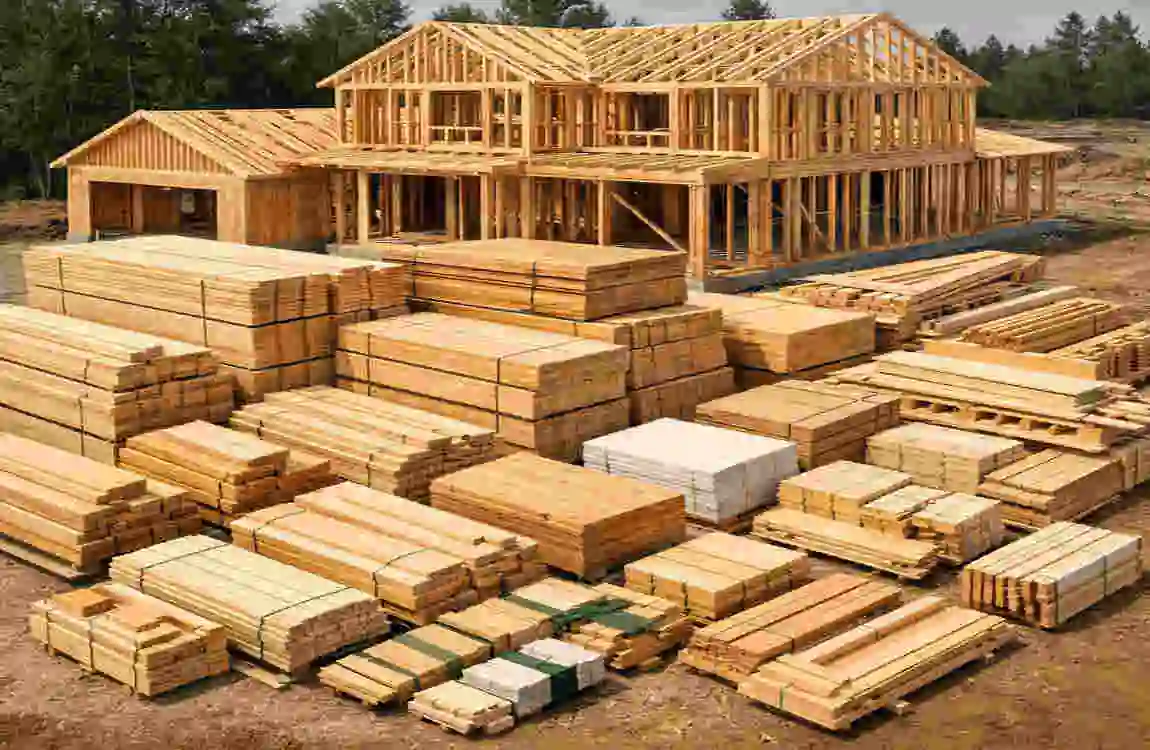
Building a house is a massive undertaking, and it is easy to make a wrong turn when doing your calculations. If you want to know how much lumber is needed to build a house safely, you must avoid these common amateur traps.
Mistake: Underestimating the Waste Factor. It is incredibly tempting to look at your perfect math and say, “I am a careful worker; I do not need to buy 15% extra wood for waste. I will buy exactly what the calculator says and save money.”
- The Fix: Never lie to yourself. You will drop a board in the mud. You will cut a joist an inch too short. A pile of wood will sit in the sun and warp into an unusable shape. Always, always order your 10% to 15% waste buffer. The cost of pausing your entire construction crew for three days while you wait for a handful of extra 2x4s to be delivered will vastly exceed the cost of buying a little extra wood upfront.
Mistake: Guessing on Load Spans An amateur builder might look at a wide living room and guess, “Yeah, a standard 2×10 board can totally hold up the floor above that.” If you guess wrong, your second-story floor will bounce like a trampoline every time someone walks on it.
- The Fix: Never guess when it comes to gravity. Always double-check your floor and roof spans against your local building code span tables. If the table says you need a thicker engineered LVL beam for a certain distance, buy the beam. Your safety is not worth saving a few dollars.
Sustainable Lumber Choices
As we look toward the future of home building in 2026 and beyond, we have a responsibility to think about the environmental impact of our dream homes. The lumber industry has a massive carbon footprint, but you have the power to make incredibly sustainable choices without sacrificing the strength or beauty of your house.
Choose FSC-Certified Wood
As mentioned earlier, always look for the Forest Stewardship Council (FSC) stamp on the end of your boards. This global certification ensures that for every tree chopped down to build your house, new trees are planted, natural habitats are fiercely protected, and local indigenous communities are respected. It is the gold standard for ethical forestry.
Embrace Reclaimed Wood
If you want to add immense character to your luxury home while being incredibly eco-friendly, consider using reclaimed wood. This is wood salvaged from old, demolished barns, historic factories, or decommissioned warehouses. You can use large reclaimed timber beams to frame your vaulted ceilings or create stunning, rustic accent walls. Because this wood was harvested decades ago, it adds zero new carbon footprint to your build!
When you make sustainable choices, you ensure that the forests remain healthy and vibrant long after your dream house is finished.
Frequently Asked Questions: How Much Lumber is Needed to Build a House?
Are you feeling a little overwhelmed by the math behind your upcoming home build? You are certainly not alone! Figuring out exactly how much lumber is needed to build a house is one of the most common hurdles for new builders and DIY homeowners.
To make things incredibly simple, I have gathered the most frequently asked questions about house framing and lumber quantity. Let’s break down these complex construction concepts into easy, bite-sized answers.
How much lumber do I actually need for a standard 2,000-square-foot home?
If you are building an average-sized, single-story home, you can expect to use between 13,000 and 18,500 board feet of lumber.
Of course, this number will shift slightly based on how tall your ceilings are and the specific pitch of your roof. To help you visualize where all this wood is actually going, here is a quick breakdown of a standard framing package:
How do I calculate “board feet” for my framing?
When you buy wood for a whole house, you do not buy it by the individual piece or by the pound. You buy it by volume, using a measurement called a board foot. One board foot is equal to a piece of wood that is exactly 1 inch thick, 12 inches wide, and 1 foot long.
Do not let the math intimidate you! You can easily calculate the board feet of any piece of lumber using this simple three-step process:
What is the average cost of wood for a new build in 2026?
Lumber prices fluctuate constantly based on global supply chains and local housing demand. Currently, you can expect to pay anywhere from $4 to $8 per board foot for standard structural framing wood.
If we apply this to our 2,000-square-foot example home, you should prepare a raw materials budget of roughly $50,000 to $100,000 just for the wooden skeleton of your house. Always remember to check with your local lumber yard for the most accurate, up-to-the-minute pricing in your specific zip code!
Should I order extra wood for my project?
Absolutely, yes! You must always order more wood than your calculator strictly requires.
Even the most experienced professional builders make mistakes. You will inevitably cut a board too short, drop a joist in the mud, or discover that a few pieces warped while sitting in the sun. To protect yourself from these frustrating delays, you should always add a 10% to 15% waste factor to your final lumber order. Buying a little extra wood upfront will save you from paying massive emergency delivery fees later!