
Before you can start picking out paint colors and laying down a fresh foundation, you have to get rid of the existing structure. Naturally, as a homeowner eager to get your building project underway, you are probably asking yourself a very important question: how long does it take to demo a house?
When planning a massive project like a rebuild or major renovation, understanding your timeline is incredibly important. You have contractors to schedule, budgets to manage, and temporary housing to arrange. Waiting around for a house demolition to finish can feel like watching paint dry if you do not know what to expect.
So, let us get the big answer out of the way right up front. On average, it takes anywhere from 1 to 8 weeks to completely demo a house.
Why is there such a massive gap between one week and eight weeks? Well, tearing down a building is not quite as simple as taking a wrecking ball to the front door, as you see in the movies. The demolition process is a highly orchestrated dance of permits, safety checks, heavy machinery, and careful cleanup.
What Is House Demolition?
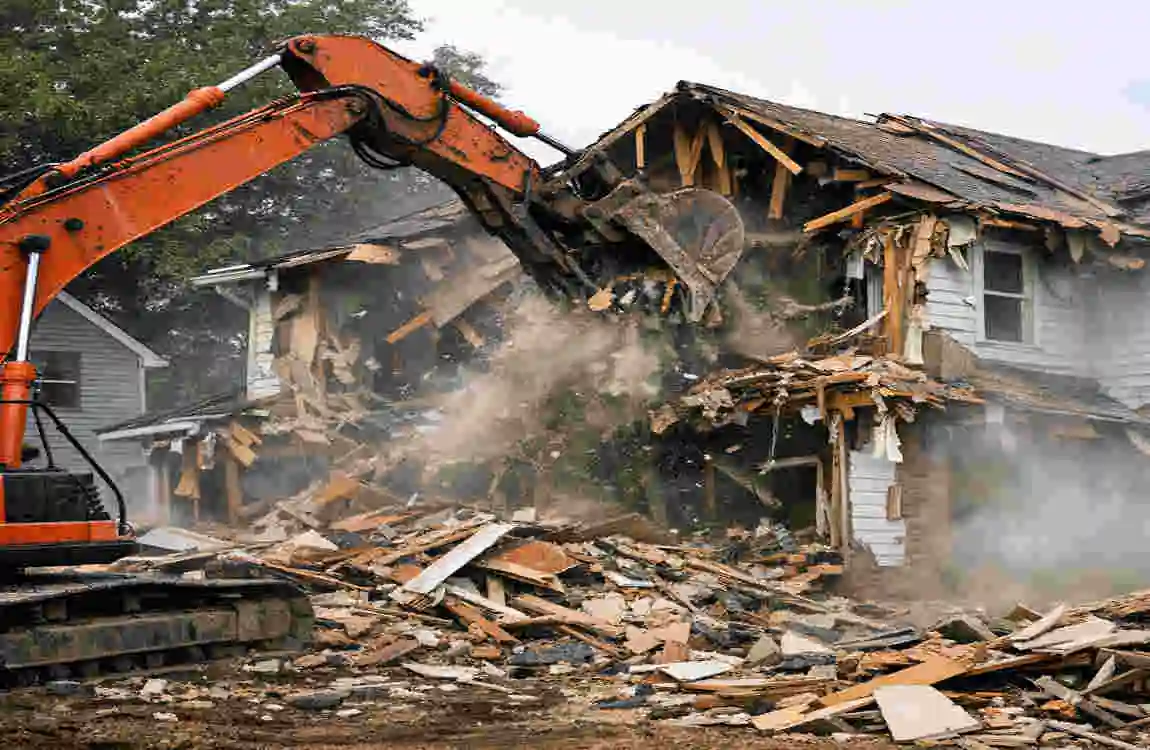
Before we can dive into the nitty-gritty details of the timeline, we need to get on the same page about what house demolition actually means. In simple terms, demolition (or “demo” for short) is the process of safely stripping down or completely removing a house structure from its plot of land.
However, there is more than one way to tear down a house. The route you choose will heavily impact your overall demo, a house process overview, and timeline. Generally, we can break demolition down into a few distinct categories:
Selective Interior Demo vs. Full Teardown
If you are starting from scratch and scraping the lot clean, you are looking at a full teardown. This means the entire structure, right down to the foundation, is broken apart and hauled away, leaving you with a dirt lot.
On the flip side, if you are doing a massive renovation, you might only need a selective interior demo. This involves gutting the inside of the house—tearing out drywall, flooring, and non-load-bearing walls—while leaving the exterior shell and foundation perfectly intact.
Mechanical Demolition vs. Deconstruction
When it comes to how the house comes down, you generally have two main choices.
Mechanical demolition is what most people picture. Large, heavy machinery, like excavators and bulldozers, systematically crushes and tears the house apart. It is loud, it is messy, but it is incredibly fast.
Deconstruction, on the other hand, is the manual process of taking a house apart piece by piece. This is often called “unbuilding.” The goal here is to salvage as many materials as possible—like vintage wood floors, antique doors, and intact bricks—so they can be recycled or reused. As you might guess, this manual salvage method takes significantly longer.
Common Reasons for House Demolition
Why do people choose to tear down a house in the first place? Here are a few common demo goals:
- Major Renovations: Gutting a home to change the floor plan entirely.
- Custom Rebuilds: Buying a lot in a great location to knock down the old house and build a custom dream home.
- Safety Hazards: Removing a structure that has been condemned due to fire damage, severe mold, or structural failure.
- Lot Clearing: Making way for commercial properties or multi-family housing.
Factors Affecting Demo Duration
You now know that the answer to “how long does it take to demo a house” ranges from 1 to 8 weeks. But how do you know where your specific project will fall on that timeline?
There is no one-size-fits-all answer because every single house is unique. The time it takes to clear your lot depends on several factors. Let us take a close look at the main house demo timeline factors that will dictate your schedule.
The Key Variables
To give you a quick snapshot, here is a handy comparison table showing how different factors impact your overall timeline:
Factor Impact on Time: Real-World Example
House Size: Larger footprint = longer demo time. (e.g., 1,500 sq ft takes 3-5 days; 4,000 sq ft takes 1-2 weeks of physical work). Tearing down a small 2-bedroom bungalow is vastly quicker than a sprawling multi-story mansion.
Location & Permits Urban bureaucracy causes delays, while rural areas often move with speed. Waiting 2-4 weeks for strict city approvals versus just a few days in an unincorporated county.
Method Chosen: Mechanical demolition is the absolute fastest; manual deconstruction is the slowest. An excavator can crush a home in 1 day; hand demoing to save wood takes 1 week or more.
Safety Hazards: Finding asbestos or lead paint can add 1-3 weeks to the safe abatement process. Pre-1980 homes often require specialized removal of toxic materials before regular demolition begins.
Weather/Season Heavy rain, mud, or snow can literally double your timeline. Summer is ideal for fast work; winter blizzards grind machines to a halt.
Digging Deeper into the Factors
The Size of Your House. Bigger houses take longer to demolish and haul away. A tiny, single-story ranch home can sometimes be knocked down in a single afternoon. A massive, three-story custom home with a deep poured-concrete basement will require days of heavy machinery work to break the materials down into manageable pieces.
Your Location and Permit Requirements: Do not underestimate the power of local government paperwork. If you live in a dense urban area, the city may have strict noise ordinances, dust-control measures, and street-closure rules. Getting all the right stamps on your permits can take weeks. If you live out in the country, the rules are often much looser, allowing you to get to work much faster.
The Method of Demolition As we mentioned earlier, choosing between a giant excavator and a team of workers with crowbars will drastically change your schedule. If you want to move quickly, mechanical is the way to go. If you are passionate about saving the environment and reducing landfill waste, deconstruction is fantastic, but you must be patient.
Hidden Hazards This is the big one. If your home was built before the 1980s, there is a very high chance it contains asbestos in the flooring, insulation, or roof shingles. It might also have lead paint. You cannot just smash these materials with a bulldozer, or you will release toxic dust into the neighborhood air. You have to hire specialized abatement teams to carefully remove these hazards before the real demo begins, which easily adds weeks to the clock.
Mother Nature, heavy machinery does not perform well in a muddy swamp. If your region experiences a week of torrential rain, your site might become too soft for dump trucks to enter without getting stuck. Snow and ice can also make working conditions incredibly unsafe for the crew.
Step-by-Step House Demo Timeline
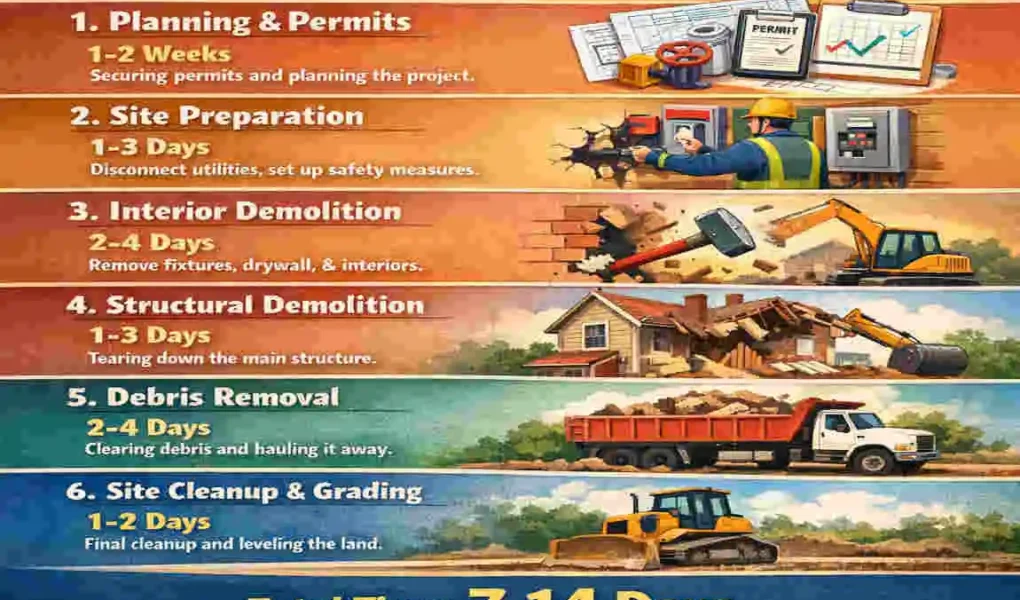
Now that we understand the factors at play, let us walk through the actual step-by-step house demo timeline. If you want to know what your contractors are doing during those 1 to 8 weeks, this section breaks the complex process down into easy-to-understand segments.
Here is what a standard, full-scale demolition looks like from the moment you decide to tear the house down to the moment you are left with a clean dirt lot.
Planning & Permits (1 to 4 weeks)
You might think demolition starts with a sledgehammer, but it actually starts with a lot of paperwork. This administrative phase is often the longest part of the entire project. So, how long are demo permits valid for? It highly depends on your local municipality.
- Inspections and Surveys: Before the city will let you tear anything down, they need to know what is inside the house. You will have to hire inspectors to check for asbestos, lead paint, and other hazardous materials.
- Filing for Permits: Once you have your inspection reports, your contractor will file for a demolition permit. The city will review your plans to ensure you do not damage public utilities or violate environmental regulations.
- The Waiting Game: In a small town, you might get a permit in three days. In a bustling metropolis, you might be waiting a full month.
Prep & Safety (2 to 5 days)
Once the permits are officially in hand, the physical preparation begins. You cannot just start knocking down walls while the house is still plugged into the city’s power grid!
- Utility Disconnection: This is arguably the most crucial safety step. Your contractor must coordinate with local utility companies to completely shut off and cap the electricity, natural gas, water, and sewer lines. Hitting a live gas line with an excavator is a catastrophic event, so this step is never rushed.
- Securing the Perimeter: The crew will set up temporary chain-link fencing around your property line. This keeps curious neighbors, kids, and pets out of the dangerous construction zone.
- Bringing in the Equipment: You will start seeing large dumpsters and heavy machinery being delivered to the curb.
Interior Strip-Out (3 to 7 days)
Even if you are doing a full mechanical teardown, the crew usually does a partial manual strip-out of the interior first.
- Removing Valuables: Any fixtures you want to save—like copper piping, modern appliances, custom cabinets, or intact windows—are carefully removed.
- Hazard Removal: If the inspectors find asbestos or lead during Phase 1, the specialized abatement team arrives immediately. They wear protective hazmat suits, seal off the house, and safely remove the toxic materials. Note: If hazard abatement is required, this phase can easily stretch from a few days to a few weeks.
- Gutting the Fluff: The crew might strip out carpets and large chunks of drywall to make the final knockdown cleaner and easier to separate for the landfill.
Structural Demo (1 to 5 days)
This is the main event! It is exactly what you picture when you hear the words “house demolition.” Depending on the house size, the actual crushing of the structure is surprisingly fast.
- The Knockdown: A skilled operator in a massive hydraulic excavator will start at the top of the house. They will crush the roof, pull down the framing, and systematically collapse the walls inward so the debris stays contained in a neat pile.
- Foundation Removal: Once the wooden and brick structure is gone, the machinery will dig into the earth to rip up the concrete foundation slab or basement walls.
Estimates by Height
- Single-Story Homes: The physical knockdown of a one-story home usually only takes 1 to 2 days.
- Two-Story Homes: Because there is more material and it requires a bit more care to bring down safely, a two-story home takes 3 to 5 days.
debris Removal (2 to 7 days)
Just because the house is in pieces on the ground does not mean the job is done. Now, you have a massive pile of wood, concrete, glass, and metal sitting on your lot.
- Sorting the Mess: A good demolition crew will use the excavator to sort the materials. Concrete goes into one dumpster, metal goes into another for recycling, and general trash goes into a third.
- Hauling it Away: Fleets of dump trucks will cycle in and out of your property, taking the debris to various recycling centers and landfills. The time this takes depends entirely on how many truckloads of material your house produces and how far away the local dump is.
Site Cleanup & Inspection (1 to 3 days)
We have finally reached the finish line.
- Grading the Dirt: The excavator will smooth out the dirt where the house and foundation used to sit. This process, called grading, ensures your lot is level, safe, and ready for the next phase of construction.
- Final Walkthrough: The city inspector will likely return one last time to look at the empty lot. They want to verify that the sewer lines were capped correctly and that the site is safe.
- Sign-Off: Once the inspector gives the thumbs up, the fences come down, the contractors pack up, and your demolition is officially complete!
Average Timelines by House Type
As we have established, the scope of your specific project changes everything. If you are searching the internet, trying to figure out “how long to demo a standard house,” you need to compare apples to apples.
To give you a much better idea of what to expect, let us look at average timelines broken down by specific types of homes. These estimates include the physical work phases (prep, knockdown, and cleanup), assuming your permits are already in hand.
Small Homes and Bungalows (Under 1,500 sq ft)
Estimated Time: 3 to 7 days total. If you have a modest, single-story home, you are in luck. These structures are incredibly quick to tear down. Because they lack deep, complicated basements and heavy second-story loads, a skilled crew with a single excavator can usually collapse the house in a day, spending the rest of the week simply hauling away the small amount of debris.
Standard Family Homes (1,500 to 2,500 sq ft)
Estimated Time: 1 to 2 weeks. This is your typical American suburban home. It likely has two stories, an attached garage, and perhaps a basement. Because there is significantly more square footage, the crew has to work more methodically. Bringing down the second story safely takes time, and you will need twice as many dump trucks to haul away the crushed drywall, roofing, and concrete.
Large and Custom Estates (3,000+ sq ft)
Estimated Time: 3 to 6 weeks. When you get into mansion territory, demolition becomes a major commercial-style operation. These homes often feature multiple HVAC units, complex plumbing networks, deep poured-concrete cellars, and heavy masonry (such as full-stone exteriors). The sheer volume of material means that the hauling phase alone can take two full weeks.
Urban Rowhouses and Townhomes
Estimated Time: 2 to 4 weeks. Even if an urban rowhouse is small in square footage, the timeline is long. Why? Because of access limits. You cannot swing a massive excavator wildly when your house physically shares a wall with the neighbor’s house. Townhouse demolition often requires a delicate, hybrid approach of manual deconstruction and careful small-machinery work to ensure the structural integrity of the attached properties is not compromised. Furthermore, navigating dump trucks through tight city streets significantly slows the hauling process.
A Quick Regional Note: Where you live matters geographically, too. Tearing down a house in a spacious, quiet suburb usually goes much faster than trying to demolish a home in a cramped, busy city center where you have to fight traffic and strict noise curfews every single day.
Cost vs. Time Trade-Offs
When you are planning a demolition, you will quickly learn that time and money are deeply intertwined. A demo of house costs and the timeline is basically on a sliding scale. If you want the job done incredibly fast, you will pay a Premium. If you want to save money, you will have to sacrifice your time.
Let us break down the trade-offs so you can make the best decision for your budget.
Mechanical Speed vs. Upfront Costs
Using heavy machinery is by far the fastest way to clear your lot. An excavator can easily save you 20% to 30% in overall time compared to manual methods.
However, renting excavators and bulldozers and hiring specialized, licensed operators is expensive upfront. You are paying for the heavy equipment transport and the driver’s high hourly rate. But because the job is finished in days rather than weeks, your total labor costs are cut short.
Manual Deconstruction: Slow but Profitable
If you choose the deconstruction route, you are choosing the slow path. It takes weeks for a crew to carefully pull out nails, unbolt cabinets, and pry up floorboards. Your labor costs will be significantly higher because you are paying a team of workers for a month instead of a few days.
However, there is a major financial upside. You can sell those salvaged vintage bricks, antique doors, and copper pipes. Often, the money you earn from selling salvaged materials can offset the extra labor costs. Plus, you get a massive tax deduction if you donate the usable materials to a charity like Habitat for Humanity.
The DIY Dilemma: Pro vs. Amateur Timings
You might be thinking, “I have a sledgehammer and a truck, maybe I can do this myself and save a ton of money!”
While DIY demolition is possible for small projects like a shed or a single room, taking on an entire house by yourself is a massive, exhausting undertaking.
Common Delays and How to Avoid Them
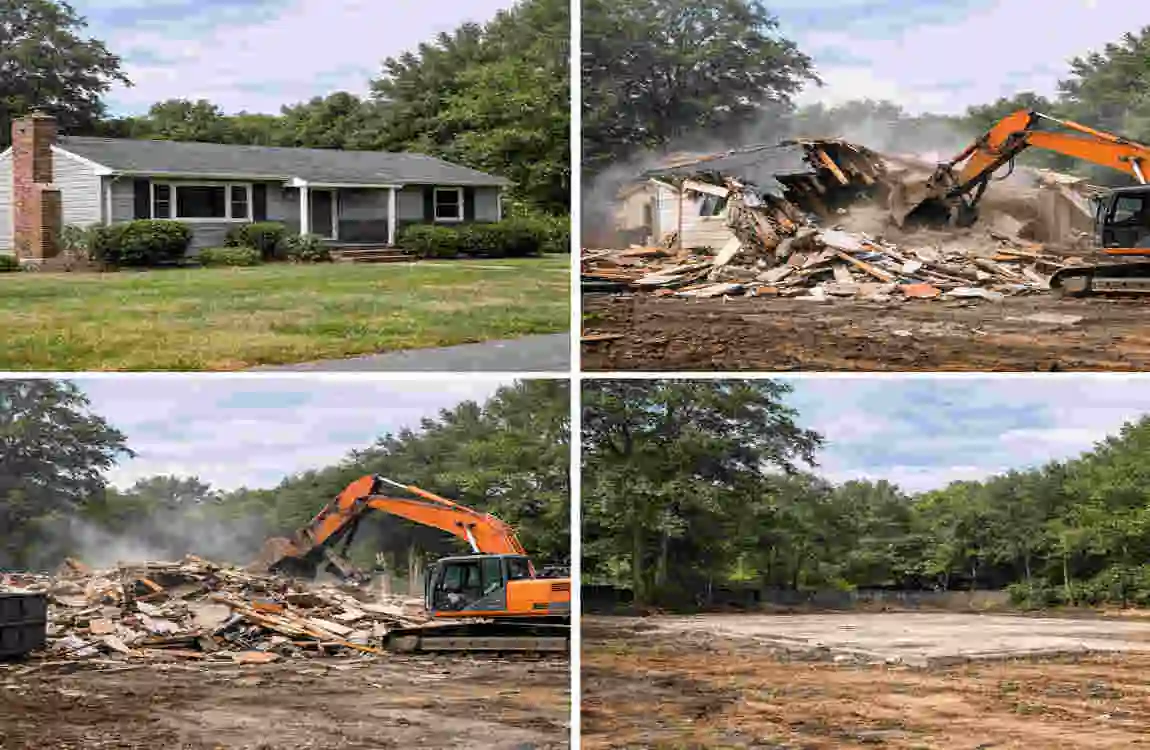
Even the most perfectly planned projects can hit a snag. When you are dealing with local governments, heavy machinery, and Mother Nature, surprises are bound to happen. However, if you know what these roadblocks look like ahead of time, you can navigate around them.
Here is a list of the most common demolition delays and exactly how you can avoid them:
- Permit Hold-Ups: This is the number one cause of delays. If your city planning office is backlogged, your project sits idle.
- How to avoid it: Do not wait until the last minute. Start the permit application process at least two full months before you want to begin demolition.
- Unexpected Hazardous Materials: Imagine getting ready to bulldoze, only to have the inspector find hidden asbestos wrapped around an old basement pipe. Everything stops until it is safely removed.
- How to avoid it: Budget for comprehensive environmental inspections very early in the process. Know exactly what is inside your walls before you schedule the heavy machinery.
- Weather and Seasonal Interruptions: You cannot control the sky. A week of heavy rain will turn your dirt lot into a mud pit, making it impossible for heavy dump trucks to gain traction.
- How to avoid it: Look at the calendar. Schedule your demolition during your region’s dry seasons. Summer and early fall are generally the most reliable times of year for fast construction work.
- Contractor Availability Issues: The best demolition crews are often booked months in advance. If your guy gets delayed on another job, your start date gets pushed back.
- How to avoid it: Vet your contractors carefully. Use checklists to ensure they are licensed, insured, and have a solid reputation for showing up on time. Get your start dates locked in early with a written contract.
Real-World Case Studies
Sometimes, the best way to understand timelines is to look at real-world examples. Let us examine two very different, anonymized demolition projects to see how the factors we discussed play out in real life.
The Fast Suburban Flip
The Property: A small, 1,200 sq ft single-story ranch home in a quiet, modern suburb. The Goal: The homeowner wanted to clear the lot quickly to build a modern duplex. The Timeline: Because the house was relatively new (built in 1995), environmental testing came back clean—no asbestos, no lead. The suburban county office approved the permits in just 4 days. The contractor brought in a single large excavator.
- Prep: 1 day.
- Knockdown: 1 day.
- Debris hauling and grading: 3 days. Total Physical Time: 5 days. Mechanical demo made this a lightning-fast, highly efficient project.
The Toxic Teardown
The Property: A sprawling, 3,000 sq ft two-story colonial home built in 1952, located in an older city neighborhood. The Goal: Complete removal to build a custom estate. The Timeline: The initial inspection revealed asbestos in the popcorn ceilings and lead paint on the exterior siding. The city permits took 3 weeks to clear due to strict historic district regulations.
- Hazard Abatement: A specialty crew took 10 full days to seal and remove the toxic materials safely.
- Prep & Utilities: 3 days.
- Knockdown: 4 days (carefully pulling it down to avoid the neighbor’s fences).
- Hauling: 6 days (due to heavy traffic to the city dump). Total Physical Time: Over 3 weeks of daily on-site work, preceded by nearly a month of permitting.
As you can see, the size, age, and location of the luxury house create vastly different experiences!
FAQs: How Long Does It Take to Demo a House?
We have covered a massive amount of information, but you might still have a few specific questions lingering. Let us tackle some of the most frequently asked questions about house demolition timelines.
How long does it take to demo a small house? If the house is under 1,500 square feet and has no hidden hazards like asbestos, the physical demolition process is surprisingly fast. You can expect the actual teardown and cleanup to take 3 to 7 days in total.
Does a full demolition take longer than a partial interior demo? It might sound backward, but a partial interior demo often takes longer than a full teardown. When you do a full teardown, an excavator crushes everything. When you do a partial demo, workers must carefully remove walls and flooring by hand to ensure they do not compromise the home’s structural integrity. Hand labor is always slower than heavy machinery.
What is the timeline if I also need to demo a pool or a large shed? Adding secondary structures to your project will absolutely add time. Removing a backyard shed will generally add 1 extra day to your timeline. Digging up and filling in an inground concrete swimming pool is a massive undertaking that will easily add 3 to 5 extra days to your overall schedule. Make sure your contractor is aware of all structures during the quoting phase.