You have seen them scrolling through your social media feeds or perhaps featured in a Netflix documentary. The tiny house movement has exploded globally, with over 10,000 new units being built every year. From the minimalist landscapes of Scandinavia to the emerging eco-communities in Pakistan, people are trading massive mortgages for manageable, mobile, and modest living spaces.
But amidst the excitement of downsizing and decluttering, there is one burning question that every potential owner asks. It is the elephant in the (very small) room: How long does a tiny house last?
Is this a temporary housing fix, or is it a legacy you can pass down to your children?
Here is the short answer: With quality materials and proper care, a tiny house can last 30 to 50 years. In fact, some professionally engineered modular homes are designed to last over a century, rivaling the lifespan of traditional brick-and-mortar houses.
However, the “how” is just as important as the “how long.” A tiny house built on a whim with scrap materials might only see you through a decade. In contrast, a state-of-the-art steel-frame build could outlive us all.
Average Lifespan: How Long Does a Tiny House Last?
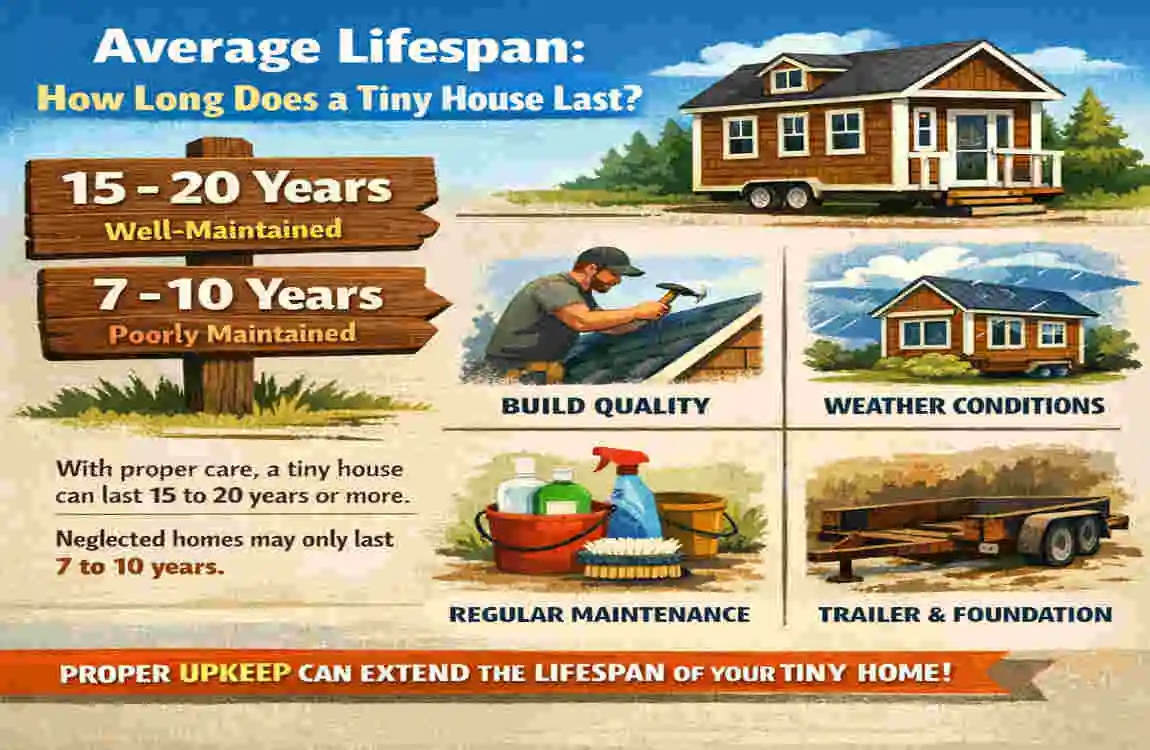
When we talk about the lifespan of a tiny house, we have to stop treating them all as the same thing. Asking how long a tiny house lasts is a bit like asking, “How long does a vehicle last?” A well-maintained Toyota Land Cruiser has a very different life expectancy than a budget scooter.
The lifespan generally falls into three distinct categories based on who built it and what they used.
The Breakdown: DIY vs. Pro Builds
If you are handy with a hammer, you might be tempted to build your own tiny home. While this is fulfilling, DIY wood-framed builds often face challenges that shorten their life. Without professional engineering, these homes typically last 20 to 30 years. The issues usually aren’t catastrophic collapses but rather moisture intrusion, warping, or trailer rust that becomes too expensive to fix.
On the other hand, professionally built tiny homes adhere to strict building codes. These builders use high-grade materials and understand weight distribution. You can expect these to last 50+ years, largely because they are sealed better against the elements.
Then, there is the gold standard: Steel and Concrete structures. These are often modular homes placed on permanent foundations. Because they don’t suffer from rot or termite damage, their lifespan can easily exceed 75 to 100 years.
Lifespan Comparison Chart
To give you a clearer picture, here is how the different build types stack up against each other:
Build Type, Expected Lifespan, Key Factor Affecting Longevity
DIY Wood Build 20 – 40 years Material quality & construction skill
Professional/Factory 50 – 75 years Engineering standards & sealing
Steel Frame/Concrete 75 – 100+ years Resistance to rot, rust, and pests
The Real-World Context
These numbers aren’t just guesses. We have seen data from long-term projects in Australia and the US where tiny homes have been subjected to harsh sun and heavy snow. The ones that are still standing tall after two decades share one common trait: they were built with the climate in mind.
For example, a wooden tiny house in the dry heat of Arizona might last 40 years without rot, but put that same house in the humidity of Lahore or Karachi without proper treatment, and it might begin to degrade in 15 years. Context is everything.
Key Factors Affecting Tiny House Lifespan
If you want your tiny house to be a long-term asset, you need to understand the enemies of durability. It comes down to four main pillars: Materials, Foundation, Climate, and Design. Let’s dive deep into each one.
Materials and Construction Quality
The mantra “you get what you pay for” is painfully true in construction. The skeleton of your house dictates its health.
Wood vs. Steel Framing: Traditional wood framing is common and affordable. However, wood is organic. It expands when it’s humid and shrinks when it’s dry. Over time, this movement can cause seals to crack, letting water in. Steel framing is becoming the top choice for longevity. It is lighter than wood, doesn’t rot, termites hate it, and it is fire-resistant. If you are building for the next 50 years, steel is the way to go.
The Magic of SIPs: Many modern builders are switching to SIPs (Structural Insulated Panels). Think of these like a giant ice cream sandwich. You have foam insulation sandwiched between two rigid boards. They are incredibly strong and airtight. Using SIPs can double the lifespan of your walls because they eliminate the “thermal bridging” that causes condensation and mold inside the walls.
Siding Matters: Don’t just slap cheap plywood on the outside. Exterior cladding takes the brunt of the weather. Cedar is naturally rot-resistant, but metal siding or fiber cement (like Hardie board) is virtually indestructible and requires almost no maintenance.
Foundation and Mobility Impact
This is the defining feature of a “Tiny House on Wheels” (THOW), but it is also the weak link.
The Trailer is the Foundation: If your house is on wheels, the trailer is your foundation. A standard flatbed trailer isn’t designed to permanently hold a house. You need a purpose-built tiny house trailer. These have heavy-duty axles and a frame designed to minimize flexing. If the trailer frame rusts out, your house loses its structural integrity.
Tires and Axles: Tires degrade even if they aren’t moving. UV rays rot the rubber, and the weight of the house can cause flat spots. To make a mobile tiny house last, you should jack it up and place it on blocks when you park it long-term. This takes the weight off the suspension and tires, preserving the “mobility” aspect for decades.
Permanent Foundations: If you remove the wheels and place the house on a concrete slab or piers, you instantly extend its life. You remove the risk of tire rot and trailer rust, and you provide a stable base that won’t shift during storms.
Climate and Location Challenges
Your local environment is constantly trying to dismantle your house.
The Pakistan Context: In places like Pakistan, we face distinct challenges. We experience intense heat, high humidity, and high UV radiation during the monsoon season.
- Humidity: In humid zones, moisture is the enemy. You need treated lumber that resists rot and fungal growth. Ventilation is key; you need exhaust fans that actually move air out to prevent mold buildup inside the walls.
- Heat: Intense sun can warp vinyl siding and crack cheap roofing sealant. You need UV-resistant roofing materials, like standing seam metal roofs, which reflect heat and last 50 years.
Extreme Weather Prep: If you are in a windy area, your tiny house needs to be anchored. Because they are light, they can tip over. Earthquake anchoring and hurricane ties (metal straps that hold the roof to the walls and the walls to the trailer) are non-negotiable for longevity.
Design and Engineering Secrets
Finally, the house’s geometry matters.
Roof Pitch: A flat roof might look modern, but it is a recipe for leaks. A sloped roof sheds water and snow immediately. The faster you get water off your roof, the longer your house lasts.
Weight Distribution: If you put all your heavy appliances (fridge, washing machine, water tank) on one side of the house, the trailer frame will twist over time. A professional designer balances the load to ensure the frame stays straight.
Certifications: Look for builders who follow standards like the NOAH certification or local engineering codes. These certifications mean a third party has inspected the build at various stages (framing, electrical, plumbing) to ensure it wasn’t just thrown together.
Maintenance Secrets for a 50+ Year Tiny House
You cannot just build it and forget it. A tiny house requires a more hands-on relationship than a standard home. Because it is smaller, small problems can quickly become big disasters. However, the advantage is that maintenance takes much less time.
Here is your roadmap to keeping your tiny home in top shape for half a century.
Daily and Weekly Routines
You don’t need to be a contractor to do these. It is about observation.
- Moisture Watch: Keep an eye on your windows. If you see condensation on the inside of the glass, your humidity levels are too high. Open a window or run a dehumidifier.
- Clean the Gutters: Because tiny houses often have smaller gutters, they clog faster. A clogged gutter sends water down your siding, which eventually leads to rot.
- Check the Level: Every few months, check if your house is level. If the ground settles, your house twists. This can crack drywall and make doors stick. A few turns of a wrench on your stabilizer jacks can fix this in minutes.
Annual Inspections
Once a year, usually before the rainy season or winter, do a “deep dive.”
- Roof Inspection: Climb up there (carefully). Look for cracks in the sealant around skylights and chimneys. UV rays eat silicone for breakfast. Re-caulking these spots costs pennies but saves thousands in water damage.
- Undercarriage Check: Crawl under the trailer. Look for rust. If you see surface rust, sand it down and immediately spray it with a rust converter paint. Check the wooden subfloor from below for any dark spots that indicate water leaks.
- Plumbing Pressure Test: Tiny house plumbing is often compact and hidden. Check all connections under sinks and behind the toilet for slow drips.
Upgrades for Longevity
Technology can help you extend your home’s life.
- Smart Moisture Sensors: You can buy small sensors that sit under your sink or near the water heater. If they detect water, they send an alert to your phone. This lets you catch a leak the moment it happens.
- Solar Panels: While mainly for power, solar panels also act as a shield for your roof, taking the brunt of the sun’s damage and protecting the roofing material beneath.
Estimated Maintenance Costs (PKR)
Budgeting is part of maintenance. Here is what you should expect to spend in Pakistan (estimates) to keep your home pristine.
Maintenance TaskFrequencyEstimated Cost (PKR)
Roof Sealant & Caulk Every 2 years 20,000
Trailer Axle Grease/Service Every 5 years 50,000
Exterior Paint/Stain Every 3-5 years 40,000
Full Professional Inspection Yearly 10,000
Busting the “Temporary” Myth
There is a misconception that tiny houses are temporary structures, like a tent. This is false. A maintained tiny house rivals a stick-built home. The only difference is that you are likely the property manager. If you embrace that role, the house will reward you with decades of shelter.
Real-World Examples: Tiny Houses That Last Decades
It is easy to talk about theory, but let’s look at what this looks like in the real world.
The 40-Year-Old Pioneer. In the United States, before the term “tiny house” was trendy, people were building small cabins on trailers. There is a documented case of a cedar-clad tiny home built in the late 1980s in the Pacific Northwest—a very rainy region.
- The Secret: The owner applied a high-quality oil finish to the wood siding every three years without fail.
- The Result: Today, the wood looks aged and rustic, but it is solid. There is no rot. The trailer was placed on concrete blocks early on, so the suspension is shot, but the foundation is rock solid. It serves as a fully functional guest house today.
The Monsoon Survivor Closer to the region, a modular tiny house project in Southeast Asia was built to withstand monsoon rains.
- The Build: They used steel framing and elevated the structure 2 feet off the ground on concrete pillars to avoid flooding.
- The Lesson: After a decade of intense storms, the houses are pristine. The key was large roof overhangs (eaves). Extending the roof 2 feet past the walls ensured that rain rarely hit the siding directly. This simple design choice likely added 20 years to the building’s life.
User Stories Forums like Reddit and Tiny House Blog are full of testimonials. One user, “NomadLife2015,” shared that after living in their DIY build for 10 years, they had to replace the floor. Why? A slow leak in the shower went unnoticed. This reinforces our point: Maintenance is everything.
Cost of Longevity: Building a Durable Tiny House
Is it worth spending extra money upfront? Absolutely. In the world of construction, cheap is expensive. If you cut corners now, you will pay double later in repairs.
Initial Investment Tiers
Let’s break down the budget in Pakistani Rupees (PKR) to see what different price points get you in terms of lifespan.
Budget Build 2 Million – 5 Million PKR
- What you get: A repurposed trailer, wood framing, vinyl windows, and standard insulation.
- Lifespan: 25–30 years.
- Verdict: Good for a starter home or a temporary placement. You will need to invest heavily in maintenance after year 10.
Mid-Range Build 6 Million – 10 Million PKR
- What you get: A custom-built tiny house trailer, steel framing or high-quality timber, spray foam insulation, and metal roofing.
- Lifespan: 40–60 years.
- Verdict: The sweet spot. This house is built to residential standards and will hold its value well.
Premium Engineering 12 Million+ PKR
- What you get: Structural Insulated Panels (SIPs), architectural-grade cladding (like Shou Sugi Ban or Zinc), triple-pane windows, off-grid solar systems, and smart home integration.
- Lifespan: 60+ years.
- Verdict: This is a legacy build. It is essentially a luxury condo that happens to be small.
Long-Term Savings
While 12 million PKR sounds like a lot for a small space, compare it to a traditional house. The utility bills in a well-insulated tiny house are often 70% lower. Over 20 years, that energy saving alone can pay for the original build cost. Plus, durable tiny houses have a resale value. A flimsy DIY project loses value like a used car, but a certified, durable tiny home appreciates like real estate.
Common Myths and Mistakes About Tiny House Lifespan
Let’s clear the air on some things you might have heard.
Myth: “They are flimsy and will blow away.”
This is the most common fear. People assume that because it is on wheels, it is fragile.
- Fact: Tiny houses are actually more structurally sound than normal houses. Why? Because they have to withstand earthquake-level forces every time they are towed down the highway at 80 km/h. They are bolted together with hurricane clips and cross-bracing that normal houses don’t have.
Myth: “They are too cold in winter.”
- Fact: Because the space is small, it is incredibly easy to heat. With good insulation (spray foam), a tiny house can stay warm with just a small electric heater, even in freezing temperatures.
Common Mistake: Skipping Permits
Some builders try to fly under the radar. They build without following codes to save money. This is a lifespan killer. If you want to sell your house in 10 years, and it has no certification, nobody will buy it. Plus, insurance companies won’t cover uncertified builds.
Common Mistake: Poor Ventilation
In a tiny space, breathing, cooking, and showering generate significant moisture. If you don’t install a high-quality exhaust fan and air exchanger, you are basically living in a plastic bag. Mold will eat your house from the inside out within 5 years.
Future-Proofing: Trends for Everlasting Tiny Houses
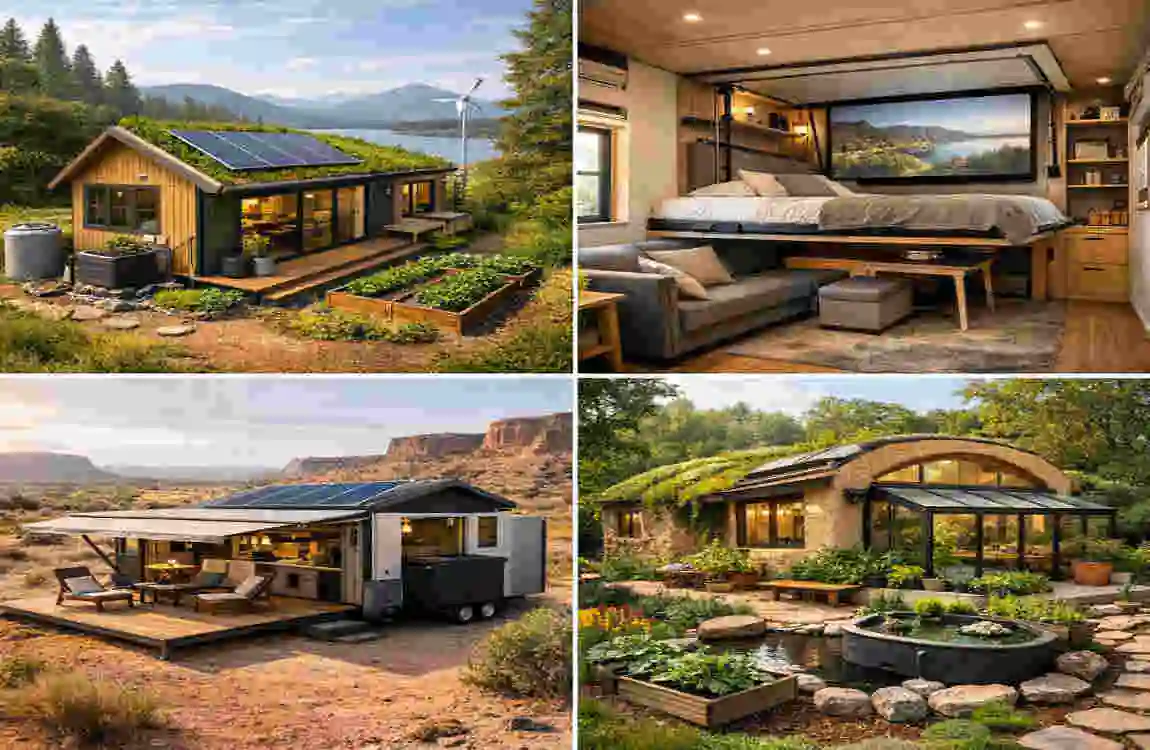
Building technology is advancing rapidly. If you are building in 2026, you have access to materials that didn’t exist a decade ago.
3D Printed Shells: We are seeing the rise of 3D-printed concrete tiny homes. These are printed in a single piece. No seams, no nails, no gaps. These structures are waterproof, fireproof, and essentially turn into stone. Their lifespan is theoretically hundreds of years.
Self-Healing Materials: Scientists are developing concrete and bioplastics that can “heal” their own cracks. If a small hairline fracture appears, bacteria embedded in the material react with moisture to form limestone, which automatically fills the crack.
AI Monitoring: In the near future, your house will tell you when it needs fixing. Sensors embedded in the walls will measure structural stress and humidity levels, alerting your smartphone before rot even starts.
Frequently Asked Questions FAQs
How long does a tiny house on wheels last compared to one on a foundation? A tiny house on wheels typically lasts 30–50 years because the trailer (axles, tires, suspension) requires maintenance and is susceptible to road vibration and rust. A tiny house on a permanent foundation can last 50–75+ years, similar to a traditional home, as it is protected from the wear and tear of mobility and ground moisture.
What materials make a tiny house last the longest? Steel framing is superior to wood because it doesn’t rot, warp, or attract termites. Structural Insulated Panels (SIPs) provide incredible strength and insulation longevity. For the exterior, metal siding or cement board lasts much longer than wood siding, which requires frequent painting and sealing.
Do tiny houses hold their value over time? Yes, but only if they are built well. A professionally built, certified tiny house from a reputable builder can retain a high resale value, sometimes even appreciating. DIY-built homes without certification often depreciate like RVs because potential buyers cannot verify the quality of the construction behind the walls.
How often should I inspect my tiny house for maintenance? You should visually inspect the roof and gutters every 3 to 6 months. A full, deep inspection (checking plumbing, electrical, and the trailer undercarriage) should happen once a year. If you tow the house to a new location, inspect it immediately upon arrival to check for anything that shifted during transit.
Can I insure a tiny house for the long term? Yes. In the past, this was difficult, but now many insurance providers offer specialized tiny house insurance. However, most require your home to be NOAH certified or built to RV industry standards. Having insurance ensures that if damage occurs, you have the funds to repair it, effectively extending the lifespan of your investment.