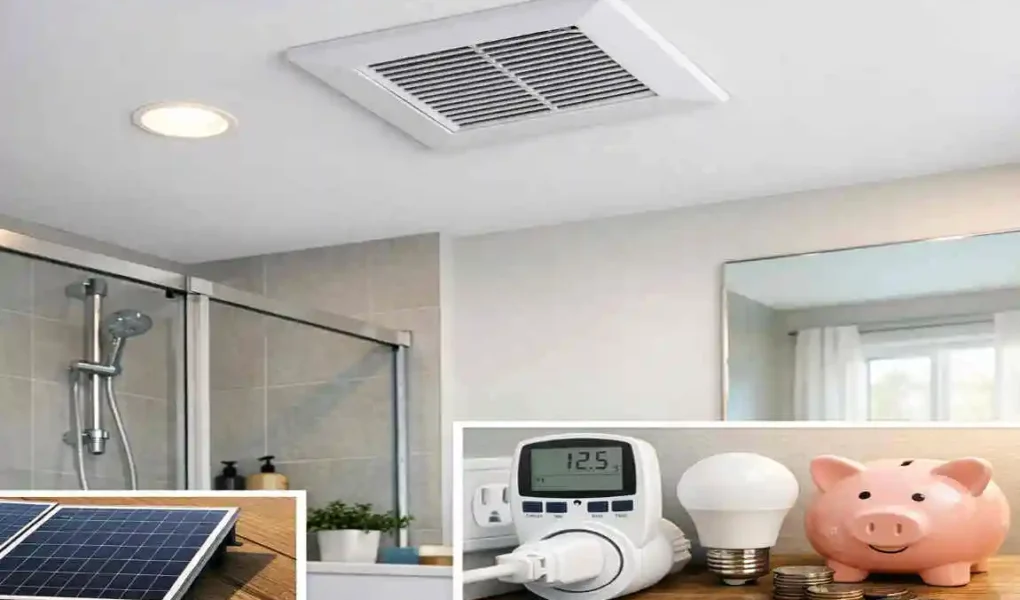
Picture this: It’s the middle of July, and the humidity is thick enough to cut with a knife. You’ve just stepped out of a refreshing shower, and naturally, you flip on the bathroom exhaust fan to clear the steam. It whirs to life, pulling that moisture out and saving your mirror from fogging up. But then, you leave the room. Maybe you forgot about it. An hour passes. Two hours. Suddenly, a thought nags at you: Does a bathroom fan use electricity? And if so, is this little habit quietly inflating your monthly utility bill?
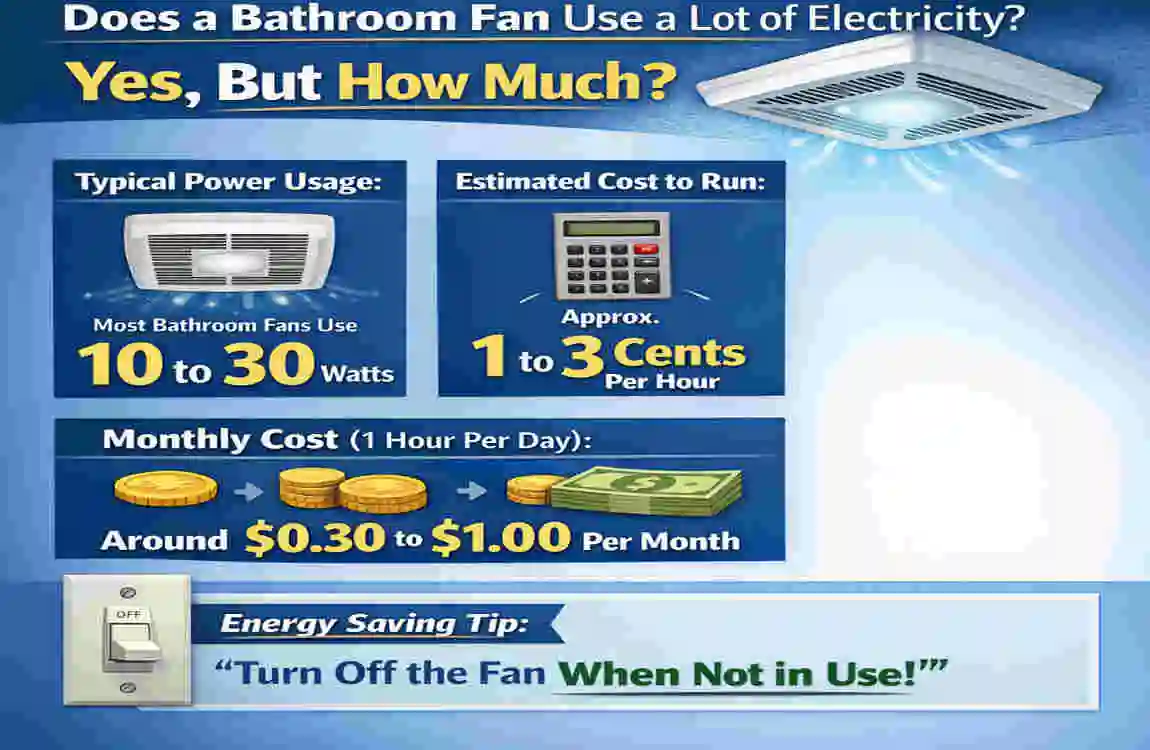
The short answer is yes, bathroom fans use electricity. However, the amount might surprise you. Typically, a standard unit consumes between 10 and 50 watts, depending on the model and age. While this seems negligible compared to your air conditioner or clothes dryer, it’s not free. In fact, average US households spend upwards of $1,500 per year on energy bills, and “phantom” or misused devices—like a fan running all day—contribute to that total.
Core Answer: Yes, But How Much?
Bathroom Fan Basics
To understand the cost, we first need to understand the machine. A bathroom exhaust fan is a simple electric motor connected to a fan blade system. Its primary job is ventilation: removing excess moisture, humidity, and unpleasant odors from the bathroom to the outdoors. This is critical for preventing mold growth, peeling wallpaper, and warped wood.
Because it relies on an electric motor to spin those blades, it must draw power from your home’s electrical grid. However, not all fans are created equal.
- Standard Exhaust Fans: These are the common builder-grade models found in many homes. They typically draw roughly 20-50 watts.
- Energy Star/High-Efficiency Fans: Designed for performance and silence, these modern marvels can use as little as 10-30 watts.
- Combination Units (Fan + Light + Heater): This is where the numbers jump. If your fan has a built-in heat lamp or resistance heater, it can consume anywhere from 60 watts (just a light) up to 1200+ watts (with heat).
Wattage Breakdown
Let’s look at the numbers side by side. This table assumes a standard electricity rate of $0.15 per kilowatt-hour (kWh).
Fan TypeAverage WattageHourly Cost (at $0.15/kWh)
Basic Exhaust Fan 20 – 50 Watts $0.003 – $0.0075
Energy Star Efficient 10 – 30 Watts $0.0015 – $0.0045
Fan with Light/Heater 60 – 1200 Watts $0.009 – $0.18
The Formula: Want to calculate your specific cost? It’s a simple equation: $$(\text{Watts} \times \text{Hours Used} \times \text{Electricity Rate}) / 1000 = \text{Cost}$$
For example, if you have a standard 30-watt fan and you run it for 1 hour every day for a year: $$(30 \times 365) / 1000 = 10.95 \text{ kWh}$$ $$10.95 \text{ kWh} \times \$0.15 = \textbf{\$1.64 per year}$$
While $1.64 sounds tiny, this calculation assumes perfect usage. The real cost comes from phantom loads (leaving it on 24/7) or using high-wattage heater combos, which can quickly turn that $1 coffee into a $20 steak dinner in terms of energy waste.
Factors Impacting Electricity Use
Knowing the wattage is step one, but several variables dictate your actual monthly spend.
Motor Efficiency and Features
Older motors are energy hogs. If your fan rattles like a generic prop plane, it’s likely fighting friction and drawing more power than it needs to. Conversely, newer motors with DC (Direct Current) technology are incredibly efficient. Furthermore, extra features play a huge role. Does your fan have a nightlight? A humidity sensor? A heater? Each add-on increases the total draw.
Usage Patterns
How you shower matters. A quick 5-minute rinse requires far less ventilation than a 30-minute steam sauna session. The longer the hot water runs, the more moisture accumulates, and the longer the fan needs to run to clear it. Leaving the fan on “just because” or forgetting to turn it off is the number one culprit for inflated costs.
Home Factors and Climate
Your home’s environment dictates necessity.
- Insulation: Poor insulation can make bathrooms feel colder, requiring more fan use.
- Climate: In humid areas like Florida, the ambient air is already moist, meaning the fan has to work harder and longer to achieve a “dry” room compared to a bathroom in arid Arizona.
Home Energy Hacks to Slash Your Bill
You don’t have to live in a steam room to save money. Here are 10 tested hacks to optimize your bathroom ventilation and keep your electric bill low.
Upgrade to Energy Star Fans
If your current fan sounds like a jet engine, it’s time for a change. Energy Star-rated fans are the gold standard. They use 70% less energy on average than standard models.
- The Benefit: They often consume fewer than 10-15 watts while moving the same amount of air. Plus, they are significantly quieter.
- The Hack: Swap out that old 50W builder-grade fan for a new Energy Star model.
- Estimated Savings: ~20-30% on fan-related energy usage.
install Humidity Sensors
Human error is the enemy of efficiency. We often forget to turn fans off.
- The Benefit: A humidity-sensing switch detects the moisture level in the room. It turns the fan on automatically when steam builds up and—crucially—turns it off once the humidity drops to a normal level.
- The Hack: Replace your standard wall switch with a sensor switch. It eliminates the “oops, I left it on all day” scenario entirely.
- Estimated Savings: Cuts runtime waste by up to 50%.
Add Timer Switches
If a sensor feels too high-tech, go analog (or digital) with a timer.
- The Benefit: You can set the fan to run for exactly 20 minutes after your shower—the optimal time to clear moisture—and then shut off automatically.
- The Hack: install a simple countdown timer switch (10/20/30/60 minute buttons). Hit “20” on your way out, and walk away worry-free.
- Estimated Savings: Prevents hours of unnecessary idling.
Utilize Variable Speed Controls
Not every bathroom visit requires a hurricane-force draft.
- The Benefit: Some modern fans offer variable or dual speeds. Low speed is perfect for continuous ventilation or odor control, using minimal watts, while high speed handles shower steam.
- The Hack: Use the low setting for general use and save the high setting strictly for shower time.
- Estimated Savings: Reduces wattage draw during non-peak times.
Switch to LED-Integrated Fans
Many exhaust fans double as overhead lights. If yours still uses an incandescent bulb, the light might be using 60 watts while the fan only uses 30!
- The Benefit: LEDs use a fraction of the power (about 9 watts vs. 60 watts) and last years longer.
- The Hack: If you can’t replace the whole unit, at least swap the bulb inside the fan housing to an LED.
- Estimated Savings: Instantly cuts the lighting portion of the energy load by ~80%.
Use Smart Plugs for Monitoring
Knowledge is power.
- The Benefit: If your fan plugs into an outlet (common in some attic setups) or if you are curious about other bathroom appliances, smart plugs can track energy usage in real-time via a smartphone app.
- The Hack: While hard to do with hardwired fans, use this logic for portable bathroom heaters or fans. Monitor the usage to identify peak times.
- Estimated Savings: Awareness typically leads to a 5-10% reduction in voluntary usage.
Sync Thermostat and Ventilation
Your home is a system.
- The Benefit: If your home is already cool and dry thanks to a smart thermostat and AC, your bathroom fan has less work to do.
- The Hack: Ensure your HVAC system is running efficiently. A dehumidifier running in the hallway might reduce the need for aggressive bathroom venting.
- Estimated Savings: Holistic energy reduction across the home.
Insulate Ducts and Windows
Efficiency isn’t just about the motor; it’s about the airflow.
- The Benefit: Leaky ducts or drafty windows make the fan work harder to pull air out, or they allow humid outdoor air back in.
- The Hack: Seal the venting ductwork in your attic. Ensure the damper (the little flap outside your house) isn’t stuck open.
- Estimated Savings: Improves fan efficiency, reducing required runtime.
install Low-Flow Showerheads
This is a root-cause solution.
- The Benefit: Less water means less steam. A low-flow showerhead reduces the volume of hot water sprayed, thereby reducing the amount of steam generated.
- The Hack: Swap to a WaterSense-labeled showerhead.
- Estimated Savings: Shorter fan runtime needed because there is less moisture to remove.
Consider Solar Backup or Vent Fans
For the ultimate green upgrade.
- The Benefit: Solar-powered vent fans run entirely off the sun’s energy, meaning they draw zero grid electricity.
- The Hack: If you are doing a major remodel, look into solar-assisted venting options.
- Estimated Savings: 100% reduction in grid electricity for that device.
Savings at a Glance
HackEstimated Monthly SavingsInstallation Cost
Energy Star Fan $2 – $5 $50 – $150
Humidity Sensor $3 – $7 $20 – $50
Timer Switch $1 – $3 $15 – $30
Cost Calculation Guide
Want to be precise? Here is a step-by-step guide to calculating your exact costs.
Step 1: Identify Wattage. Check the label on your fan. You should remove the plastic cover. Look for a sticker that says something like “Model XYZ, 120V, 0.5 Amps” or “40 Watts” directly. Note: If it only gives Amps, multiply Amps by Volts (usually 120 in the US) to get Watts. (e.g., 0.5A x 120V = 60 Watts).
Step 2: Log Your Hours. Be honest. detailed. Do you run it for 30 minutes a day? Two hours? Python Logic for the Nerds:
watts = 40 # Your fan’s wattage
hours_per_day = 1
days = 365
rate = 0.15 # $/kWh
kwh_used = (watts * hours_per_day * days) / 1000
total_cost = kwh_used * rate
print(f”Annual Cost: ${total_cost:.2f}”)
Apply Your Rate Check your utility bill for your “Generation and Distribution” rate. It varies wildly by region. In some places, it’s $0.10/kWh; in others, it’s over $0.30/kWh.
The Verdict: For most efficient users, the fan costs less than $5 per year. But for those with heater-combos or 24/7 habits, it can creep up significantly.
Common Myths Busted
Let’s clear the air on some persistent rumors about bathroom ventilation.
Fans don’t use enough electricity to matter.
False. While a single 30W fan is small, it contributes to your home’s “baseload.” Furthermore, if you have a heat-lamp fan (1000W+), running it for just 30 minutes burns as much energy as leaving a 60W bulb on for 8 hours. It adds up.
You should run the fan 24/7 to prevent mold.
False. This is overkill for most homes and a waste of electricity (and conditioned air). You are literally sucking the heating or cooling you paid for right out of the house. A humidity sensor is the smarter, cheaper solution.
Cheaper fans save the most money.
False. A $20 fan might seem like a deal, but it’s likely inefficient and has poor airflow. You will end up running it longer to clear the room, costing more in electricity over its lifespan than if you had bought the $80 efficient model.
FAQs
Does a bathroom fan use electricity?
Yes. It uses an electric motor to move air. However, standard ventilation fans use very little energy (10-50 watts), costing pennies per month. Fans with built-in heaters use significantly more.
How many watts does a bathroom fan use?
- Standard fan: 20–50 Watts
- High-Efficiency (Energy Star): 10–30 Watts
- Fan with Heater: 1000–1500 Watts
Can bathroom fans save energy?
Indirectly, yes! By effectively removing humidity, they protect your home from moisture damage (saving repair costs) and can make the air feel cooler in summer, potentially lowering your AC load.
What is the best low-electricity fan
Look for the Energy Star Most Efficient label. Brands often update models yearly, but any Panasonic Whisper series or Delta Breeze model typically leads the pack in low-wattage performance.