
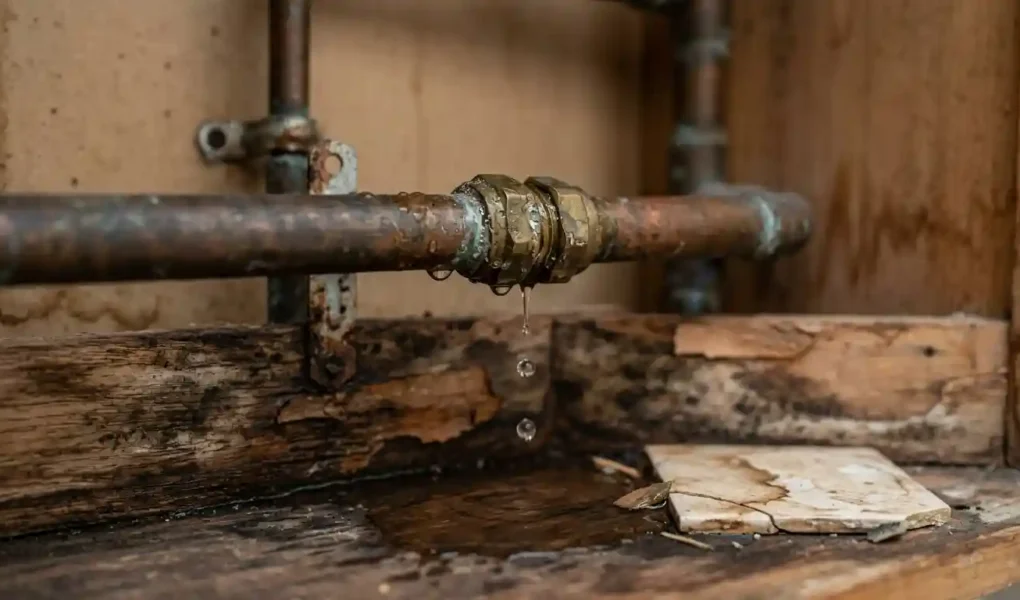
It often starts with a skirting board. The bottom edge swells a little and the paint starts to bubble, but most people just figure the mop was too wet. A few months later the hallway cupboard smells musty, and there’s a brown stain creeping up the wall. That leak’s probably been going for close to a year.
Brick veneer homes are really good at hiding leaks, and a lot of houses in Melbourne’s middle and outer suburbs were built this way in the 60s to 80s. If you ask a plumber in Templestowe or anywhere around the north-east, they’ll usually say the stain is hardly ever right on top of the pipe that’s leaking.
What’s Actually Behind the Bricks
The brick you see from the street isn’t what’s holding the house up. That’s the timber frame’s job. The brick is just one layer sitting in front of it, with a gap of about 40 to 50 millimetres in between. Your pipes run through the timber, hidden behind the plaster.
That gap is there so any rain that gets through the bricks can run down and drain out the little weep holes at the bottom of the wall. Trouble is, it does the same thing with water from a leaking pipe. If a copper joint behind the shower starts leaking, the water can run down the back of the bricks and out into the garden bed. A damp patch in the garden isn’t something anyone looks twice at.
Where the Water Goes Instead of Where You’d Look
Water in a brick veneer wall doesn’t go where you’d expect. It follows the timber frame and drips downward, sometimes running sideways along a noggin before it heads down a stud. Eventually it finds a soft bit of plasterboard and shows through. So a tiny leak in the kitchen’s hot water pipe might end up as a stain two rooms over.
Signs worth paying attention to, even when they seem minor:
- Skirting boards that swell, split or pull away from the wall
- A musty smell inside built-in robes or linen cupboards, particularly on walls with plumbing behind them
- Paint bubbling low on a wall rather than up near the ceiling
- Carpet that feels cool or faintly damp along one edge
- Your water bill has been going up for a few quarters, even though nobody’s using more water
That last one’s easy to check yourself. Make sure nothing in the house is using water, then write down the number on your meter. Come back in an hour and check it again. If it’s moved, you’ve probably got a leak somewhere.
Slabs, Stumps and Pipes Nobody Has Seen in Decades
Plenty of brick veneer homes from this era sit on concrete slabs, with supply pipes running underneath or set into the slab itself. A leak there doesn’t need a wall cavity to hide in. Water spreads beneath the floor coverings, sometimes warming a patch of tiles if it’s a hot water line, sometimes doing nothing visible at all until timber floorboards start cupping.
Homes on stumps have a different problem. Water drops into the subfloor, and unless someone crawls under there, it can sit for years. Damp subfloors lead to timber rot and, eventually, a floor that feels slightly springy in one spot.
Original pipework in houses this age is often 40 or more years old. Some of it is copper, some is galvanised steel, and a lot of it has been patched by different tradespeople over the decades, which adds more joints and more places to fail.
Finding a Leak Without Pulling the Wall Apart
These days, nobody has to start cutting into plasterboard just to see what’s there. Acoustic equipment can actually hear water escaping from a pipe, even through brick or concrete, which narrows it down to a small part of the wall or floor. Thermal cameras help too. They pick up temperature differences, so a hot water leak or a damp patch shows up pretty clearly on the screen.
Put the two together and a plumber can usually find the exact spot. So instead of ripping out half the bathroom, they only open up one small section to fix it.
If your house is 50 years old and the skirting board’s swelling, it’s probably not the mop. Don’t wait on it. If something looks or smells a bit off, get a leak detection check done before the water gets into the frame.