Homes that have high entryways, dramatic roof peaks, and multi-story facades are a fantastic year-round feature. But in the holiday season, these elements present a different set of issues for external lighting. Also, with low-sloped roofs and small entryways, which are more moderate in size, they are easy to decorate, but tall structures require careful planning, precise measurement, and thought-out design to achieve a polished and symmetrical look.
In a home with a grand two-story entryway or sharply pitched gables, attention to the structural and design elements may make all the difference in creating a cohesive and elegant look.
Understanding the Architectural Challenges
Multi-story entryways are designed to take the gaze upwards. The vertical scale, which is used to create grandeur, also means that lighting has to be balanced proportionately. What may look like perfectly spaced lighting on a lower roof may appear sparse or out of place when put on a tall peak.
Steep roof slopes add a different level of complexity. The sharper the angle, the more the roofline stands out. Lights put in without thought to this pitch will appear distorted or misaligned from the street. Also in tall facades there are elements like columns, dormers, and arched windows that, in the total lighting plan, require very thoughtful integration.
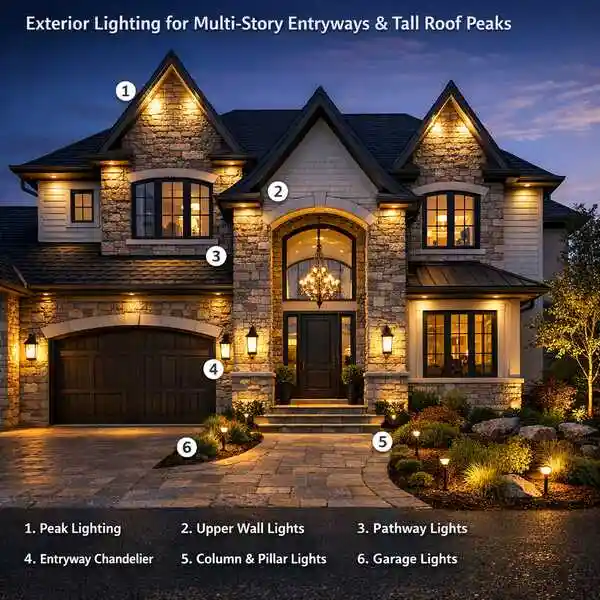
Before installation, it is key to identify focal points. In large entryways of homes, this includes:
- The highest roof peak
- The outline of the entry arch
- Vertical columns or trim
- Second-story windows
Incorporating these elements while at the same time preserving visual balance is the base of good exterior lighting design.
Ladder Access and Safety Considerations
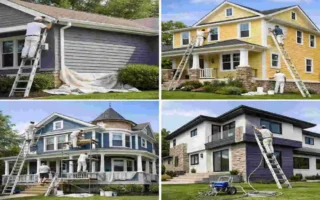
In many cases, very tall entryways and large peaks present the issue of safety in access. Home ladders in most of these situations are not enough for multistory rooflines. Also, when extended ladders do present themselves, they may still have trouble maneuvering over the landscaping, porches, and uneven ground.
Steep roofs also present issues for sure. Access is a problem, which in turn causes a high incidence of slips and falls. Also in the winter, when surfaces may be covered in ice or water, the risk increases. For high placement of lights, special tools and proper stabilization are required.
Due to these safety issues, many homeowners reevaluate the DIY option. What also plays a factor is the height, angle, and architectural elements, which tend to complicate things, thus the need for care in the planning and use of proper equipment.
Maintaining Symmetry on Large Rooflines
Symmetry plays a very important role in the decoration of tall facades. As the size of the surface area increases, so does the noticeability of the imperfections. What may go unnoticed on a smaller home in terms of even spacing out elements or in strands that may have come loose or are out of place on a multi-story entryway will stand out.
Consistent space is a must along long roof pitches. As for high gables, which are tall, lights should follow the roofline exactly, at the same distance between bulbs and attachment points. On very long roof runs, measure before installation to avoid lights that end up too short or that overlap too much at the corners.
In multi-peak designs visual balance is just as important as mathematical spacing. If one peak is to be lit up, then adjacent peaks should also be taken into account. It is a practice to not leave a secondary peak in darkness while highlighting a primary one, as it creates a lopsided look. A total picture that takes in the entire façade is what makes for a complete look.
Scaling the Lighting Design to Match the Architecture
Another issue that is seen is that tall homes are not properly lit. Tiny bulbs, which are far between, may look cute on a cottage, but in a great tall space, they can appear very sparse and unsatisfying.
Larger architectural features often benefit from
- Slightly closer bulb spacing
- Brighter or larger-format lights
- Defined outlines along trim and ridges
The aim is to add to the home’s proportion rather than dominate it. A thought-out design that is in scale improves architectural drama without looking cluttered.
Columns and vertical trim also may be wrapped or accented to bring attention to the column’s height, which in turn draws the eye upward in a smooth, intentional way as opposed to creating visual breaks between levels.
Planning for Power and Connectivity
Tall buildings usually require longer runs for the lights and also more connections. In terms of design, where the elements of the cord will run and how to hide them is a very important element of the process.
At times outlets may not be put in convenient places near the top of a structure. By using careful design, which includes routing along trim lines, behind downspouts, or through very discrete paths, a neat look may be achieved. Also, in the issue of circuit overloading, which comes up when light displays expand over many stories, it is very important to do the math and calculate total wattage in advance.
In these cases, what goes into the electrical layout is as important as the visual design.
Why Many Homeowners Choose Professional Installation
Homeowners that go with professional Christmas light installation do so in part because of height issues, steep angles, symmetry issues, and safety concerns, which are not uncommon. Also, professional installers have that extra experience in passing through tall entryways, getting at the hard-to-reach high points, and keeping a proper even look across very large roof spaces.
For those seeking expert help, services like Centerville home Christmas lighting design and install services are presented to order. The team takes the time to really get to know the space and what is desired from it. The professional design team will look at each ridge, column, and peak and bring them to life with precision. Risk is minimized, and at the same time, the visual impact is maximized.
Creating a Cohesive Holiday Statement
When done well, exterior lighting on a multi-story home is a stunning feature. Tall entryways present the best surface for great vertical accents. Steep roofs are a great element to play with, which in turn frames the home in the night. The key is in the planning.
Start out with a rough scale of the facade. Careful measurement of roof lines is a must. Also determine what the focal points are and how light will play across different levels. Think also of how the display will read from the street and not just at close range. Even small changes in how elements are spaced or placed can greatly improve the final product.
Homes with dramatic architecture should have lighting that enhances instead of competes with their structure. In terms of safety, symmetry, and proportional scaling, this approach transforms the most difficult multi-story entryways into a festive display.
Through careful design and, in many cases, professional input, tall roof peaks and weathered facades become the feature of the season, which in turn are put on beautiful, balanced, and elegant display from top to bottom.